Commemorate the 1914 Christmas Truce
Join the Doughboy Foundation and participating embassies at the National World War I Memorial on December 16
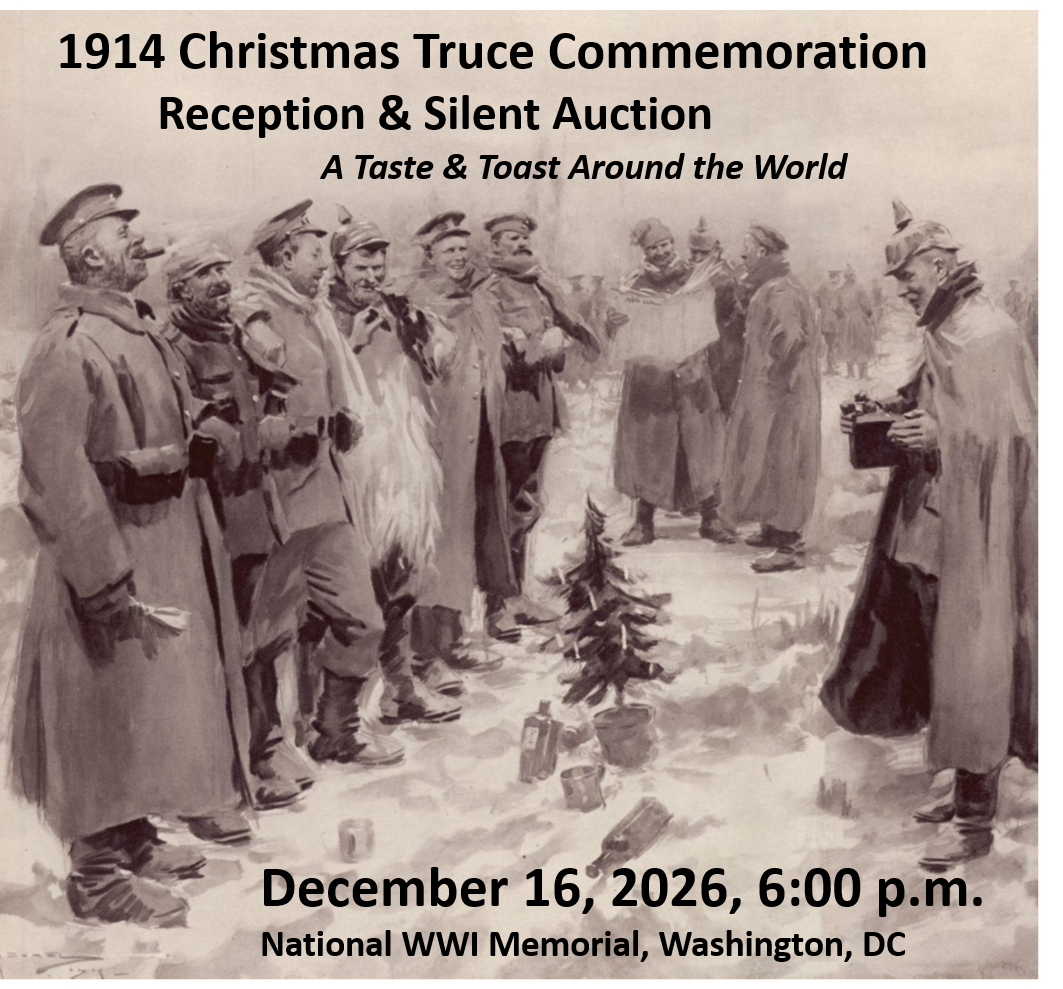
On Christmas Day in 1914, just months into what would be one of the bloodiest wars in human history, carols were heard in trenches across the front lines. Without instruction from their commanders or countries, men met in the bloody fields of No Man’s Land. Before returning to their trenches and the war, they traded cards and rations, kicked a football around, and joined together in celebration.
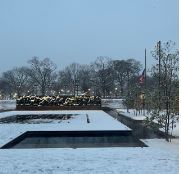
Inspired by this historic 1914 Christmas Truce - when soldiers along the Western Front paused hostilities to share fellowship, carols, and tokens of goodwill - The Doughboy Foundation invites you to participate in an intimate evening event at the National World War I Memorial on Wednesday, December 16 that will bring together the diplomatic community, veterans, and members of the public to honor shared humanity through music, history, and international holiday traditions.
|
Keep Faith with the American Doughboy: Support the Doughboy Foundation This Giving Tuesday, December 1, 2026
Tuesday, December 1, 2026, marks Giving Tuesday—a global day of generosity dedicated to supporting the causes and missions that strengthen our communities and preserve our shared heritage.
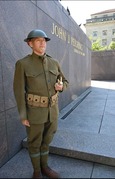
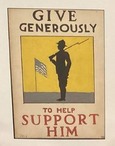
This Giving Tuesday, we invite you, our dedicated Dispatch readers, to stand with the Doughboy Foundation. Our mission is simple yet vital: to ensure that the 4.7 million Americans who served in the First World War—and the 116,516 who made the ultimate sacrifice—are forever remembered and honored by future generations. Every contribution—whether a one-time gift or a recurring pledge—makes a tangible impact across our core programs
|
As the holiday season approaches, we invite our community of supporters, history enthusiasts, and military families to join the Doughboy Foundation in a timeless tradition of gratitude. On Saturday, December 19, 2026, volunteers across the nation will gather for National Wreaths Across America Day to place fresh balsam wreaths on the headstones of our country’s fallen heroes—and we need your help to reach our goal of 500 sponsored wreaths.
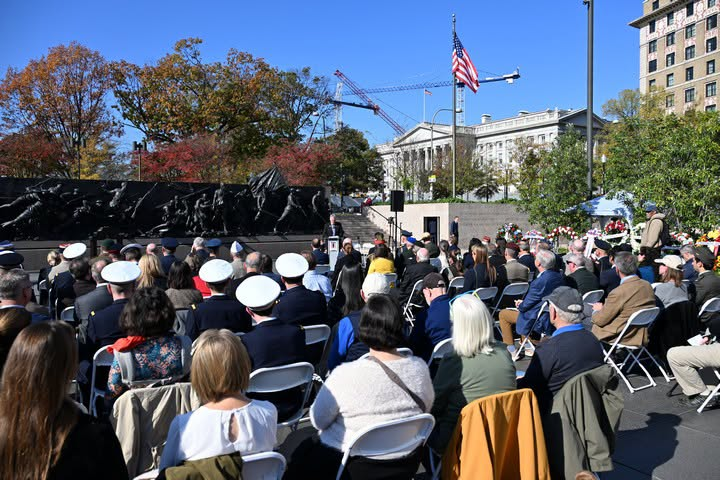 Photo © Bruce Guthrie
Bells of Peace 2026:
A Solemn Remembrance at the
National World War I Memorial
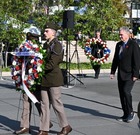
On November 11, 2026, at 11:00 a.m. EST, over 500 guests gathered in person at the National World War I Memorial on Pennsylvania Avenue in Washington, D.C., for the annual Bells of Peace Ceremony with thousands more tuning in nationwide via a live broadcast and livestream on C-SPAN.
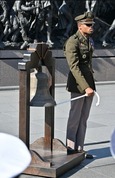
Presented by the Doughboy Foundation, in partnership with the Embassy of the United Kingdom and the National Park Service, the ceremony brought together veterans, dignitaries, and the public to honor the legacy of the Great War.
Originally designated as Armistice Day to celebrate the end of the Great War, November 11 stands today as Veterans Day—a moment to pause, reflect, and recognize all military veterans who have served the United States. Through the Bells of Peace, the Doughboy Foundation and its partners continue to anchor our national consciousness in the history of the First World War, ensuring that the generation who served “Over There” is never forgotten. Lest we forget.
|
Finding the Hello Girls: Nov. 2026 update
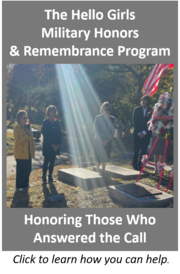
The U.S. Army Signal Corps Female Telephone Operators of WWI, known as the Hello Girls, were finally awarded a Congressional Gold Medal in 2024, thanks in large measure to the hard work and diligence of a small group of descendants of Hello Girls and several dedicated researchers. In 2025, the group evolved into the Hello Girls Military Honors and Remembrance Program (M-HARP), a new Special Program of the Doughboy Foundation, with the mission of honoring and preserving the legacy of these 280 women.
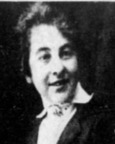
Lydia C. Gelinas Warren, 2nd Group,
8 November 1892 – 17 March 1989
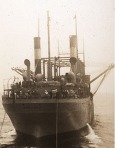
Writing for the PowerShips magazine of the Steamship Historical Society of America, historian and author Marvin Barrash, the
great nephew of Lawrence Merkel, Fireman, Second Class, U.S.S. Cyclops, has published another wornderful article about the colossal U.S. Navy collier whose fate remains one of the enduring unsolved mysteries of World War I. Whether you know about the U.S.S. Cyclops already, or if her story is new to you, you'll want to read this gripping saga. Find out more about how the great ship departed Barbados for the U.S. on March 3, 1918, with 309 men on board, and was never seen or heard from again.
|
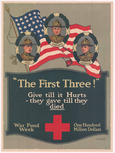
On November 3,1917, three Americans became the first soldiers of the American Expeditionary Forces to die in combat on French soil. Corporal James Gresham, Private Merle Hay, and Private Thomas Enright were killed in the brief, close quarters fight that followed a sudden German barrage. Two days later the three were buried near where they fell, under a French inscription honoring them as the first soldiers of the United States to fall on French soil for justice and liberty. Learn how their company commander, Captain Willis Edwin Comfort, and other employees of the U.S. Department of Agriculture who served in WWI, are still honored today in a hidden memorial in the USDA Whitten Building in Washington, DC.
|
Michael Santoro
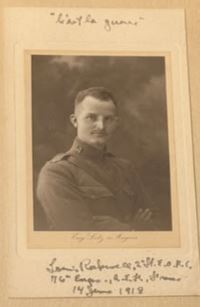
"This is a portrait of Lieutenant Louis Rockwell of the 2nd Engineers, 2nd Division, who arrived overseas with Company E on September 12th, 1917. He would be singled out by his company commander to attend the First Corps School, and was commissioned as an officer. He was briefly attached to the 116th Engineers in June 1918, which is when he had this portrait taken. Just a month after this photograph was taken, during the Battle of Soissons on July 19th, 1918, Rockwell was wounded by a gas shell." Michael Santoro explores more of the hidden history to be found in WWI artifacts. Read more about this portrait, and learn how, later in the war, Rockwell also experienced the death of his cousin, Pilot Thomas Farnsworth of the 96th Aero Squadron, entirely by chance, in 1918.
|
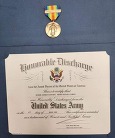
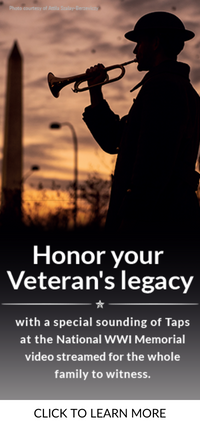
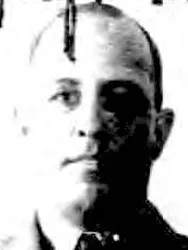
On November 16, 2026, Daily Taps at the National World War I Memorial in Washington, DC was sounded in honor of WWI veteran Maj. Joseph T. Clement, U.S. Army.
Clement served with the 39th Infantry Regiment, 4th Division, American Expeditionary Forces, during World War I. On July 18, 1918, near La Ferte-Milon, France, Clement demonstrated extraordinary courage during an Allied advance against German positions. Although recovering from an illness or injury in the hospital, he reported for duty as his regiment prepared to attack. When urgent orders needed to reach the officer commanding the assault battalion, Clement volunteered for the dangerous assignment. Accompanied by two soldiers, he made his way forward through intense artillery fire, located the assault units, and successfully delivered the attack order. He then continued through another artillery barrage in an effort to locate the assault battalion commander. During this hazardous mission, he was wounded by shellfire. For his extraordinary heroism, Major Clement received the Distinguished Service Cross. He was also cited for gallantry in action and awarded the Silver Star for his efforts to maintain communications under enemy fire. |
|
 |
The Daily Taps program of the Doughboy Foundation provides a unique opportunity to dedicate a livestreamed sounding of Taps in honor of a special person of your choice while supporting the important work of the Doughboy Foundation. Choose a day, or even establish this honor in perpetuity. Click here for more information on how to honor a loved veteran with the sounding of Taps.
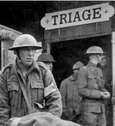
The United States participated in World War I for only 19 of the conflict's 52 months, yet its military medical work in that short span revolutionized trauma care, on and off the battlefield. American medical teams turned wartime lessons into lasting innovations, from front-line surgery and blood storage to mental-health care and physical rehabilitation, and into a more coordinated system of saving lives. "Everyone learned that forward surgery reduced infection rates, sped up recovery and saved some lives," said Sanders Marble, senior historian at the Army Medical Department Center of History and Heritage. The forward surgical units were meant not only to save lives, but to return more patients to duty and shrink the hospital system through fewer infections and shorter stays. Read more, and learn how practices first honed in 1917 and 1918 still shape U.S. military medicine today.
|
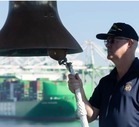
The bells on the Battleship Iowa, moored in San Pedro, rang at 11 a.m. on Veterans Day — 21 tolls, struck at the exact moment the armistice took effect to end World War I in 1918. The ship joined the nationwide Bells of Peace observance, honoring America's veterans and commemorating the end of the Great War. Navy Veteran Allen Stubblefield was among those who spoke during the ceremony on the historic decks. The observance ties a living Navy landmark on the California waterfront to the eleventh hour of the eleventh day of the eleventh month, when the guns at last fell silent. Read more, and learn how a World War II battleship helped carry forward the original meaning of November 11.
|
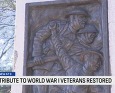
For years, something was missing from a 1921 tribute in Kansas City's historic northeast: the plaques on the American Legion Memorial Drinking Fountain, dedicated to local soldiers and sailors who fell in World War I. Kansas City Parks has now restored those plaques, putting the names and the purpose of the fountain back where neighbors can see them. It is a modest monument compared with the Liberty Memorial across town, but it was raised by the same impulse — to keep faith with the men who did not come home — and its repair is a reminder that even a drinking fountain can carry a city's memory. Learn more about the restoration, and how a vandalized World War I tribute was made whole again more than a century after it was dedicated.
|
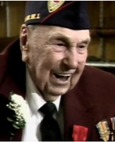
At 103, Otto "Ole" Ihringer needed a wheelchair to get around. But once he started talking about World War I, it was hard to keep up. In March 1999, at the VFW in Carrington, North Dakota, French Deputy Consul General Jean-Pierre Tutin presented him with the Legion of Honor for his service on French soil. "Not bad for a bum," Ihringer joked, then wondered whether he deserved it — and said he wanted to speak for fellow Doughboys who could no longer speak for themselves. A Bordulac farm boy, he had enlisted in April 1918, served in Company M, 358th Infantry, 90th Division, fought at St. Mihiel and in the Meuse-Argonne, and spent about 70 days on the front. During one barrage he waited to get up because the soldier on top of him had died. "You had to meet the challenge whether you were scared or not," he said. He died that December, believed to be North Dakota's last surviving World War I veteran. Read more, and learn why a short interview became one of the most memorable of a reporter's career.
|
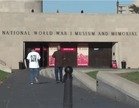
"If you have not been here and visited, you are doing yourself a disservice," said Kansas City hotelier Doug Gamble, standing at the National World War I Museum and Memorial as the institution marked 100 years. Gamble\'s hotels now share a portion of bookings referred by the museum, a partnership that underscores how tightly the memorial is woven into the fabric of Kansas City. About 80 percent of the museum\'s 200,000 annual visitors come from outside a five-mile radius, and guests often say the museum and memorial were a big draw. Museum President Matthew Naylor said he is confident the next century will present "fabulous opportunities for us to serve the people of Kansas City." The Veterans Day ceremony featured Lt. Gen. Jim P. Isenhower III, and the last evenings of Liberty\'s Beacon lit the north lawn. Learn more about a national and hometown treasure at 100, and how Kansas City continues to claim it as its own.
|
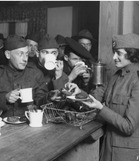
Meals in America during World War I looked a little different than they do today. The newly created U.S. Food Administration, under Herbert Hoover, hoped to avoid forced rationing and instead asked Americans to consume less wheat, meat, and sugar so that grain mills could export half their output to soldiers and allies. Hoover designated certain days of the week meat-free, sweetless, wheat-free, and pork-free. President Wilson led a campaign for victory gardens in yards, vacant lots, and even schoolyards. A 1918 edition of "American Cookery" offered "well-balanced family menus" built on substitutes: oatmeal bannock, wheatless crackers, cornmeal muffins, and "war bread" of barley or rye, with potato doughnuts at breakfast and biscuits of barley and rice flour at dinner. Wheat does not appear at all on the suggested menus. Learn more about those tables, and how a home-front diet became part of America's war effort.
|
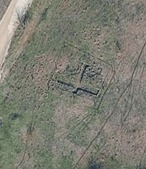
From the air, you can still see it: the silhouette of an airplane, dug into the North Texas prairie and covered with concrete, used for target practice when the U.S. Army Air Service trained pilots there in 1917. Fort Worth's City Council has now given that 0.39-acre remnant of Taliaferro Field No. 1, one of three airstrips the city built after the United States entered the war, the highest level of historic protection, with plans for a neighborhood park. "Most people don't know about it," said Jim Hodgson of the Fort Worth Aviation Museum, which led the preservation fight. Water was sprayed on the silhouette so trainees could see their bullets bounce. "The water helped pilots see their bullets bouncing off the target," Hodgson said. Fort Worth, he added, is the only place in the country that still has three of these fields. Learn more about the site, and how a hidden piece of World War I aviation history will be saved for future generation.
|
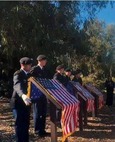
More than a century after 68 Santa Barbara soldiers lost their lives in World War I, community members, veterans, and local leaders gathered near Loon Point to rededicate a memorial to the men who died in 1917 and 1918. The original tribute dates to 1928, when 70 oak trees were planted, each honoring a fallen soldier. Freeway construction later displaced the trees, and a piece of the city's history was at risk of being forgotten. New memorial panels now preserve the names. "There were some improvements made to the freeway, that displayed some of the oak trees, that were planted in their honor by local groups, so because of that displacement we had to find a way to honor their memory and make sure that wasn't lost," said Congressman Salud Carbajal. Learn more about the rededication ceremony, organized by The Pierre Claeyssens Veterans Foundatio,. and how 68 names were given a new place to be remembered.
|
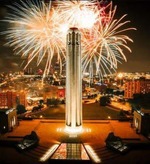
With Veterans Day near, a writer made a special point, when in Kansas City, to walk through the National World War I Museum — the official museum, so designated by Congress, for interpreting America's place as a combatant from April 6, 1917, the day of the war declaration, to the armistice on November 11, 1918, and the Treaty of Versailles. The essay is a reminder that the United States came late to what the writer calls "a labyrinth of slaughter and delusion," and that forgetting comes easily if we do not choose to remember. The museum, and a holiday born of that armistice, are two of the ways the nation still tries. Read more, and learn how one visit to Kansas City becomes an argument for not letting the Great War slip from American memory.
|
 |
|
| |
World War I was The War that Changed the World, and its impact on the United States continues to be felt over a century later, as people across the nation learn more about and remember those who served in the Great War. Here's a collection of interesting news items from the last month related to World War I and America.
|
|
John F. Gould painting donated to National World War I Museum
Presidential Message on Victory Day for World War I
Archived letters offer glimpse into local WWI private’s life
WWI Memorial holds hidden history more than 100 years later
Thousands of Michiganders kept fighting months after WWI ended
Armistice Day – Bringing Peace to a World at War
Veterans Day Began With An Unnecessary War
Trenton’s WWI Doughboy to be dedicated on Veterans Day
Stanford & Palo Alto celebrate Veterans Day at WWI building
Norwich Honors World War I Marine At Chelsea Parade
This Veteran’s Day unremembered: AEF Siberia
WWI memorial back upright after truck knocks it over in Troy Hill
Astoria marks Veterans Day with Doughboy, bells to toll
Capt. John Dale “Jack” Heiny’s letters from France during WWI
Family treasures World War I diary
Army honors Wisconsin son, killed on a WWI Italian battlefield
Fort Mifflin recreates 1918 Marine WWI Thanksgiving dinner
Wreath laying commemorates creation of 42nd Infantry Division
WWI nurse’s “relentless optimism” inspired Oregon Foundation
5 Black WWI Vets to be Added to HS Commemorative Plaque
Military Order of the World Wars Honors General John J. Pershing
World War I Draft Registration in Prince William County
Honoring Service: Veteran Robert Cluett III, WWI
WWI veteran Elwyn ‘Uncle Hoppy’ Hopkins rarely spoke of war
Manchester soldier’s journey from the Mexican border to WWI
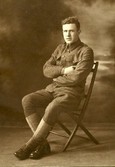
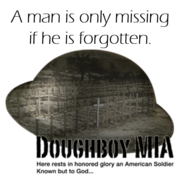
A man is only missing if he is forgotten.
Our Doughboy MIA this month is Corporal Edward James Malone, ASN1706748, Company K/307th Infantry/77th Division. Corporal Malone was hit in the neck by machine gun fire on September 9th, 1918 during an advance in the Vesle sector and died in the arms of his best friend, Private Harold Cronin, a few minutes later. Malone was buried on the battlefield by his squad with a marked grave and identification was included with the remains, but when GRS went to find him following the war, they were unable to locate him.
Would you like to be involved with solving the case of Corporal Malone, and all the other Americans still in MIA status from World War I? You can! Click here to make a tax-deductible donation to our non-profit organization today, and help us bring them home! Help us do the best job possible and give today, with our thanks. Remember: A man is only missing if he is forgotten.
|
Merchandise from the Official
Doughboy Foundation WWI Store
|