A Salute to America's "Ace of Aces" and the Men and Technologies of World War I that built American Grand Prix Racing
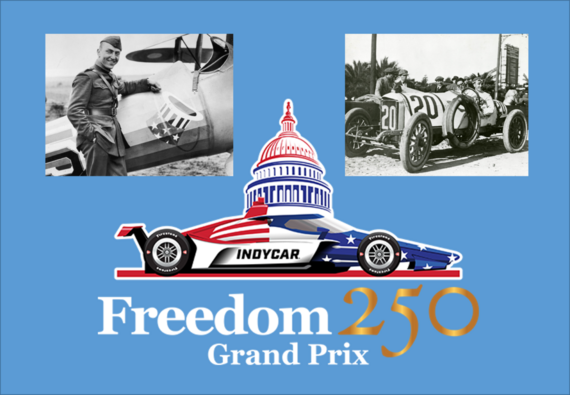
The Freedom 250 Grand Prix of Washington, D.C. will take place Aug. 22-23, 2026, marking the first‑ever NTT INDYCAR SERIES race on the National Mall. The free, two-day motorsports event will celebrate America’s 250th anniversary with world‑class racing set against the backdrop of some of America’s most historic landmarks, including the Washington Monument and the U.S. Capitol.
But most people celebrating our Nation’s 250th birthday with the speed and innovation of INDYCAR at the race in Washington or online may not know that the technological and driving seeds that sprouted into a century of American auto racing were sown during and just after World War I. Read the amazing story of how American ingenuity, manufacturing, and driving skills contributed to victory in World War I, and jumpstarted the nation's racing obsession in the post-war era. None more than Eddie Rickenbacker.
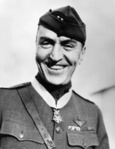
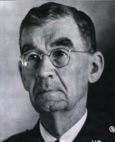
Rickenbacker was a pioneering racer who drove in the Indy 500 four times from 1912-1916 with three starts. But after the U.S. entered World War I, he enlisted in the Army Air Service, became a fighter pilot in the 94th Aero Squadron, and soared to legendary status as America’s “Ace of Aces” with 26 confirmed aerial victories, earning the Medal of Honor. After WWI, among many other accomplishments, he became second owner of the Indianapolis Motor Speedway! The Doughboy Foundation will honor Major Eddie Rickenbacker and the WWI legacy of American motor racing with the sounding of Daily Taps at the National World War I Memorial at 5:00 p.m. EDT on Saturday, August 22. Racing fans in DC for the Freedom 250 Grand Prix may attend in person at the Memorial. Everyone everywhere can watch Daily Taps online via YouTube every day.
|
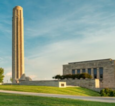
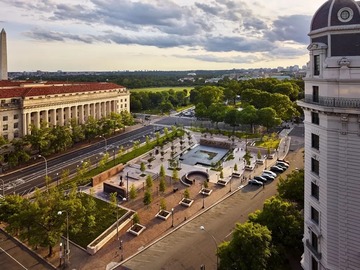 Cultural Landscape Foundation awards Cultural Landscape Award for Design to the National World War I Memorial in DC
Designer David Rubin and Land Collective were selected for a prestigious WLA award for the landscaping design of the National World War I Memorial, built by the Doughboy Foundation for the United States World War I Centennial Commission. The WLA prizes celebrate the top achievements in global landscape architecture, acknowledging both built and conceptual projects. Many of these projects develop landscapes and spaces that tackle challenges faced by communities, cities, and the natural environment. Learn more about how the Memorial stood out among the 275 entries across 16 categories from landscape architecture firms worldwide.
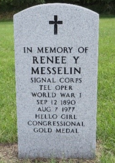
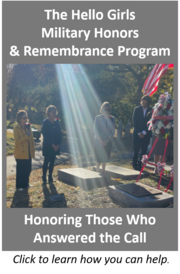
The U.S. Army Signal Corps Female Telephone Operators of WWI, known as the Hello Girls, were finally awarded a Congressional Gold Medal in 2024, thanks in large measure to the hard work and diligence of a small group of descendants of Hello Girls and several dedicated researchers. In 2025, the group evolved into the Hello Girls Military Honors and Remembrance Program (M-HARP), a new Special Program of the Doughboy Foundation, with the mission of honoring and preserving the legacy of these 280 women.
Honoring a Hidden Hero: Renee Messelin Remembered in Chicago ceremony
The Hello Girls Speak to Every Generation
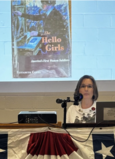
M-HARP member Catherine Bourgin reflects on how, in "a remarkable week in June 2026, the Hello Girls’ story was told in a competition hall at the University of Maryland, on a library balcony overlooking McKeldin Mall, in an ordinary classroom that became a stage, and at a symposium table in Maryland’s Veterans Museum. It was told through research and creativity, through a website and a dramatic reading, through a grandmother’s correspondence aged to look like history, and through words spoken quietly from a podium to an attentive audience of military historians and former officers in Newburg, MD." Read the entire article, and learn how, 106 years after they returned from WWI and were almost lost to history, "The Hello Girls are still being found."
|
Michael Santoro
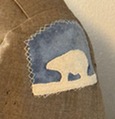
Defending the Vologda Railway: The Service of Polar Bear Harold H. Holliday
"In the Spring of 1917, the Pittsburgh Post reported on the enlistment of a certain Andrew A. Cohill into the conflict that is now known to us as the First World War. The Post detailed this story under the headline “Joins to See Brother” stating, “With the hope of seeing his brother, who is now in France with the Thirty-Fourth Gary Infantry…Andrew A. Cohill…enlisted yesterday in the engineering regiment. His brother, J.L. Cohill, went to the front with the first of the Canadian troops. The last word from him was a letter from France received last December.” From this beginning, Katherine Haun traces the journey of Andrew and his sibilings John and Victoria into and after World War I. Learn how the three, separated after the death of their mother, scattered about the world during and after World War I, but how interesting links remain a century later.
|
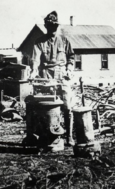
In late March 1916, the 5th Cavalry regiment was sent on an expedition across the Mexican Border due to the continuing threat from revolutionary Pancho Villa, who, at this point, had led several raids in United States territory, resulting in the death of American civilians and soldiers. Historian James Angel notes that "The actions along the border are often overshadowed by America’s entry into the First World War the following year. Yet, these actions resulted in the death of U.S. service members and civilians, and their sacrifice remains worthy of research and study." Read about one such soldier, Andrew Watson of Tennessee, who with the rest of the 5th Cavalry regiment, went on the expedition into Mexico to help aid with suppressing the forces under Pancho Villa.
|
On Thursday, July 2, 2026, Daily Taps at the National World War I Memorial in Washington, DC was sounded in honor of WWI veteran Private Norman E. McLeod, U.S. Army.
|
At just 16 years of age, Norman E. McLeod joined the Plant City Rifles, Second Florida Regiment (National Guard) on 13 Jun 1916. He was mobilized on 19 June 1916 for service on the Mexican border. Returned to in late spring of 1917 after America's entry into the war and mobilized again as part of the 124th Infantry Regiment, 31st Division (known as the Dixie Division) and sent to Camp Wheeler, GA.
Norman chose to go to France sooner than the Dixie Division was scheduled to go and transferred to L Co, 103rd Infantry Regiment, 26th Division.
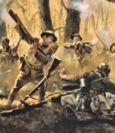
Norman's unit was part of the Aisne-Marne Campaign, advancing up the Marne salient and pushing into Belleau Wood, moving 10 miles from 18-25 July 1918. The Germans were heavily engaged in the use of mustard gas and heavy artillery along this front and the battles were furious and unrelenting.
|
|
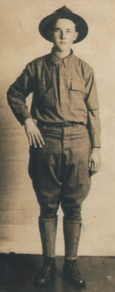 |
On January 24, 1919 Norman McLeod's family received a telegram that read: "MR. R.D. MCLEOD, PLANT CITY FLA, DEEPLY REGET TO INFORM YOU THAT PRIVATE NORMAN E. MCLEOD, INFANTRY, IS OFFICIALLY REPORTED AS KILLED IN ACTION JULY NINETEENTH. LETTER FOLLOWS. HARRIS THE ADJUTANT GENERAL." The confusion brought about by the war had delayed the news of Norman's death. He was killed by an artillery shell not far from Chateau Thierry. He had been in the war less than a month.
Norman E. McLeod returned to Plant City one last time when his remains were shipped home from France, arriving 19 July 1921, three years after he was killed. His sacrifice lives on through American Legion Post 26.
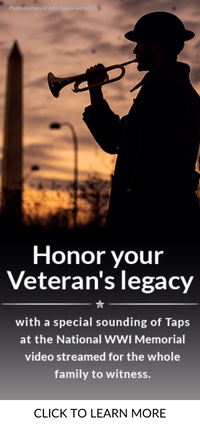
The Daily Taps program of the Doughboy Foundation provides a unique opportunity to dedicate a livestreamed sounding of Taps in honor of a special person of your choice while supporting the important work of the Doughboy Foundation. Choose a day, or even establish this honor in perpetuity. Click here for more information on how to honor a loved veteran with the sounding of Taps.
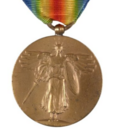
More than a century after the guns fell silent along the Western Front on November 11, 1918, the First World War has slipped entirely out of living memory. Every one of the 4.7 million Americans who mobilized for the conflict has passed on, and the firsthand voices of the trenches went with them. What remains is physical. The objects these men and women carried, wrote, and brought home are now the closest thing we have to their testimony. For the families who keep them, these keepsakes do something no history book can. Read more, and learn how a letter, a dented helmet,or a tarnished medal takes the vast and abstract story of the Great War and anchors it to one person, one name, one life. They are how a great-grandchild comes to meet a man they never knew.
|
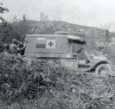
From its founding, the American College of Surgeons (ACS) has maintained close ties with the US military. During its first five years as a professional organization, the ACS appointed Navy Surgeon General Charles F. Stokes, MD, FACS, as a member of the first Board of Regents, recruited thousands of American surgeons to serve in World War I, and deployed its first president, John M. T. Finney, MD, FACS, to Europe. These actions represent just a few of the measures taken by ACS founder Franklin H. Martin, MD, FACS, and others to ensure military surgical care met the same rigorous standards they had set for civilian surgical care. Learn how these efforts resulted in optimal clinical outcomes on the battlefields of Europe and strengthened medical readiness at home, and how today, ACS continues to take a leadership role in medical preparedness efforts, maintaining the legacy and advancing the ideals of its early leaders.
|
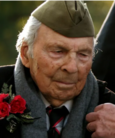
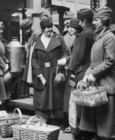
Frank W. Buckles (left), the last known surviving World War I veteran, died in 2011 at 110 years old. In 2025, the VA estimated the United States had only 45,418 World War II veterans still alive, a loss of just under half since 2022. It’s a stark reminder that one day there will be no one left of the 16.4 million who served during World War II. It can’t be easy to be the last of a dying generation, but someone has to be. Read more, and meet the men who were, like Buckles, the last living veterans of America’s other conflicts.
|
 |
|
| |
| |
World War I was The War that Changed the World, and its impact on the United States continues to be felt over a century later, as people across the nation learn more about and remember those who served in the Great War. Here's a collection of interesting news items from the last month related to World War I and America.
|
|
|
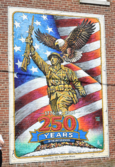
WWI Doughboy highlights A250 mural at VFW Post #1405
World War I kickstarted a boom in the U.S. Chemical industry
Bronze monument features WWI-era “Doughboy” for A250
America’s first female soldiers served during WWI
Rare blood-stained WWI trench coat found in museum
Tesla and the Great War — Explored in Tesla: Wizard at War
World War I soldiers in Cape County
332nd U.S. Infantry’s WWI Military and Political Role in Italy
When Democrats were smearing socialists over World War I
World War I marked a pivotal turning point for military dogs
U.S. Army’s ‘Hello Girls’ honored at Holy Cross
Notable Medical Researchers from World War I
The Complex, Unfinished Legacy of the WWI "Bonus Army"
Reasons why the WWI 1911 should be America’s national weapon
The Chemistry of World War I Gas
German-Americans battle loyalty questions in WWI St. Louis
Debates about neutrality in the leadup to World War I
American Field Artillery in the Great War
American Patriotic Clothing Trends during World War I
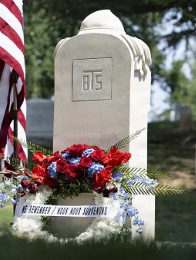
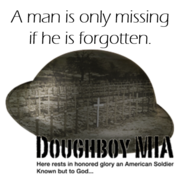
A man is only missing if he is forgotten.
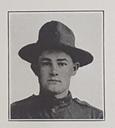
Our Doughboy MIA this month is Private Verne Blythe, born in Marshall, Indiana on May 28th in 1892. Blythe was working as a telegraph operator in Danville, Illinois before the war for what would eventually become AT&T when he enlisted in early June, 1917. He received his training at Jefferson Barracks in Missouri and Fort Leavenworth, Kansas before embarking for overseas duty on February 19th, 1918 as a member of Company C, 5th Field Signal Battalion which was part of the 3rd Division.
During the second battle of the Marne – where the 3rd would gain everlasting fame as the ‘Rock of the Marne Division’ – Private Blythe was severely wounded by artillery fire on July 15th, 1918, and died soon thereafter. Little more of his story is known at this time, but it is currently believed that he may have later been buried as an Unknown.
Would you like to be involved with solving the case of PVT Verne Blythe, and all the other Americans still in MIA status from World War I? You can! Click here to make a tax-deductible donation to our non-profit organization today, and help us bring them home! Help us do the best job possible and give today, with our thanks. Remember: A man is only missing if he is forgotten.
|
Merchandise from the Official
Doughboy Foundation WWI Store
|