|
|
|
|
|
|
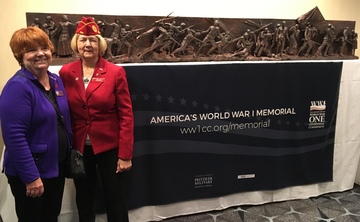 WW1CC & Memorial maquette on hand for the American Legion's big week in DC
Last week was a big one for our Commission member organizations, the
American Legion. Over 200 members of their national leadership were in
Washington, DC for their annual Winter Conference at the Washington
Hilton, with such featured speakers as Secretary of Veterans Affairs
David J. Shulkin. Following several days of meetings, the Legion
leadership conducted their massive annual 'Storm The Hill' outreach
effort to members of Senate and Congress. In the midst of it all, the U.S. World War I Centennial Commission
was there, telling the story of our programs, including the new National
World War I Memorial at Pershing Park in Washington DC. The Legion invited us to set up
the scale-model maquette created by our sculptor Sabin Howard, and
recently featured on television's "FOX & FRIENDS." Read more about the maquette's appearance at the Legion meeting.
Throughout Women's' History Month in March, 2018 we'll be featuring stories
of women who served and supported the war effort a century ago.
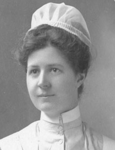 WW1CC intern Nicole Renna writes this week about Vashti Bartlett, a Maryland native who was a Johns Hopkins
Hospital Training School for Nurses 1906 graduate, and proudly served
the Allied forces as a nurse in World War I, both as a Red Cross nurse and a member of the Army Nurse Corps. Read more about her proud service to the nation here.
|
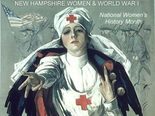 Elsewhere, Janice Brown on the Cow Hampshire web site notes that "When we think of World War I, most of us picture the men in military
uniform readying for battle. Women played as great a part in everything.
Some women served as yeowomen, nurses, telephone operators and others
who were often at the battlefield and subject to the same grave dangers
of bombs, gas and disease. The women left behind experienced great hardships, but also it was a
door of opportunity for them." Read more about the Women's History Month program on Brown's New Hampshire History Blog.
|
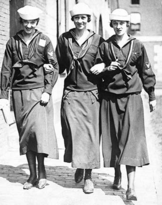 On the National Council for the Social Studies socialstudies.org web site, Carl and Dorothy Schneider write that "American women experienced this 'Great War' differently than any previous war. For the first time, the Army and Navy nurse corps were activated. It was the first American war in which no woman enlisted as a foot soldier disguised as a man, for it introduced thorough physical examinations. Yet it was the first war in which women officially and openly served in the Navy, the Marine Corps, and the Army Signal Corps. For the first time in the history of the world, 25,000 women, 15,000 of them civilians, crossed a hostile ocean to succor war's victims-many of them long before the United States entered the war. Women struck out on their own like entrepreneurs, finding their own ways to help people and seeking the money and capital to accomplish their goals." Read the entire in-depth essay about American women in WWI here.
|
 Two hundred twenty-three women served as telephone operators in the U.S. Army Signal Corps during World War I. These were the first women to serve as soldiers in the U.S. Army, specifically in non-nursing roles. Eric Saul, veteran Historian and Museum Director, writes about the extensive J'Ecoute exhibition he mounted decades ago at the U.S. Army's Presidio Museum in California, honoring and recognizing the "Hello Girls" and awarding some of the still-living veterans their long-awaited World War I Victory Medals. Read more about the J'Ecoute exhibition and the presentation ceremonies for the medals here.
|
2018 flu bug is similar to 1918 outbreak but still with significant differences
 During the centennial of the end of World War I, the District of
Columbia National Guard will host a series of special activities,
programs, and events to commemorate the end to the first war.
Approximately 400,000 National Guard Soldiers served in the Great War,
among them were 2,000 Guardsmen from the District of Columbia. “As we mark 100 years of the end of World War I, we reflect back on
the many contribution and sacrifices made by the Soldiers of the
District of Columbia National Guard; citizen-Soldiers who answered the
call to protect the Capital and defend the nation in time of great
need,” said Brig. Gen. William J. Walker, acting commanding general,
District of Columbia National Guard. Read more about the District of Columbia National Guard’s centennial commemoration activities here.
|
 The
WW1 Centennial News Podcast is about WW1 THEN: 100 years ago this week,
and it's about WW1 NOW: News and updates about the centennial and the
commemoration.
Available on our web site, iTunes, Google Play, and TuneIn.
|
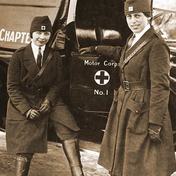
Episode #61
Highlights: Healers of WW1
March Preview - Roundtable with Dr. Edward Lengel, Katherine Akey & Theo mayer | @02:15
Spoils of War from Russia - Mike Shuster | @13:10
Medicine in WW1 - Charles Van Way, George Thompson & Sanders Marble | @18:30
New VSO WW1 support site @ ww1cc.org/veteran | @26:00
African American nurses in WW1 - Dr. Marjorie DesRosier | @27:35
100C/100M project from Raymond WA - Gordon Aleshire | @33:25
Women Physicians in WW1 - Eliza Chin, Keri Kukral & Mollie Marr | @36:50
Speaking WW1 - “Archie” | @43:10
WW1 War Tech - The Browning Machine Gun | @45:05
WWrite Blog on Brest-Litovsk Treaty | @47:10
American War Artist and his curator - Katherine Akey | @48:10
|
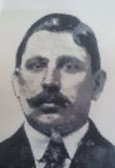 A man is only missing if he is forgotten.
Monday's MIA this week is Battalion
Sergeant-Major George P. Storm. Born
in September 1879, George Storm enlisted at Allentown, Pennsylvania on December
6, 1898, served through several enlistment periods and was a professional
soldier. In August, 1917, he was assigned to the 16th Infantry and with them
went to France. On 4
October, 1918, during the Meuse-Argonne campaign, when his battalion had made
an advance outside Exermont, Sergeant-Major Storm stayed behind to wrap up
activities at the battalion’s old post of command. Once his duties were
complete there, he set out through violent shellfire to the new PC position.
However, shortly after setting out from the old PC, he was killed by shellfire.
At the time of his death, he was just two months from retirement. Buried
by the unit chaplain in a short stretch of trench near where he died, his grave
had been well marked and noted at headquarters. However, when GRS searched for
the grave location post war they were unable to locate it. Despite a second
search, Sergeant-Major Storm remains missing to this day. In 2015, Mr. Jay Perkins of the 1st Division Museum at Wheaton, Illinois
brought the case to Doughboy MIA. Since then we have dug into the case extensively
and believe that the recovery of Battalion-Sergeant Major Storm’s remains are
entirely possible using today's technology, and plans are in the works to
attempt a retrieval.
Help us with this case – give ‘Ten for Them’.
For just $10.00 you can have a hand in helping solve this and other cases. Give 'Ten For Them' to Doughboy MIA and help us make a full
accounting of the 4,423 American service personnel still listed as
missing in action from WW1. Make your tax deductible donation now, with
our thanks.
|
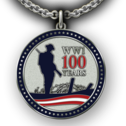 Charm Pendant
$9.95
The question came up: "For Women's history month, do we have any commemorative items for them?". Well heck yea!.
Proudly wearing the WWI 100 Years charm pendant is a fantastic conversation starter about WW1.
The satin nickel charm, worn on a necklace or bracelet, is a simple, yet meaningful, way to display your pride and remember those who sacrificed throughout our nation’s great history.
NOTE: This is the charm only. The necklace or bracelet is not included.
This and many other items are available as Official Merchandise of the United States World War One Centennial.
|

|
|
|
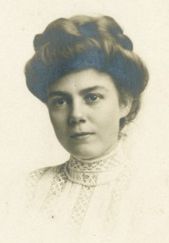
Submitted by: Mary Rohrer Dexter
“Those
who go forth ministering to the wants and necessities of their fellow
beings experience a rich return, their souls being as a watered garden,
and a spring that faileth not…” – Lucretia Mott
Tucked away in the South West corner of Miami County, Indiana is the
small community of Amboy where in 1844, the first Friends Worship
service was held in Miami County and six years later, a log church was
erected at a location that would later be next to Amboy Friends
Cemetery. Until a school was built in 1872, the church doubled as
a school. In 1867, the Panhandle Railroad was completed
through Miami County and the small town of Amboy was platted as the
location of the train station.
When, in 1871, Benjamin B. Lamb laid an addition to the original Amboy
platt, his son Ezra must have been living in the area, for on July 28,
1878, Ezra Lamb and his wife Eliza were holding a beautiful baby girl
in their arms whom they named Mary Alice.
As she grew, Mary
Alice probably attended school in Amboy at a building known as The
Academy. The years flew by and soon Mary Alice Lamb was attending
school at Earlham College in Richmond, Indiana. She graduated in
1901 with a teaching degree. By this time, she was a young woman,
5’4 1/2” tall, sporting brown hair and brown eyes. Known to her
friends as Alice, her first teaching job was at Stit School, four miles
from the home in which she grew up. Every morning she would drive
to school in a two-wheel cart pulled by a horse. If it rained,
she would wear water proof garments or pull into the nearest barn lot
until the rain let up. Sometimes, if the weather was very bad she
would stay with the Stit family, on whose land the school was
located.
|
|
|
|
|