|
|
|
|
|
|
Doughboy statue sparks NJ historian's mission to photograph WWI monuments
 For years, Erik Burro would pass the statue of a WWI U.S. soldier every day on his commute just a few blocks from his city home and office but he paid it little attention. His realization in 2016 that the centennial of U.S. entry into World War in 1917 was approaching the following year made him stop and take a closer look at the Burlington statue depicting a Doughboy, and the memorial hall behind it. The visit to the statue triggered his curiosity and eventually led him to become a man on a mission to find and photograph other World War I monuments, first in South Jersey and then statewide, a quest that has resulted in traveling photography exhibits of major WWI monuments in the state. Read more about Burro's "Legacy of Remembrance" here.
|
"Learn more about this war and its continued impact on us today"
 Author/historian Timothy P. Brown has
an interest in World War I, and his interest led him to a unique aspect
of the war -- football. The game was in early stages of development at
the time of the war, but it was already a nationally-popular pastime to
play, and to watch. It was also a growing symbol that brought context
and high-relief to the actions taking place in the war, and to the
people who were fighting in it. His new book, Fields of Friendly Strife,
follows the players of the 1918 Rose Bowl, on the field, and on the
battlefields. Timothy Brown gave us some moments to discuss the book,
the war, and how football was more than just a game.
|
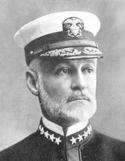 The U.S. Naval War College Museum in Newport, RI has unveiled a new exhibit to teach people more about World War I. It focuses on the Navy’s role in the war, using the career of Navy Adm.
William S. Sims to tell the story. Sims commanded U.S. naval forces in
Europe during the war, and his family donated artifacts for the War College exhibit. The Navy’s role in WWI was the learning ground where the officers who became the fleet's strategists in World War II figured out how to coordinate complex operations and forge relationships
with allies.
Sims went on to lead the war college. He changed the curriculum based
on his experiences during the war and influenced a generation of naval
leaders. Read more about Admiral Sims and the Naval War College exhibit here.
|
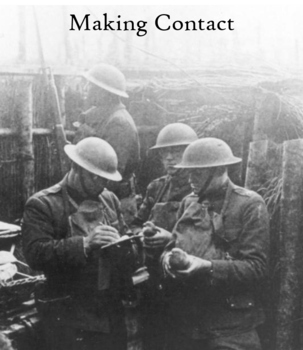
 Unsung heroes of World War I, the carrier pigeons of both the Allied
and Central Powers helped assist their respective commanders with an
accuracy and clarity unmatched by technology. The National Archives has a vast collection of messages that these
feathered fighters delivered for American soldiers. Using these messages
and the history of the carrier pigeon in battle, we can look at what
hardship these fearless fowls endured and how their actions saved
American lives. One of the most impressive things about the war records of the
carrier pigeons was how widely the birds were used. Their service as
battlefield messengers is their most known use, and the pigeons found
homes in every branch of service. Read more about these essential feathered flying communicators here.
|
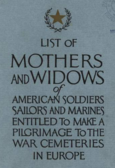 On March 2, 1929, President Calvin Coolidge signed PL 70-952. That
law authorized the War Department to arrange for trips, designated as
pilgrimages, by the mothers and widows to the overseas graves of
soldiers, sailors, and Marines who died between April 5, 1917 and July
21, 1921. Congress later expanded eligibility to include the mothers and
widows of men who were buried at seas or whose place of burial was
unknown. After World War I, more than 30,000 American dead from that conflict
remained overseas, buried in U.S. cemeteries. The passage of the law
resulted from the work of the mothers and widows of those servicemen and
their supporters who pushed for the pilgrimage to the gravesites at
government expense. The resulting trips took place between 1930 and 1933. To facilitate travel by the mothers
and widows, the Department of State established the “Special Pilgrimage
Passport.” Read more about these unique travel documents.
|
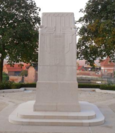 To commemorate and remember America's role in World War I, American
Battle Monument Commission sites in Europe will host a variety of
centennial ceremonies in 2018. Commemorations will kick off Memorial Day weekend 2018
with special ceremonies at Somme American Cemetery, Aisne-Marne American
Cemetery and Cantigny Monument. The ceremonies will continue throughout the year, ending with the 100th anniversary of the Armistice. The ceremonies will mark the 100th anniversary of key events, such as
the first World War I U.S. Offensive, the Battle of Belleau Wood, the
Meuse-Argonne Offensive, and more. All the ceremonies are free to attend and open to the public. Read more about the planned ABMC centennial memorial ceremonies here.
|
 The
WW1 Centennial News Podcast is about WW1 THEN: 100 years ago this week,
and it's about WW1 NOW: News and updates about the centennial and the
commemoration.
Available on our web site, iTunes, Google Play, and TuneIn.
|
 Highlights - Episode #54
1917 key events in review |@ 01:30
Wilson’s 14 points |@ 07:50
Crisis for the allies - Mike Shuster |@ 11:45
A Century in the Making - Sabin Howard |@ 16:45
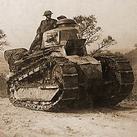
Speaking WW1 - Tank |@ 25:00
The Education Program - Dr. Libby O’Connell |@ 26:30
100 Cities / 100 Memorials Round #2 deadline |@ 32:40
The Chaplains Corps in WW1 - Dr. John Boyd |@ 33:15
American Women Physicians in WW1 |@ 39:10
PAFA at Frist |@ 40:30
The Buzz - Katherine Akey |@ 41:15
|
 Benjamin Britten's Musical Masterpiece, War Requiem. Part 1: Interview with Tenor, Paul Groves
This week's WWrite blog post features the WWI musical masterpiece by British composer, Benjamin Britten–War Requiem. We hear from the world-renowned tenor, Paul Groves, on the unique performance of War Requiem at Europe's premier opera house, the Lyon Opera in France. Part poetry, party liturgy, part theater, see the ways in which this operatic representation has wowed the world. Through the lens of WWI, Groves talks about Pink Floyd, Hiroshima, Wilfred Owen, education, and his family's war history. Not to miss!
|
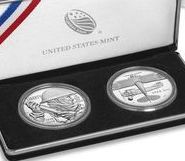 FOR A LIMITED TIME ONLY: These combination coin and service medal sets will only be available for 1 month. ORDER NOW. $99.95
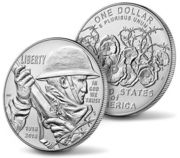
The COIN design, titled “Soldier’s Charge,” depicts an almost stone-like soldier gripping a rifle. Barbed wire twines in the lower right hand side of the design. Inscriptions include “LIBERTY,” “1918,” and “IN GOD WE TRUST.”
The SERVICE MEDAL design depicts an iconic SPAD XIII, a World War I fighter flown by many Americans and valued for its speed, strength, and firepower, viewed from the top and side. The inscription “SPAD XIII” identifies the aircraft.
These sets are limited to 100,000 units across all five medal product options, and can be ordered only between noon ET on January 17, 2018, and 3 p.m. ET on February 20, 2018, unless the limit is reached prior to that date. Production will be based on the orders received within this window. Fulfillment of these sets will begin in late May 2018.
Produced by the US Mint, the World War I Centennial 2018 Uncirculated Silver Dollar, the Proof Silver Dollar and the 5 service medal combination sets are all available for a limited time directly from the US Mint.
|
|
|
|
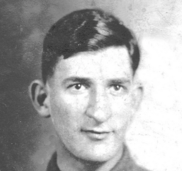
Submitted by: Gene Fax {Grandson}
Oscar Lubchansky born around 1896, Oscar Lubchansky served in World War 1
with the United States Army. The enlistment was in 1917 and the service
was completed in 1919.
An AEF Veteran’s War Stories
These stories were told to me by my grandfather, former Sergeant
Oscar Lubchansky (d. 1958), 2nd Battalion, 313th Infantry Regiment, 79th
Division, American Expeditionary Forces.
Whether they are
historically accurate is debatable, but they are an accurate
representation of a veteran’s memories. At this late date, second-hand
memories are all we’ve got.
American soldiers had an insatiable appetite for fresh eggs. Whenever
Lubchansky and his comrades were en route and a halt was called, the
soldiers would crowd around the kitchen door of the nearest farmhouse
shouting, “Oofs! Oofs!” The farm wives would be frightened at first, but
would soon figure out that the Americans wanted des oeufs and would pay for them. After that, all went well.
|
|
|
|
|