Acceptance and Commitment Therapy for Moral Injury (ACT‑MI)
Veterans have told our team that having a place to address moral injury is important, especially after completing PTSD treatment (Borges et al, 2019). In response, Dr. Borges and others developed Acceptance and Commitment Therapy for Moral Injury (ACT MI; Borges*, Farnsworth*, Barnes, & Walser) (Borges et al., 2026a; Borges et al., 2026b, Borges, et al. 2022).
*Both authors contributed equally to this intervention
ACT‑MI was designed to help Veterans:
- Make room for painful emotions without letting those emotions take over
- Understand what their moral pain reflects about their values
- Take steps toward meaningful, value‑driven living
- Reconnect with people and activities that matter to them
While our researchers are still working to determine the efficacy of ACT-MI, early studies show Veterans find ACT‑MI helpful and meaningful.
One Veteran described the change this way: “It was like the past 15 years I have been walking around in a fog not living my true self… now it’s 100 times better… I can go outside. I can spend time with my kids. I can be a better mom.”
Another Veteran shared: “I felt like the hole that was inside of me for 30 years… was filled. And I didn’t need to escape in substances anymore. My entire life changed.”
Dr. Borges speaks about ACT-MI on the April 2026 Suicide Risk Management lecture. Find her talk at the link above.
New Research to Improve Care
Our team was recently awarded a grant from Congressionally Directed Medical Research Programs to conduct a large clinical trial of ACT-MI. The study will:
- Compare ACT-MI to another therapy focused on moral injury
- Examine how these approaches support Veterans’ day to day functioning
- Identify what helps or gets in the way of using ACT-MI in VA settings
- Adapt the treatment to meet the needs of active duty service members
This research will give us a clearer picture of how best to support Veterans facing moral injury. The goal is to improve functioning and reduce risks connected to moral injury like isolation, substance use, and suicidal behavior.
|
Looking Ahead
Dr. Borges notes that prevention is an important next step. Strengthening teamwork, shared decision‑making, and creating healthy group cultures may help protect against moral injury before it occurs. This is especially relevant for people in high-stakes roles such as service members, health care workers, teachers, and law enforcement personnel.
Closing Reflections
“Humans have the capacity to change their behavior regardless of the pain they have faced or the strategies they have relied on to manage that pain. We have been so inspired to see Veterans across service eras, branches, and trauma types transform their lives using skills they learned in ACT-MI.” - Dr. Lauren Borges
|
Key Publications from Our Researchers
Stay tuned for updates on the ACT‑MI manual, ongoing studies, and new tools for VA providers!
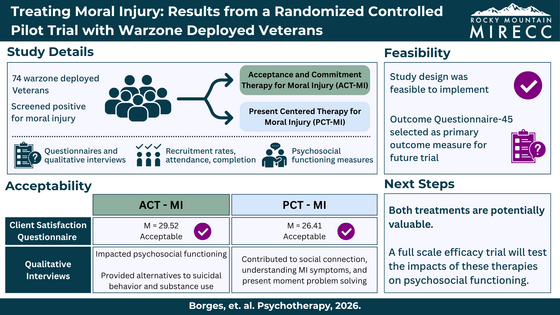
Acceptance and Commitment Therapy for Moral Injury (ACT-MI) and Present Centered Therapy for Moral Injury (PCT-MI): Results from a randomized controlled pilot trial with warzone deployed Veterans (Borges, et al., 2026a)
 Acceptance and commitment therapy for moral injury: conceptualizing and intervening on moral injury through the lens of contextual behavioral science (Borges, et al., 2026b)
A Service Member’s experience of Acceptance and Commitment Therapy for Moral Injury (ACT-MI): “Learning to accept my pain and injury by reconnecting with my values and starting to live a meaningful life." (Borges, 2019)
Veterans’ perspectives on discussing moral injury in the context of evidence-based psychotherapies for PTSD and other VA treatment (Borges, et al., 2019)
Case conceptualizing in Acceptance and Commitment Therapy for Moral Injury (ACT-MI): An active and ongoing approach to understanding and intervening on moral injury (Borges, et al., 2022)
|