|
It's Complicated - But Worth It
Rocky Mountain MIRECC studies Veteran suicide from multiple perspectives. This is because there are many factors that contribute to suicidal thoughts and actions, as well as many factors that could offer protection.
We look at all of it – biology, mental health, physical health, social factors (like finances and social connection), and at-risk populations.
In this newsletter, we highlight a few of our studies from the past year. If you would like to learn more, we include links to some of the publications.
|
|
It All Starts with the Data
Researchers rely on data to understand the scope of a challenge and where to focus time and resources. We conducted several studies that gathered and examined critical Veteran data.
Sometimes, data is limited or missing altogether. Nationally representative data on suicidal thoughts and nonfatal self-directed violence was scarce until the creation of ASCEND (Assessing Social and Community Environments with National Data).
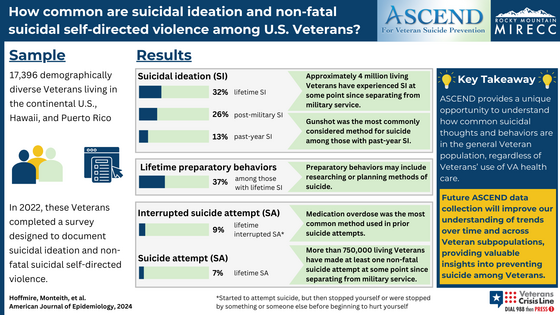 ASCEND is a recurring, nationally representative survey of Veterans. This publication provides essential information about suicidal thoughts, suicide attempts, and attempt methods. Read more about ASCEND here.
We also examine how to make the best use of existing data. This publication details the feasibility of linking VA-Department of Defense data with Centers for Disease Control and Prevention (CDC) data.
Homing in on Risk Factors and Protections
Testing and Implementing Clinical Interventions

Next, we test the feasibility and effectiveness of interventions aimed at reducing risk and promoting protective factors and general well-being.
For instance, since we know that firearms pose a particular risk for Veterans, we test interventions that may help reduce risk for Veterans in crisis. One recent study looked at including significant others in lethal means safety conversations.
Guidance for implementation includes publications on how to effectively deliver scientifically supported treatments, such as Functional Analytic Psychotherapy and Cognitive Processing Therapy, even when there are treatment barriers, like high suicide risk.
|
Supporting Those Who Care for Veterans
We also aim to bring community and VA providers the best information and tools to treat at-risk Veterans.
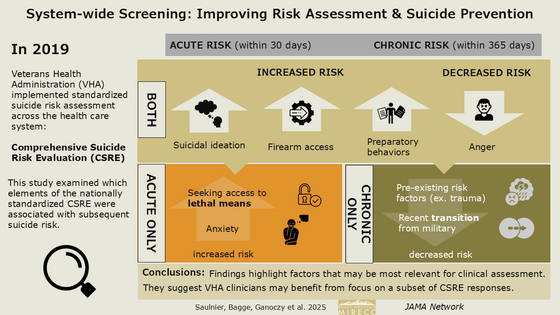 Our team reviewed the results from VA’s implementation of standard suicide screening at each VA facility.
We also teamed up with the Department of Defense to update clinical guidelines for treating Veterans at risk of suicide. These updates offer 24 recommendations that cover tools, therapy, outreach, and pharmacology.
But what about providers treating Veterans in community settings? Our VA Patient Center of Inquiry - Suicide Prevention links community providers with specific, local resources.
|
|
What's Next?
In the upcoming year, Rocky Mountain MIRECC for Suicide Prevention will continue to gather data, examine risk and protective factors, test innovative treatments, and support providers.
We hope you will reach out to us (RockyMountainMIRECC@va.gov) with any questions or if you’d like to learn more!
|
|
|
Did someone forward you this newsletter?
|
|
|
|