|
|
|
Share this email with your colleagues to make sure they get the latest VHA IE news: SUBSCRIBE
|
|
|
|
Providing Veterans with access to mental health care during times of crisis is a top priority for VA. Mobile Response Teams play crucial roles in supporting that mission, increasing trust within the Veteran community and decreasing the potential for involuntary hospitalization or incarceration.
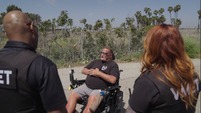
Veterans Mobile Evaluation Team (VMET) and Veterans Response Teams (VRT) are two innovative programs that collaborate with local law enforcement to expand care for off-campus Veterans experiencing a mental health crisis. When Veterans experience a mental health crisis away from VA property, collaboration with local community and law enforcement is critical in providing timely and comprehensive care.
VMET equips VA clinicians and police officers to respond to a Veteran in crisis alongside local law enforcement, connecting the Veteran with VA care and resources to support their mental health. Since its designation as a 2018 VHA Shark Tank Competition winner, VMET has expanded to eight VA facilities. Chalmers P. Wylie Veterans Outpatient Clinic and VA Oklahoma City recently adopted VMET and are already demonstrating success. To learn more about VMET visit, their page on Diffusion Marketplace.
|
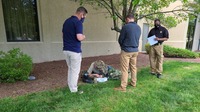
VRT is a comprehensive training program providing local law enforcement officers – who are Veterans themselves – the skills to help Veterans in crisis and connect them to supportive care and services.
“We found that the connection of one Veteran talking to another is really impactful. If you have a Veteran police officer, they can have shared experiences where they have firsthand military experience and they understand exactly the unique challenges that the Veterans are going through,” explained VISN 4 VA Police Chief Paul Woodland, a Navy Veteran himself.
Local success of VRT has led to its expansion into six VA facilities across the country. As of August 2024, Delaware’s VRT has trained over 200 officers from 65 different agencies. To learn more about VRT, visit their page on Diffusion Marketplace.
|
 September's edition of The Exchange highlighted Equity in Innovation. Moderated by Blaine Fitzgerald, Diffusion Specialist Programming Lead and Community Manager for Diffusion Marketplace, panelists included Dr. Tammy Finney and Mitra Gobin-Wade from VA's Center for Development and Civic Engagement (CDCE) discussed their efforts to ensure equitable access to health care for Veterans through volunteerism, philanthropy, and community partnerships.
CDCE’s mission centers on recruiting volunteers for health care programs aimed at supporting Veterans. Their strategic framework emphasizes Leadership, Collaboration, and Impact, harnessing the power of community resources to enhance Veterans' care. A key theme was the importance of an equity lens in their initiatives. Gobin-Wade stated, “At CDCE, we aim to cultivate the use of an equity lens,” ensuring all Veterans, regardless of demographics or geography, access innovative VA programs and services. The goal is to eliminate disparities by distributing resources equitably.
Dr. Finney emphasized, “Our goal is to ensure equity across the field,” highlighting how collaborations help bridge care gaps. The CDCE is committed to making sure all Veterans benefit from innovative health care programs, closing with Dr. Finney's call to action: "We aim to inspire people to be the change they want to see."
Note: Accessible only to VA employees
|
|


VA provides care to an estimated 600,000 Veterans with Chronic Kidney Disease (CKD), a condition in which kidney damage occurs slowly over many years. HKTYK is a prevention-based practice designed to empower Veterans with the knowledge and skills to take control of their kidney health. Inspired by other VA Age-Friendly innovations, Rebecca Schlueter, then a registered dietitian (RD) at Lexington VA Healthcare System, along with a team of other RDs, started HKTYK in 2017. HKTYK offers access to VA dietitians in a virtual or in-person setting, providing a specific type of Medical Nutrition Therapy that encourages Veterans to manage their blood sugar and blood pressure to slow the progression of CKD. Veterans learn about healthy cooking methods, recipes, physical activity, and how to advocate for their health. With support from Diffusion of Excellence as a 2019 VHA Shark Tank Competition Winner, HKTYK has helped over 1,000 Veterans with CKD regain control of their health. Today, HKTYK is available at 27 VA facilities across the country with another 21 replications in progress. To learn more about HKTYK and its impact, visit Diffusion Marketplace and read their recent highlight in VA News.
|
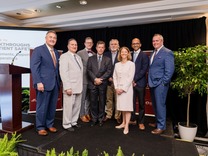
Originally developed in 2011 at Omaha VA Medical Center, The Surgical Pause screens Veterans for frailty and flags those at high-risk so surgical teams can ensure proposed treatment plans effectively mitigate risks and align with a Veteran’s overarching life goals. Utilizing a Risk Analysis Index (RAI) to screen Veterans for frailty in as little as 30 seconds; surgical teams engage in detailed discussions with Veterans to assess a procedure’s viability in relation to the Veteran’s personal goals regarding dependence on others and acceptable risk levels. The practice’s pilot programs at Omaha VA Medical Center drastically reduced six-month mortality rates from 25% to 8% facility-wide; prompting the practice to enter the 2019 VHA Shark Tank Competition. Following the practice earning a winning bid at the competition, The Surgical Pause received support from VHA’s Diffusion of Excellence as a National Diffusion Practice. With the support of VHA’s National Surgery Office, The Surgical Pause has already been implemented successfully in over 50 VA facilities. To learn more about The Surgical Pause visit Diffusion Marketplace and read more about the practice earning the 2023 John M. Eisenberg National Level Innovation in Patient Safety and Quality Award.
|
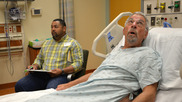
Emergency department (ED) visits for older adults often lack appreciation for underlying geriatric syndromes, care coordination, and follow-through by the ED team, resulting in missed opportunities to provide the best care, recognize the root cause of presentation, prevent further functional decline, and decrease ED revisits or hospital admissions. With the aim of providing comprehensive geriatric-focused emergency care for Veterans, acute care geriatrician Dr. Jill Huded and her team at VA Northeast Ohio Healthcare System developed the first comprehensive geriatric ED program within VHA, providing ED personnel with training in multidisciplinary geriatric evaluation and care coordination. VA’s Geriatric Emergency Department program identifies older Veterans at high risk for functional decline, screening them for geriatric syndromes and facilitating multidisciplinary care coordination utilizing former military medics as a novel workforce in the ED. Pilot testing of the program showed that when compared to a matched control group during an implementation study, patients seen by Louis Stokes Cleveland VA Medical Center Geriatric Emergency Department (GED) program staff experienced a 7.4% lower rate of admission from the ED and a 7.2% lower 30-day admission rate. Following the practice’s selection as a 2019 VHA Shark Tank Competition winner, VA Geriatric Emergency Department has expanded to 68 VA facilities across the country, with another 22 implementations currently in progress. To learn more about VA Geriatric Emergency Department, visit Diffusion Marketplace or read personal stories about its impact in a VA News highlight from 2021.
|
|
|

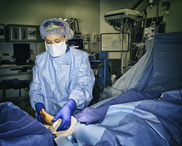
Dr. Nichol Salvo, a 2024 VHA Innovation Ecosystem Senior Innovation Fellow, Chief of Podiatry and Program Director of Limb Preservation at VA Atlanta Healthcare System, has developed the High-Risk Eye and Limb Preservation Program, or HELPP. In rural primary care facilities around the Atlanta region that do not provide podiatry services on their own, Dr. Salvo has overseen the incorporation of intermediate care technicians (ICTs) into elective podiatric visits through HELPP.
“We realized during the pandemic that all these patients had gone a year without nail and callus care,” Dr. Salvo said. “Being able to reach them in a new, more accessible way, has allowed us to expand care to Veterans and, in many cases, prevent risk of amputation.”
Through investigating novel advancements and filling gaps in health care availability, Dr. Salvo started utilizing telehealth to oversee ICTs. Instead of needing to go to the Atlanta VA Medical Center, this has allowed rural Veterans to receive care closer to, or in their homes.
VHA's Office of Rural Health recently selected HELPP as a 2025 Enterprise-Wide Initiative in Louisville, Kentucky and Cookeville, Tennessee in VISN 9 and Corpus Christi, Texas in VISN 17. Congratulations to Dr. Salvo!
|
|
|
|
|
|