The Official Newsletter for School Certifying Officials
Greetings GI Bill Partners,
On January 3, 2024, I joined the Digital GI Bill team to film the first video of the State of Education Service series. This video will share Education Service’s continued mission to modernize the delivery of benefits over the next 3-5 years through four strategic initiatives — Customer Service Excellence, Continuous Improvement, Platform and Technology Enhancement, and People Advocacy. We’re looking forward to sharing the video in the next few weeks.
Respectfully,
Joseph Garcia, Executive Director
Education Service
Veteran Benefits on Display at Student Veterans of America National Conference
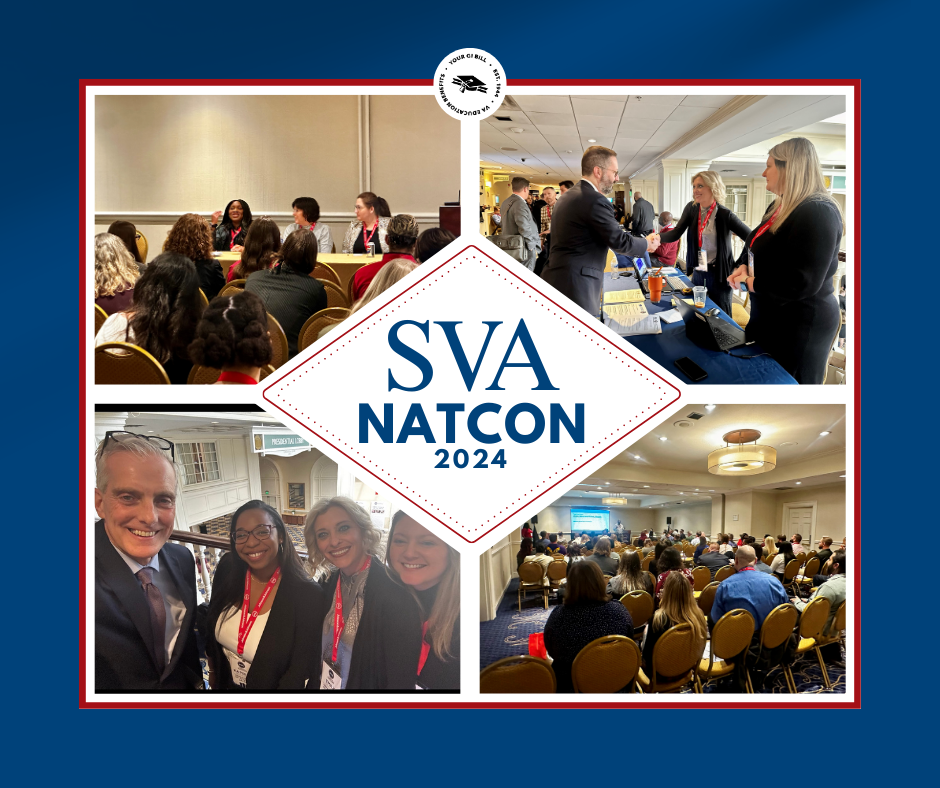
From January 4-6, more than 70 VA staff members attended Student Veterans of America’s Annual NATCON where they spoke with thousands of Veterans, beneficiaries, and School Certifying Officials. During the conference, the team did everything from answering simple eligibility questions to processing claim adjustments on-site and collaborated on 11 breakout sessions.
Secretary of Veterans Affairs, Denis McDonough, paid VA’s Education Service (EDU) team a visit in the Claims Clinic, expressing thanks and appreciation for the work EDU is doing to support Veteran students. VA’s Under Secretary for Benefits, Josh Jacobs, also visited with the team, discussing the ways he and his office can continue to support the important work being done in VA Education Service to make VA Education Benefits as accessible and easy to use as possible.
Risk Based Survey Updates
One of EDU’s four pillars is to promote world-class customer experience for our Veterans and those that support them, such as School Certifying Officials (SCOs) like you or our State Approving Agency (SAA) partners. After receiving feedback from you and our SAA partners, VA has modified how Risk Based Surveys (RBSs) are allocated and performed.
At the request of the SAAs, VA will eliminate all FY 2024 RBSs that stem from persistence rate, retention rate, and transfer rate. Those factors are not required by law but were included in the SAA RBS pilot and originally carried forward based on SAA recommendation. This has substantially reduced the number of RBSs assigned for FY 2024.
Routinely, though not exclusively, RBS will be assigned based on the following legislatively mandated risk factors.
- Rapid student population increase.
- Rapid tuition and fee payment increase.
- Volume of validated student complaints.
- Severity of validated student complaints.
- 85/15 rule violation.
- Veteran completion rates.
- Financial stability.
- Advertising and marketing practices.
- Federal or State government actions in court.
RBSs are also mandatory when VA receives notice of certain actions specified in statute (38 U.S.C. § 3673(e)(2)) or for three consecutive years following conversion of a private for-profit educational institution to a private nonprofit or public educational institution (38 U.S.C. § 3699B).
Compliance Surveys, Targeted Risk Based Reviews (TRBRs) and RBS are all vital to protecting and ensuring the integrity of the GI Bill. VA and SAAs are extremely cognizant of the amount of work these compliance activities exert on your facilities and never undertake them lightly. Similarly, VA and SAAs actively listen to feedback from our Education and Training Institution partners on the compliance process and, when able, try to adjust processes and procedures to streamline the compliance process as much as possible.
Recommended School Certifying Official to student ratio update
On December 8, 2023, VA formally released its suggested ratio of full-time School Certifying Officials (SCOs) to GI Bill beneficiary students. That suggested ratio is one full-time SCO to every 125 GI Bill students at the educational institution. The SCO Handbook has been updated to reflect the new ratio.
Relevant links:
State Approving Agency Uniform Application
A uniform application for all approvals has been developed by the VA in conjunction with the National Association of State Approving Agencies (NASAA). Implementation of a uniform application was required per 38 United States Code (USC) 3672A.
SAAs will continue to be your primary point of contact regarding the approval process. Your SAA will reach out to you to provide the new uniform application and will provide you with all necessary information on how to use the new form as you submit future approval packages. For questions concerning an outstanding approval, please contact your State Approving Agency (SAA).
Those seeking program approvals that are under the jurisdiction of VA, such as On-the-Job Training (OJT) programs at federal agencies, should continue to contact federal.approvals@va.gov.
Calendar of events
 January Office Hours: January 17, 2024 – January 18, 2024
February Office Hours: February 21, 2024 – February 22, 2024
March Office Hours: March 20, 2024 – March 21, 2024
To view the dates for other upcoming webinars, please visit the National Training Team - Schools Training Calendar.
To view the summary and recordings for previous webinars, please visit the Education Service Webinars and Training webpage.
Spring peak enrollment is coming
Every spring term, VA experiences an increase in the education workload due to the peak enrollment period. There is no need for you to hold or resubmit previous enrollments during this time, as this may cause a delay or error in processing.
For fiscal year 2024 VA EDU timeliness standards currently are (accounting for October 2023 – December 2023):
-
Original claims – the first claim filed by a beneficiary, for the formal review of the initial application for Education benefit eligibility – average processing time of 12 days.
-
Supplemental claims – any subsequent claim filed by a beneficiary or school, for the formal review of enrollment certifications - average processing time of 5 days.
If you have certification questions, please review the SCO Handbook or contact your Education Liaison Representative (ELR).
Your students may be eligible for the GI Bill tutoring benefit
Your students rely on you to help them understand all the uses for their GI Bill benefits. One benefit students may miss is the tutoring benefit. If a student meets all of the following:
- Enrolled in an educational program at half-time or more.
- Using the Montgomery GI Bill Selected Reserve (Chapter 1606), Montgomery GI Bill Active Duty (Chapter 30), Post-9/11 GI Bill (Chapter 33) or the Dependents’ Educational Assistance (Chapter 35) benefit.
- Having trouble in a required subject and needs a tutor.
Then the student can be reimbursed by the GI Bill up to $100.00 a month to a total of $1,200.00.
Please remember that the student’s course instructor or teacher must agree that the student needs a tutor and must write a letter on the student’s behalf.
Please share this information with your students and any relevant academic advising offices as you see fit. If additional information is needed or if a student wishes to apply for this benefit, please share our webpage.
|