Snapshot: The IRS’s Inflation Reduction Act Spending Through March 31, 2026
Why did we do this audit?
The IRS initially received $79 billion in supplemental funding under the Inflation Reduction Act of 2022 (IRA). By March 2026, Congress had reduced this funding by $53.4 billion, leaving $26 billion available through September 30, 2031.
What did we find?
As of March 31, 2026, the IRS had spent approximately $16.5 billion (64 percent) of its current IRA funding. The largest expenditure was $7.7 billion for employee compensation and $5.4 billion for contractor advisory and assistance services.
Cumulative IRA Expenditures by Funding Activity
Through March 31, 2026
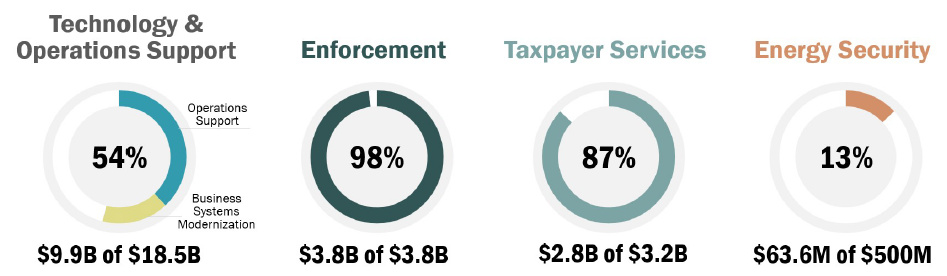
As of March 31, 2026, the IRS had cancelled 167 IRA-related contracts. For
these contracts, the IRS had already paid out $784 million before the contracts were cancelled and is holding an additional $8 million in unliquidated obligations for costs that have been incurred but not paid. Cancelling these contracts reduced the IRS's obligations by $127 million.
The IRS Timely Processed Threat and Assault Cases, but More Education Would Help Employees Properly Report Incidents
Why did we do this audit?
Some taxpayers threaten or assault IRS employees, which is a federal crime when employees are performing official duties. In these cases, the IRS places a Potentially Dangerous Taxpayer (PDT) indicator on the taxpayer’s account. Similarly, the IRS uses a Caution Upon Contact (CAU) designator when taxpayers file or threaten frivolous legal actions or liens against employees or threaten suicide during an interaction.
Between October 2022 and August 2025, the IRS reported over 1,800 cases involving a threat or assault against an IRS employee. Timely input of PDT indicators on taxpayer accounts helps protect employees who may have subsequent direct contact with these taxpayers. Furthermore, it is important that IRS employees know how to report threats and assaults to ensure that individuals who commit such actions are timely identified and investigated.
What did we find?
Office of Employee Protection (OEP) personnel mostly met the one-day requirement for placing PDT indicators on the accounts of individuals involved in threats or assaults. Of 1,826 threat and assault cases from October 2022 through August 2025, 96 percent were processed timely. The remaining 71 had acceptable reasons for delay or involved errors or assignment issues.
OEP specialists review cases after five years to determine whether the PDT or CAU indicator is still warranted on the taxpayer’s account. We found that the OEP properly reviewed and documented its five-year review of PDT cases.
However, IRS employees we interviewed at eight taxpayer-facing offices did not know about the requirement to notify TIGTA’s Office of Investigations (OI) about a threat or assault. The sites we visited also did not display any guidance on how to report assaults and threats.
Having trouble viewing this email? View it as a Web page.
|