|
|
Welcome to the April double-issue edition of the SLFRF Newsletter, meant to inform and empower SLFRF recipients. In this issue, you’ll find invitations to upcoming webinars, our recently released Project and Expenditure Report User Guide, and new resources, along with other important information related to the program. Plus, we have answers to some of SLFRF recipients’ most frequently asked questions.
We encourage you to forward this newsletter to someone you know who would benefit from receiving this newsletter, and let them know to subscribe here.
|
|
|
The U.S. Department of the Treasury (Treasury) will host a workshop series for all recipients of the SLFRF program to assist with successful submission of their 2025 Annual or Q1 Project and Expenditure (P&E) Reports, which are due on April 30, 2025. The purpose of the workshop series is to provide recipients with key resources to navigate the P&E Reports. These will be the final webinar session prior to the deadline.
Listed below are the four key areas that will be covered during each workshop session:
- P&E Report Content
- Common Reporting Errors
- Noncompliance
- Debt Collection
Join us for the workshops, offered on separate dates to give you more flexibility and the chance to get involved early. Don’t wait—sign up below and secure your spot! Workshop details and the registration links are listed below. The workshops have been recorded and are located on Treasury’s YouTube Page: https://youtu.be/KsTAkIXUhCI.
- Webinar Session 4 (2025 Annual and Q1 Report Focus): April 29, 2025
- Webinar Session 5 (2025 Annual Report and Q1 Report Focus): April 30, 2025
Who should attend? Staff responsible for submitting the 2025 Annual or Q1 P&E Reports through Treasury's Reporting Portal. Additionally, staff who administer their recipient government’s SLFRF award funds, including staff with new administrative responsibilities, are encouraged to attend. In particular, staff directly administering budget, finance, policy, grants, housing programs, Capital Improvement Plan (CIP) programs, emergency management programs, or other functions of the SLFRF program may find the workshop helpful.
Prior to attendance, please verify your Treasury’s Reporting Portal access and log in so you can follow along during the webinar. For information about accessing Treasury’s Reporting Portal, see the information below:
- To access Treasury’s Reporting Portal and submit your SLFRF reports, if you haven’t already, you’ll need to register and set up an account with one of two Treasury two sign-in services, Login.gov or ID.me. For more information visit: SLFRF Self-Service Resources.
- If you are a new user and have not previously registered with ID.me, or if you are an NEU, we ask you to register using the Login.gov process at: https://portal.treasury.gov/compliance.
- Note: We strongly suggest new users and NEUs register using Login.gov, as it offers a much easier, user-friendly experience when registering to access Treasury’s Reporting Portal.
Users who have previously registered through ID.me and submitted a compliance report may continue to access Treasury’s Reporting Portal through that method, although creating a new Login.gov account will not cause any issues. Users can login using both ID.me and Login.gov, provided the accounts use the same email address.
|
|
The April 2025 Project & Expenditure (P&E) Report User Guide will assist recipients in a successful submission of the April 2025 Annual and Quarterly P&E Report.
Treasury’s Reporting Portal opened for quarterly and annual reporters to submit P&E Reports on April 1, 2025. Treasury’s Reporting Portal will remain open until April 30, 2025. In preparation for this deadline, Treasury has released the April 2025 P&E Report User Guide to assist recipients in a successful submission. There are four notable modifications to the User Guide for the current reporting cycle. These are:
I. Reflects OMB updates to threshold amounts for Single Audits and Alternative Compliance Examination Engagements (ACEE). (Pages 81-82)
The Office of Management and Budget recently updated the single audit and program-specific audit thresholds for fiscal years beginning on or after October 1, 2024. Under the new threshold, a recipient must have a single audit or program-specific audit conducted if the recipient expends $1,000,000 or more in federal award funds during its fiscal year starting on or after October 1, 2024. For fiscal years that began prior to October 1, 2024, the threshold remains $750,000.
II. SAM.gov and Unique Entity Identifier (UEI) Verification. (Page 24)
Pursuant to 2 CFR Part 25, recipients must maintain a current and active registration in SAM.gov until the recipient submits all final reports required under this Federal award. Before submitting your report, recipients should verify the UEI is accurate and check the current status of your government’s SAM.gov registration here. If your registration status is “Inactive Registration” or “ID Assigned,” you do not have an active SAM.gov registration and will need to take action to ensure your status updates to “Active Registration.” If Treasury has an incorrect UEI for your government, type the correct UEI in the following "Updated recipient entered UEI" field.
III. Program Income Earned Post Obligation Deadline. (Pages 100-101, 123)
Both quarterly and annual reporters will need to identify program income earned on specific projects after December 31, 2024 as a separate line item. Obligation and expenditures related to the program income earned can be reported in these fields.
IV. Obligation Cap and Reclassifications. (Pages 29, 66-67)
For quarterly reporters, beginning in Q1 2025 Treasury’s Reporting Portal will establish a cap on obligated funds based on the total obligations the recipient reported in its Q4 2024 P&E Report. Recipients will still be able to reclassify funds for which an obligation existed by the deadline, as described in Treasury’s guidance.
|
Explainer Videos and Other Resources to Assist Recipients in Reporting
We want to re-acquaint you to our series of explainer videos designed to assist you with the reporting requirements for SLFRF. We understand navigating the reporting process can sometimes be challenging, and these step-by-step videos aim to provide clear, visual guidance to help resolve common issues and ensure smooth, accurate submissions. Whether you're facing technical difficulties or simply need a refresher on best practices, these videos will help you troubleshoot efficiently and stay on track with your reporting requirements.
For other explainer videos, webinars, and demonstrations, please visit: Additional Reporting Resources.
|
|
|
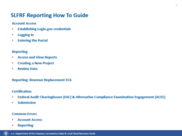
Treasury has released a new simplified Reporting How To Guide to walk recipients step by step from the user perspective through the account access and reporting process in the portal, specifically for recipients who plan to obligate and expend their entire SLFRF award under the Revenue Loss eligible use category (EC 6). This resource will point you to common errors and how to avoid or correct them in addition to addressing frequently asked questions.
|
|
|
It’s crucial that all SLFRF recipients ensure their user roles are up to date in Treasury’s Reporting Portal. If your user roles are not correctly designated, you may not be able to access your entity’s account, which could delay your reporting and compliance activities.
To assist with this, we’ve created an Explainer Video to walk you through the process of understanding and updating user roles in Treasury’s Reporting Portal. Watch it here: Understanding User Roles in Treasury’s Reporting Portal.
For detailed guidance on how to designate and update your user roles, please visit our “Recipient Compliance and Reporting Guidance Responsibilities” webpage. Specifically, scroll to the "Updating User Roles in Portal" link under the “Accessing Treasury’s Portal” section, and be sure to check out Section 3, “System Support-Treasury Submission Portal FAQs” of our SLFRF Self-Service Resources for more information on Points of Contact and Authorized Representatives.
Account Creation and New User Role Requests Template
To facilitate account creation and new user role requests for the Treasury’s Reporting Portal, please email SLFRF@treasury.gov utilizing the template below:
Subject: [Community Name] Account Access
Body:
City EIN #:
[City Name]
To Whom it May Concern:
I am the [Job Title] for the [Recipient Name], [State] and am requesting to be linked to my community’s SLFRF account. I have already created a contact account through login.gov utilizing the information listed below. I understand that I cannot utilize an email address that was previously registered to a different contact and therefore am using the same email I am sending this request from, acknowledging that all future communications will flow through this email.
I am requesting to have my contact account linked to my community account in order to stay in compliance with the program requirements. When adding my contact to our account, please ensure I have the roles of Account Administrator, Point of Contact, and Authorized Representative for Reporting assigned.
Here is our contact information to update the recipient’s record:
Name:
Title:
Email:
Phone Number:
Recipient Address with zip code:
I also understand that if I have not already created my account, the process may be delayed.
Additional resources, including explainer videos and self-service tools, are available to help you navigate this process:
Make sure your user roles are up to date today to avoid any interruptions in accessing Treasury’s Reporting Portal!
|
|
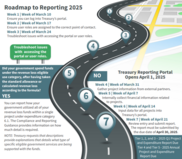
Start preparing for the April 30, 2025 reporting deadline by referring to the 2025 SLFRF Roadmap to Reporting infographic. This resource provides a week-by-week breakdown of tasks related to reporting, along with a few resources to get you started.
|
|
|
|
Here are the SLFRF questions we have received most frequently in our SLFRF@Treasury.gov inbox during Q1 2025. We hope the Q&A below helps clarify any common points of confusion.
Question: We are unable to locate the forms to submit our report to Treasury. Where are they on the SLFRF website?
All reporting for the SLFRF program is submitted online using Treasury’s Reporting Portal. There are no paper forms.
To submit your report in Treasury’s Reporting Portal using an ID.me account, please navigate to Treasury.gov/cares.
To submit your report in Treasury’s Reporting Portal using Login.gov, please navigate to Treasury.gov/Compliance/s.
Please note: Users who have previously registered through ID.me may continue to access Treasury’s Reporting Portal through that method at Portal.Treasury.gov. You are not required to register again with Login.gov; however, you can choose to do so by going to Portal.Treasury.gov/Compliance. Both Login.gov and ID.me are valid ways to log into Treasury’s Reporting Portal, and both methods will remain open going forward.
While both are valid methods of creating an account, please remember if you are using Login.gov, you can access only the Compliance Reporting sections of Treasury’s Reporting Portal; you cannot access applications or application information.
To gain access to applications, you must log in using ID.me, and then follow the instructions to log into the specific portal. You should use a Treasury’s Reporting Portal supported web browser such as Google Chrome or Microsoft Edge . As a reminder, Treasury’s Reporting Portal does not work well on Internet Explorer.
Be sure that your Account Administrator has added you to the account and has used the correct email address.
Please visit the Additional Reporting Resources webpage and click on the Reporting Resources Treasury Portal button, where you will find links to webinars, explainer videos, PDFs, and more – including User Roles.
Question: We’ve spent our money. When can we stop reporting? When is closeout?
Recipients are required to continue to submit reports to Treasury as outlined in the latest SLFRF Compliance and Reporting Guidance. Please refer to “Part 2: Reporting Guidance, Section B – Project and Expenditure Report” for reporting responsibilities and note the due dates in that section for quarterly and annual reporters. Treasury will provide further closeout instructions this year that will provide information to recipients on how to complete closeout and provide final report information.
Question: How do I edit or delete a report? Can we reopen our submitted reports? What about cumulative reporting? How do I request copies of our previously submitted report?
-
Reopening submitted reports: Reports from prior periods will not be re-opened for revisions after the reporting deadline has passed.
-
Cumulative reporting: The P&E Reports are cumulative reports, and adjustments can be made in the current reporting period, if it is still open, or in some cases in the next open reporting period when it opens.
-
Editing or deleting a report: For the quarterly or annual P&E Report, edits may be made prior to the submission deadline. If it is before the deadline and you have already submitted the report and need to make an edit, you can hit the “Unsubmit” button, make the edit, and then re-submit and re-certify the report. If the deadline has passed and you need to make edits, you will need to wait for the next reporting period to open to make edits. Once you make edits, you should provide detailed notes in the description text box for any updates. If the updates are related to projects, subawards, or expenditures, you can make the following applicable edits:
1. change the project status to cancel;
2. create a new project; or
3. create negative subaward or expenditure line items to reconcile incorrect line items.
-
To view copies of your previously submitted reports, log in to Treasury’s Reporting Portal or contact the support team (SLFRF@treasury.gov) for assistance.
Question: We missed the obligation deadline. When and how can we report our obligations in 2025?
Recipients must have obligated funds by December 31, 2024. Treasury is unable to provide any extension to or waiver of this deadline. Recipients that report quarterly were required to report this information in January 2025. Recipients that report annually must report this information by April 30, 2025. Please see Section 17 of the SLFRF FAQs for more detail.
Question: Why did I receive an IDR and what am I expected to do?
There are a variety of reasons you may receive an Information Document Request (IDR). Some of the most common reasons are:
1. Questions or clarification needed on a submitted P&E Report;
2. Missing documentation for the program award;
3. To communicate necessary updates to a previously submitted P&E Report;
4. To gather more information for oversight agencies and single audit inquiries; and
5. Post-closeout adjustments.
Step 1: Log into Treasury’s Reporting Portal and go to the Compliance Reports tab on the left.
Step 2: Once you click on the Compliance Reports tab, then scroll down to the SLFRF information and/or document requests section.
Step 3: There will be an IDR entry. Click on the blue pen icon in the status column to open the IDR. This will take you to the IDR questions and response blocks.
Step 4: Once you click on the blue pen icon, you will receive guidance on how and when to respond. You provide your response in the bottom of the IDR. Please ensure your response is thorough, and upload documents as necessary. Recipients are able to upload and submit the documents at the bottom of the page.
Once you submit your response, Treasury will be notified. If the response satisfies the IDR, then the IDR is closed, you will receive an email informing you that the IDR is closed. If the response is not satisfactory, then Treasury will contact you. Treasury has recorded a brief video to walk through the steps to access, review, and respond to IDRs in Treasury’s Reporting Portal.
Please see link here to view this IDR explainer video: SLFRF Explainer: Information Document Requests (IDRs) [https://www.youtube.com/watch?v=X-H4-eSkaEI] on the Treasury YouTube channel.
Question: What is an Initial Notice of Recoupment, and why did I receive it?
Recipients with unresolved compliance violations are considered noncompliant and may be subject to recoupment of SLFRF funds in accordance with 31 CFR 35.10. Recoupment is initiated via an Initial Notice of Recoupment. The Initial Notice of Recoupment serves as the first formal written notice of the amount subject to recoupment, along with an explanation of those amounts. This notice also will provide an opportunity to request reconsideration, and also generally will provide the recipient with an opportunity for remediation. The Initial Notices of Recoupment generally will be distributed via both postal mail and email. The notice of recoupment is located in Treasury’s Reporting Portal and the recipient received notice of an important message in the Notification Center.
|
|
|
Now that the obligation deadline has passed, recipients should look towards the expenditure deadline, which is December 31, 2026 for all eligible uses except Surface Transportation projects and Title I projects. Recipients must expend SLFRF funds obligated for Surface Transportation projects and Title I projects by September 30, 2026.
Given this stage of the SLFRF program, some recipients may have met the necessary requirements to initiate early closeout. Accordingly, we are launching the Closeout Corner section of the SLFRF newsletter, which aims to comprehensively prepare recipients for closeout, including providing recipients with educational resources when available.
Please note that closeout for the SLFRF program is not yet available and the information in this section of the newsletter is meant to prepare recipients for closeout so they are ready when available. Please stay tuned for additional information related to closeout.
Preparing for Close Out with an Active SAM.gov Registration:
To initiate close-out, recipients must have an active SAM.gov registration. This registration is administered by the General Services Administration (GSA), a federal agency. To determine the current status of your government’s SAM.gov registration, click here. If your registration is currently active, note the registration expiration date, and ensure you complete the steps to renew the registration ahead of closing out your SLFRF award. Note: Only the SAM.gov Entity Administrator can renew the registration.
If your SAM.gov Entity Administrator is no longer with your government or there is not an Entity Administrator associated with the registration, create a user account and submit an Entity Administrator Appointment Letter to gain access to update the existing registration. If there is an existing Entity Administrator but you are now assuming that role, the current Administrator will need to assign that role directly to you. Recipients should not create a new UEI/SAM registration, but instead, should renew the existing registration provided when funds were disbursed. Please find below a list of GSA-provided resources to assist with your SAM.gov registration renewal:
Non-entitlement units of local government (NEUs) that are registering their entity for the first time should e-mail their assigned UEI to Treasury at SLFRF@treasury.gov. Once the UEI is verified, we will update our records accordingly.
There is no cost to renew your SAM.gov registration, and assistance from the Federal Service Desk is free for public use. Additionally, SAM.gov does not use social media or contact individuals by phone to solicit, review, or make awards. In general, emails from the U.S. government come from a .gov or a .mil email domain. Look at both the sender’s display name and the sender’s email address. Be cautious of email addresses that are trying to look like U.S. government email addresses, e.g. sam-registration-gov@gsasam.com. If you are suspicious, do not respond or follow any links. To help identify potential phishing emails, view this article.
|
|
CONNECT WITH US
Please share SLFRF news by forwarding this newsletter to others!
Subscribe to the State and Local Fiscal Recovery Funds Newsletter by signing up here.
If you require additional assistance, please reach out to us by email:
For questions about the Treasury Portal or for technical support, please email covidreliefitsupport@treasury.gov.
For general questions about the Coronavirus State and Local Fiscal Recovery Funds, please email
SLFRF@treasury.gov.
|
|
|
|
|