
SLFRF April Newsletter | Reporting Deadline, Obligation IFR FAQs, and More
U.S. Department of the Treasury sent this bulletin at 04/18/2024 10:31 AM EDT
Volume 2, Issue 2 | April 18, 2024
Welcome to the Spring edition of the SLFRF Newsletter, meant to inform and empower SLFRF recipients. In this issue, you’ll find important updates, useful online tools, and resources related to reporting and meeting the obligation deadline. Plus, we’ve got concise answers to some of SLFRF recipients’ most frequently asked questions.
We encourage you to forward this newsletter to someone you know who would benefit from receiving this newsletter, and let them know to subscribe here.

Top Items for this Issue:
- The SLFRF Frequently Asked Questions (FAQs) have been updated in response to common recipient questions requesting clarifications about the obligation requirement.
- Treasury is extending the reporting deadline for estimated costs associated with certain administrative and legal requirements.
- The April 2024 Project and Expenditure Report User Guide has been released. Use this resource for a successful submission of your 2024 quarterly or annual Project and Expenditure (P&E) report, which is due on April 30, 2024.
- Reminder: SLFRF “pass-through entity” recipients must manage subrecipient monitoring.

SLFRF FAQs UPDATES ARE HERE!
The SLFRF FAQs have been updated to include Treasury’s responses to recipients’ common questions about the Obligation IFR.
Among other items, these SLFRF FAQs contain three important clarifications:
- First, Treasury considers an interagency agreement to constitute an obligation for purposes of the SLFRF rule if the agreement satisfies certain conditions. (FAQ 17.6)
- Second, Treasury considers a recipient to have incurred an obligation with respect to personnel costs for an employee through December 31, 2026, to the extent the employee is serving in a position that was established and filled prior to December 31, 2024. (FAQ 17.7)
- Third, Treasury is clarifying how recipients may cover cost increases associated with contracts or subawards entered into by December 31, 2024. (FAQ 17.16, FAQ 17.17)
MAY EXPLAINER WEBINARS OF NEW OBLIGATION FAQs! REGISTER NOW!
Treasury will host recipient webinars on May 8 and 9, 2024 to further explain new SLFRF FAQs that clarify the obligation requirement. Recipients are strongly encouraged to attend one of these two webinars; the same material will be presented on each date. A recording with the webinar content will be available after the sessions. Recipients may use the links below to register for a webinar:
May 8, 2024
Time: 10:00am-11:30am ET / 9:00am-10:30am CT / 8:00am-9:30am MT / 7:00am-8:30am PT
Registration link: https://ustreasury.zoomgov.com/webinar/register/WN_WEQWKZEDQp2eLViOOCBR6w
May 9, 2024
Time: 1:00pm-2:30pm ET / 12:00pm-1:30pm CT / 11:00am-12:30pm MT / 10:00am-11:30am PT
Registration link: https://ustreasury.zoomgov.com/webinar/register/WN_9QFrQzW6R5GNoTtetksehg
TREASURY EXTENDS DEADLINE FOR REPORTING ESTIMATED COSTS FOR CERTAIN LEGAL AND ADMINISTRATIVE REQUIREMENTS
Treasury is extending the reporting deadline for estimated costs associated with certain administrative and legal requirements.
As a reminder, recipients are considered to have incurred an obligation by December 31, 2024, with respect to a requirement under federal law or regulation or a provision of the SLFRF award terms and conditions to which the recipient becomes subject as a result of receiving or expending SLFRF funds. Recipients may submit to Treasury an estimate of SLFRF funds that it will use to cover such costs. Recipients are not required to submit estimates for all administrative costs associated with their projects; rather, they must submit an estimate if they want to cover such costs using SLFRF funds that they would otherwise have to return to Treasury after 2024 as unobligated.
Treasury has extended the deadline for recipient to report this cost estimate. The deadline is no longer April 30, 2024. Recipients that choose to submit an estimate must report the estimate by July 31, 2024, for quarterly reporters, or April 30, 2025, for annual reporters. This deadline extension does not affect the cadence of regular Project and Expenditure (P&E) reports; P&E reports are still due on April 30, 2024 for both quarterly and annual reporters. The estimates due will be incorporated into the appropriate P&E reports. Additionally, quarterly reporters can update their cost estimates through the P&E report due on January 31, 2025. There will be additional guidance on this matter in a future P&E user guide.
APRIL 2024 PROJECT AND EXPENDITURE REPORT USER GUIDE NOW AVAILABLE!
The April 2024 Project and Expenditure Report User Guide will assist recipients in a successful submission of the April 2024 Quarterly or Annual P&E Report.
The Treasury Portal opened for the P&E Reports on April 1, 2024. The portal will remain open until April 30, 2024. In preparation for this deadline, Treasury has released the April 2024 Project and Expenditure Report User Guide to assist recipients in a successful submission. There are four notable changes to the system for the Quarter 1 (Q1) and Annual 2024 reporting cycle, which are reflected in the user guide. These are:
Federal Audit Clearinghouse (FAC) and Alternative Compliance Examination Engagement (ACEE)
Please refer to pages 79-80
Beginning in the quarterly and annual P&E reports due April 30, 2024, there will be new questions on the Certification Tab that will ask questions to assist in determining ACEE eligibility.
Ready for Close Out
Please refer to pages 77-78
Beginning in the quarterly and annual P&E reports due April 30, 2024, there will be a new question to determine if you are ready to close out your SLFRF award. This question will only be generated for those recipients whose total SLFRF award is equal to total SLFRF expenditures. This question will read: “Have you spent your full SLFRF award and are ready to close out the award?” Please note that this question is for informational purposes only. Responding to it does not start the closeout process. Recipients should respond accordingly and await additional guidance from Treasury regarding closeout procedures. Even by answering “Yes,” you will still be required to continue periodic reporting.
Project Start and End Dates
Please refer to pages 97 and 117– see the “Completion Status” section of the table.
Beginning in the quarterly and annual P&E reports due April 30, 2024, there will be Project Start and End Dates required fields that are conditionally required based on the “Status of Completion” in the Project Overview section.
- If the project status is “Not Started,” the dates are not required.
- If the project is “Completed less than 50%” or “Completed 50% or more,” then only the Project Start Date is required.
- If the project is “Completed” or “Cancelled,” then both the Project Start Date and Project End Date are required.
Title I Uploads
Please refer to page 145 – Environmental Review Table – if responding “Other”
Previously reported Title I Projects will have a new upload requirement based on the Environmental Review response. If the response to the question “Indicate the type of environmental review required by the project” was “Other,” then there will be a requirement to upload four (4) documents.
Four new document uploads are required:
1. Treasury Approved Environmental Certification
2. Treasury Approved Public Notice
3. Treasury Approved Proof of Posting Public Notice
4. Treasury Approved Authority to Use Grant Funds Notice
2024 SLFRF ROADMAP TO REPORTING
Start preparing for the April 30, 2024 reporting deadline by referring to the 2024 SLFRF Roadmap to Reporting infographic. This resource provides an illustrative example of a week-by-week breakdown of tasks related to reporting, along with a few resources to get you started. At this point, recipients would be at week 6 (week of April 15).
SLFRF RECIPIENT AUDIT REQUIREMENTS AND AN ALTERNATIVE TO THE SINGLE AUDIT
Recipients typically need to hire auditors to conduct single audits or program-specific audits if they spend $750,000 or more in total direct and indirect federal financial assistance within their fiscal year, as discussed in 2 CFR Part 200, Subpart F. However, eligible SLFRF recipients have the option to have an alternative compliance examination engagement (ACEE) in lieu of a single audit or a program-specific audit.
ACEE Eligibility Criteria
An SLFRF recipient that spends $750,000 or more in federal awards during its fiscal year is eligible to have an auditor perform an ACEE if:
- The recipient’s total SLFRF award received directly from Treasury or received (through states) as a non-entitlement unit of local government is at or below $10 million; AND
- Other federal award funds the recipient expended (not including its direct SLFRF award funds) are less than $750,000 during the recipient’s fiscal year.
Deadline
ACEEs, single audits, and program-specific audits are due within the earlier of 30 calendar days after the receipt of the auditor’s report or nine months after the end of a recipient’s fiscal year.
Submission Information
Single and program-specific audits must be submitted to the Federal Audit Clearinghouse (FAC) at FAC.gov. The FAC website includes resources to assist recipients and their auditors to prepare and submit audits.
ACEEs can now be submitted to Treasury via the SLFRF Portal. When completing the required reporting within the portal, the recipient will be prompted to answer questions that, based on the responses, will provide a link to submit an ACEE.
Note: Recipients were able to submit ACEEs to the FAC through September 30, 2023. Recipients that were unable to submit ACEEs to the FAC are now able to submit them through the SLFRF Portal.
Resources
Recipients and their auditors can find information on how to perform SLFRF single audits, program-specific audits, and the ACEE in the 2023 SLFRF Single Audit Compliance Supplement. The information about the ACEE is located on pages 11 through 20.
Recipients are encouraged to discuss audit requirements for their federal awards with their auditors. If you have any questions about audits or the ACEE please contact the State and Local Fiscal Recovery Funds Program at: SLFRF@treasury.gov.
REMINDER: SLFRF "PASS-THROUGH ENTITY RECIPIENTS MUST MANAGE SUBRECIPIENT MONITORING
As noted in Treasury’s SLFRF Compliance and Reporting guidance, SLFRF recipients that are pass-through entities are required to manage and monitor their subrecipients to ensure compliance with SLFRF award requirements. 2 CFR 200.332(h) provides that all pass-through entities must “[c]onsider taking enforcement action against noncompliant subrecipients as described in § 200.339 of this part and in program regulations.” If a recipient recoups SLFRF funds from a subrecipient, the recipient could reallocate the funds towards another eligible project, keeping in mind the December 31, 2024 obligation deadline.
Question: Can duplicate subrecipients be removed?
Answer: No, you cannot remove duplicate subrecipients. However, you may adjust to prevent error messages for duplicate subrecipients. To start, you will need to identify the appropriate subrecipients that are receiving the error message, which are typically those that are missing their unique entity identifier (UEI) number. Once that is determined, zero out all the subawards and expenditures associated with the duplicate subrecipient. To zero out these amounts, you will need to apply a negative amount if it was entered in a different reporting period. Once zeroed out, there will be no need to enter UEI-related information associated with this subrecipient.

Top Questions in the SLFRF Inbox.
Question: Can we reopen our submitted reports? / What about cumulative reporting?
Answer: Reports from prior periods are not eligible to be re-opened for revisions since the reporting deadline has passed. The SLFRF P&E Reports are cumulative reports and any adjustments needed can be made in the current reporting period if it is still open or next open reporting period when it opens.
Question: How do I request copies of a previously submitted report?
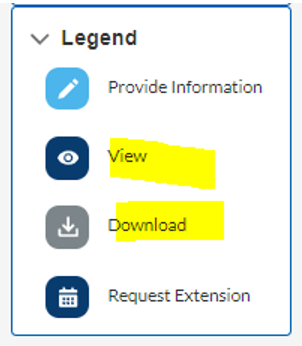
Answer: Recipients can download previously submitted reports from the Treasury Portal. Once the recipient has entered the portal and selected the Compliance Report Tab, the recipient will be able to see all of its submitted reports. On the right side of the screen, the recipient will see clickable icons to either View or Download the report, as show below.
Question: How do I edit or delete a report?
Answer: For the quarterly or annual P&E report, edits may be made prior to the submission deadline. If it is before the deadline and you have already submitted the report and need to make an edit, you can hit the Unsubmit button, make the edit, and then re-submit and re-certify the report. If the deadline has passed and you need to make edits, you are able to update the report in the currently open reporting period or wait for the next reporting period to open to make edits. Once you make edits, you should provide detailed notes in the description text box for any updates. If the updates are related to projects, subawards, or expenditures, you can make the following applicable edits:
1. change the project status to cancel;
2. create a new project; or
3. create negative subaward or expenditure line items to reconcile incorrect line items.
If you have already submitted your report and the reporting period is still open, you can still make changes. You will need to view your current submitted report by selecting the view icon that is shown highlighted below.
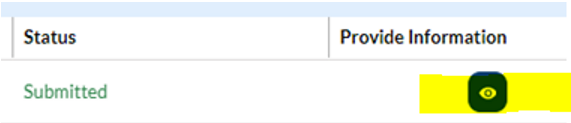
Once you have entered your submitted report on the right side of the screen in the legend at the bottom, there will be a button that says “Unsubmit.” Select that and you will be able to update your report.

Keep in mind that you will still need to re-submit and re-certify your report once your updates are complete.
Question: Who should use the Adopted Budget field?
Answer: The Adopted Budget field is defined and its use is explained in the P&E Report User Guide (p. 19, p. 96, also in Appendix D starting on p. 118). The Adopted Budget field is only a required field for Tier 1 Recipients, which are States, U.S. Territories, and metropolitan cities and counties with a population that exceeds 250,000 residents. This field is available but optional for all other recipients. The Adopted Budget within the Project Status is only the Adopted Budget for that specific project. The Adopted Budget shown on the Project Overview Section and Certification Section is a roll-up (or a summation) of all projects’ Adopted Budgets and should not exceed the Allocation amount found in the status box on the right side of the screen at the bottom.
Question: I’m having trouble with the lock feature. How do I lock projects on my report?
Answer: This was a common issue that has been resolved. However, if incorrect information in prior reporting periods was entered for a project in the current period sections, then the option to lock the project is not available in the current (or future) reporting periods. Locking the project is not a requirement, so you can still submit a report that had errors in previous reporting periods. Please refer to the newly released April 2024 Project and Expenditure User Guide and see Section IV, “Locking ability for projects that are in a ’Completed’ status” on pages 32-33 for helpful screenshots and step-by-step instructions.
Question: Can I request an extension of the deadline for submitting my report?
Answer: The SLFRF program generally does not grant extensions for reporting period due dates. Recipients’ submissions received after the reporting deadline will be considered late.
Please note: If required reports are not submitted, the recipient may face penalties for noncompliance, which may include returning SLFRF award funds to Treasury.
The data submitted by recipients will be used internally for oversight purposes and to fulfill Treasury’s program transparency and accountability obligations. If a recipient misses the due date, we ask that the recipient submit its P&E Report as soon as possible to ensure the accuracy of the publicly posted data. Late submissions undermine the efficiency, accuracy, and timeliness of the data.
Don't see your question here? Click here to visit the SLFRF Self-Service Resources and here to access the SLFRF Frequently Asked Questions.

Please share SLFRF news by forwarding this newsletter to others! Subscribe to the State and Local Fiscal Recovery Funds Newsletter by signing up here.
If you require additional assistance, please reach out to us by email:
- For questions about the Treasury Portal or for technical support, please email covidreliefitsupport@treasury.gov.
- For general questions about the Coronavirus State and Local Fiscal Recovery Funds, please email SLFRF@treasury.gov.


