|
View as a webpage / Share
October 9 - October 15
From October 17 to 22, Secretary Rubio will travel to Uzbekistan, where he will participate in the C5+1 Ministerial, and to India, where he will discuss prospects for enhanced energy cooperation and meet with business leaders.
Here’s what happened at State this week. ⤵️
- The United States mobilized immediate aid to Panama following earthquakes.
- The U.S. defends its citizens against the International Criminal Court.
- The U.S. facilitates Venezuela’s democratic transition.
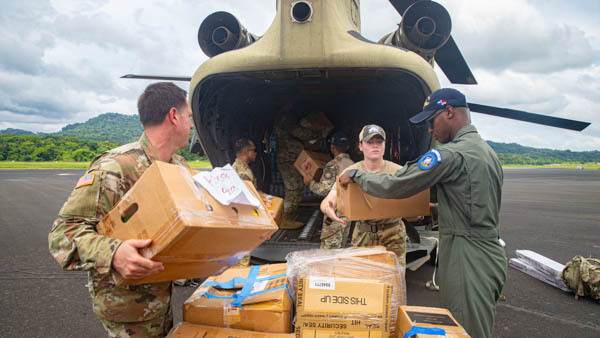 U.S. service members and Panamanian emergency response personnel load supplies onto a CH-47 Chinook helicopter to send assistance to the people of Panama in the aftermath of the October 9, 2026, earthquake. (U.S. Army /Private First Class Oshon Trowbridge)
Secretary Rubio announced that the United States rapidly mobilized resources, emergency personnel, and humanitarian assistance to Panama following a devastating 7.7 magnitude earthquake on October 9.
The Trump Administration deployed a Disaster Assistance Response Team along with Urban Search and Rescue experts to help local authorities find survivors and conduct structural damage assessments. U.S. Southern Command provided logistical and transport support to deliver food, clean water, shelter, and medical care to affected areas.
“The United States stands with the people of Panama,” Secretary Rubio noted, emphasizing the administration’s commitment to delivering rapid support to regional partners in times of crisis.
Secretary Rubio announced new sanctions on October 9 against the International Criminal Court (ICC) under Executive Order 14203 to defend American sovereignty and protect U.S. citizens from the court’s overreach.
The administration designated 17 individuals connected to the ICC, blocking their assets and restricting their ability to operate within the global financial system. The sanctions follow repeated attempts by the court to assert jurisdiction over non-party nations and target American service members, border patrol agents, and elected officials acting in defense of the United States.
“For decades, Republicans and Democrats alike rejected the idea that the International Criminal Court had the power to prosecute American citizens, military servicemembers, or political leaders,” Secretary Rubio stated. “America never joined the court. We don’t need it. And we don’t want it.”
Venezuela’s Democratic Transition
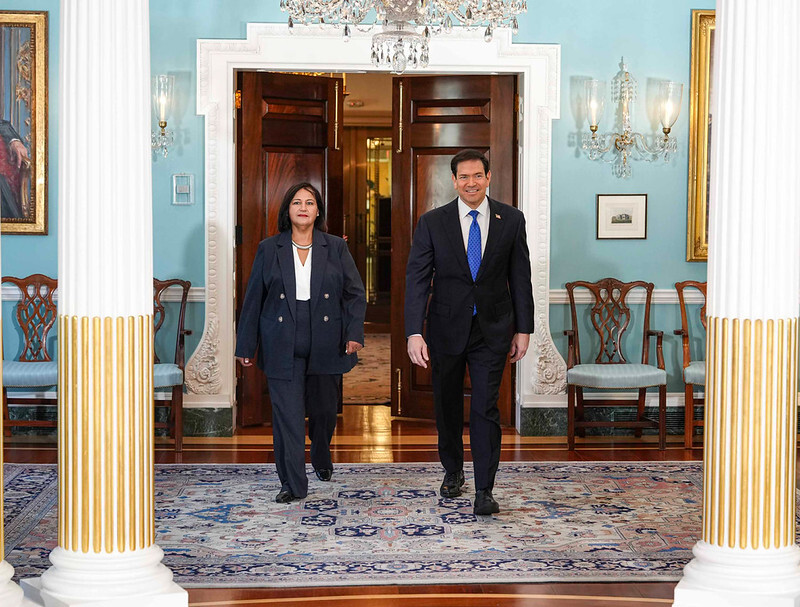 Secretary Rubio meets with 2015 Venezuelan National Assembly President Dinorah Figuera at the Department of State in Washington, D.C., October 9, 2026. (Official State Department photo by Freddie Everett)
On October 9, Secretary Rubio met with 2015 Venezuelan National Assembly President Dinorah Figuera, reaffirming our unwavering support for her and her team at the highest levels of our government.
“The Venezuelan people have the opportunity for a peaceful transition to a stable, prosperous, and enduring democracy that will secure freedom for generations to come,” said Secretary Rubio on X.
The Department of State released a fact sheet on the ongoing political reconciliation talks, emphasizing how they are producing tangible reforms in civil liberties and political rights, laying the groundwork for credible elections and a democratic transition. Two rounds of talks between representatives of Venezuela’s 2015 National Assembly and representatives of the interim government have already taken place, producing significant results: a wholesale reform and reconstruction of an independent Venezuelan Supreme Court, the restoration of access to more than 70 previously blocked internet domains, and the reform of a key repressive law. The interim government has also released more than 1,000 political prisoners and announced the release of nearly 200 more.
The third round of reconciliation talks began October 14, focusing on finalizing the Supreme Court selection process and providing individuals and political parties participation guarantees necessary for credible elections.
|