|
Patents and
Trademarks of World War One
This month marks the centennial of the United States’ entry
into World War I on April 6, 1917, and the U.S. Patent and Trademark Office
(USPTO) has taken a look back into its archives of patents and trademarks from
that era.
World War I, and the years that came after it, resulted in a
surge of American ingenuity and technological innovation. As soldiers faced different types of warfare, new technologies
emerged such as the gas mask. One early version was a breathing device patented by African-American
inventor Garrett Morgan in 1914, and subsequent inventors built on his work to create masks that protected
soldiers from poisonous gases during WWI.
Father of the modern submarine, John Phillip
Holland designed and built the first underwater
vessel for the U.S. Navy in the late 1800s. His
submarine design would
become the model for the Navy's fleet of submersibles for the next several
decades.
Certain items developed for troops in WWI went on to become
part of everyday life for Americans. One example is the “hookless fastener”
or zipper, patented by Gideon Sundback in 1916, which the U.S. military incorporated into uniforms and
boots, and also caught on quickly in civilian clothing.
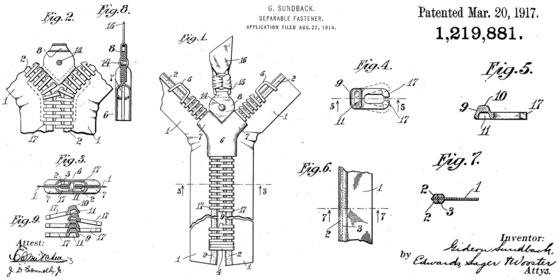
Diagram from the
patent application of G. Sundback's "seperable fastener."
Another is the wrist watch. Before WWI, most people didn’t wear them, instead relying on clocks at home or pocket watches. But following the need for wristwatches for soldiers in the field during WWI, they became popular with the general public after the war.
During the WWI years, many products were also trademarked that are still in use today. For example, Dixie®, trademarked in 1917, developed a paper cup to prevent the spread of germs, and the company still produces an array of paper products today. Many companies included symbols of patriotism in their advertisements during the war, and WWI lore even made its way into pop culture, such as Snoopy’s Flying Ace.
Some WWI veterans were also notable inventors, such as Frank J. Sprague and Leroy Grumman, currently featured in the Visionary Veterans exhibit in the National Inventors Hall of Fame (NIHF) Museum at the USPTO in Alexandria, Va. Sprague, a graduate of the U.S. Naval Academy, developed the electric railway, early electric elevators, and the commercial electric motor. Grumman, a Navy pilot, invented a unique folding-wing mechanism for naval aircraft and later established the Grumman Aircraft Engineering Corporation, now part of the Northrop Grumman Corporation.
Follow the USPTO on Twitter and Facebook to learn more about interesting historical patents and trademarks.
Read more USPTO-specific posts on the Department of Commerce blog.
|