|
October 11, 2017
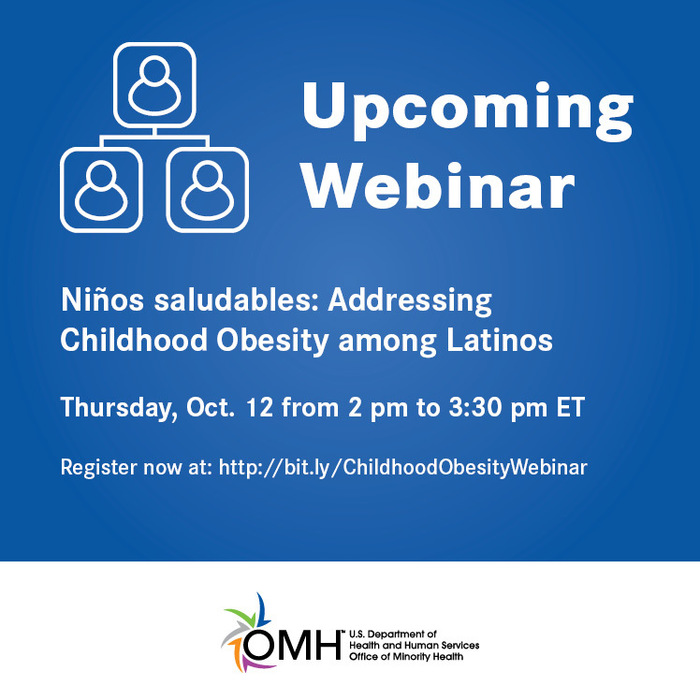 Join OMH, the Office of Minority Health Resource Center (OMHRC),
Unidos US and UT Health San Antonio for the Niños saludables: Addressing
Childhood Obesity among Latinos webinar, where they will highlight
prevalence data and explore the factors, such as culture, behavior, and
environment, that have contributed to the increase of obesity in Latino
children of all ages over the past 30 years.
Tomorrow, October 12,
2017, 2:00 pm ET. Register.
In This Issue:
Federal Grants
- HHS/Health Resources and Services Administration (HRSA), Office of Pharmacy Affairs (OPA): 340B Drug Pricing Program. HRSA is allowing eligible entities in Texas, Louisiana, Florida, Georgia, South Carolina, Puerto Rico, and the Virgin Islands to immediately enroll for the 340B Program during the Public Health Emergency Declaration by the Secretary. Deadline is October 15, 2017. Learn more.
- HHS/HRSA: AIDS Drug Assistance Program (ADAP) Emergency Relief
Funds (ERF). ADAP ERF awards are intended for states/territories that demonstrate the need for additional resources to prevent, reduce, or eliminate ADAP waiting lists. Deadline is November 13, 2017. Learn more.
- US Department of Agriculture (USDA), National Institute of Food and Agriculture (NIFA): Community Food Projects (CFP) Competitive Grant Program. The goals of the CFP are to meet the food needs of low-income individuals through food distribution, community outreach to assist in participation in Federally assisted nutrition programs, or improving access to food. Deadline is December 4, 2017. Learn more.
Scholarships / Fellowships / Internships / Mentoring
- HHS/National Institutes of Health (NIH), in partnership with the American College of Medical Genetics and Genomics (ACMG): Fellowship in Genomic Medicine Program Management. The goal of this fellowship is to increase the pool of physicians trained in managing research and implementation programs in genomic medicine (i.e., the use of genomic information as part of an individual patient's clinical care). Deadline is December 1, 2017. Learn more.
Resources
-
Association of American Medical Colleges (AAMC): New toolkit. Community Engagement, Precision Medicine, and Native Health. This health equity toolkit was developed to implement what was learned from AI/AN communities about their perceived risks and benefits of participation in the NIH All of Us Research Program. Learn more.
Resources
- HHS/NIH, National Institute of Arthritis and Musculoskeletal and Skin Diseases (NIAMS): New Asian language publications. NIAMS has added two new Asian-language titles to its Health Information Basics series: Living with Arthritis (Chinese | Korean | Vietnamese) and Living with Lupus (Chinese | Korean | Vietnamese).
- HHS/OMH, OMHRC: Training. University
- Vision, Design and Capacity (U-VDC) Grant Writing Workshop.
Learn to write winning grants and build sustainable partnerships to
improve minority health. These workshops are intended for
university/college junior faculty, staff, and health professionals. For
further information, please contact Tamara
Henry. October 26-27 at Northern Arizona University in
Flagstaff, AZ. Register | November 16-17 at Nova
Southeastern University in Ft Lauderdale, FL. Register.
- HHS/NIH, National Institute on Alcohol Abuse and Alcoholism (NIAAA): Interventional Study. Ketogenic Diet in Alcoholism. NIH researchers seek individuals 18-75 years old who have a moderate to severe alcohol disorder and are seeking treatment for alcohol use. Study will be conducted at the NIH Clinical Center in Bethesda, MD. Learn more.
Events
- Health Literacy Innovations: Webinar. Translating Across Languages, Cultures and Literacy Levels. This webinar is part of a health literacy series that will also address materials development and testing, and patient engagement with health information. Tomorrow, October 12, 2017, 2:00 pm ET. Register.
Events
- National Native American AIDS Prevention Center: Webinar. Undetectable = Untransmittable (U=U) Breaking HIV Stigma. This webinar will address topics such as HIV viral load, undetectable viral load, disclosing HIV status, and treatment as prevention. Tomorrow, October 12, 2017, 3:00 pm ET. Register.
- Urban Coalition for HIV/AIDS Prevention Services (UCHAPS): Webinar. U=U, A Undetectable Equals Untransmitable Dialogue. October 27, 2017, 2:00 pm ET. Register.

Consumer Update
- HHS/Food and Drug Administration (FDA): Do Not Use Infant Sleep Positioners Due to the Risk of Suffocation. FDA has created a video and updated the Baby Products with SIDS Prevention Claims webpage to warn of the risk of infant suffocation with the use of infant sleep positioners. Learn more.
Federal
- HHS/Office of the Secretary is recruiting for a FT, Permanent, Senior Executive Service (SES) Deputy Assistant Secretary for Women's Health (ES 00) in Washington, DC. Deadline is November 6, 2017. Apply.
Academic
- Belmont University is recruiting for the FT, tenure track position of Dean within the College of Pharmacy. Position is based in Nashville, TN. Open until filled. Apply.
- "Barriers for Compliance to Breast, Colorectal, and Cervical Screening Cancer Tests among Hispanic Patients,” published in the International Journal of Environmental Research and Public Health, explores why Hispanic study participants are less likely to seek cancer screening tests than their non-Hispanic white counterparts. Demographic factors such as gender, fear, time constraints, and awareness of the availability of services can determine compliance. Christine Miranda-Diaz et al. use the characteristics of the study participants to evaluate who more commonly undergoes these procedures and how to better serve those who do not. To view this title and find additional information, search our online catalog.
|
|
|
|