|
Building America's scientific future starts with investing in the people who will create it. For more than 75 years, the NSF Graduate Research Fellowship Program (NSF GRFP) has played a critical role in developing the talent pipeline that sustains U.S. leadership in science, engineering and technology. Its fellows have pioneered basic research, developed transformative technologies, advanced national security, and founded some of the nation's most innovative companies. That legacy continues with the release of the Fiscal Year 2027 NSF GRFP notice of funding opportunity.
This investment in talent is a part of a broader NSF portfolio. In this issue of NSF Insights, discover how today's researchers are advancing precision agriculture, artificial intelligence, and the view of the night sky.
|
|
|
If you are not yet subscribed to NSF Insights and would like to continue receiving these monthly updates, please sign up below to stay connected.
|
|
|
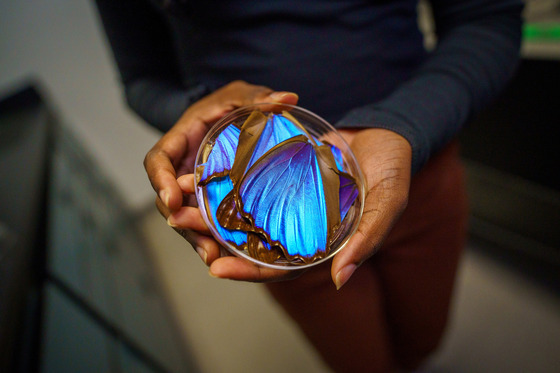
The Morpho butterfly's shimmering blue wings inspire new approaches to cancer treatment. NSF-supported scientists are using the microscopic structure that gives the butterfly's wings their brilliance to develop a simple, inexpensive way to analyze cancerous tissues. This research is supported in part by an NSF Graduate Research Fellowship. Credit: David Baillot/UC San Diego Jacobs School of Engineering
|
|
 |
|
NSF investments have led to breakthroughs in geothermal energy development and deployment, unlocking an abundant power source that can meet the nation’s growing grid demands.
|

 |
|
Precision agriculture is revolutionizing the way farmers grow crops, lowering costs, maximizing yields, optimizing the use of irrigation water, addressing farming labor challenges, and securing the supply of safe, high-quality food.
|
 |
|
NSF-funded research in reinforcement learning helped lay the foundations for the AI systems powering today's generative AI, robotics, decision-support tools, and autonomous technologies.
|
 |
|
NSF National Optical-Infrared Astronomy Research Laboratory's Director of Operations for the NSF-DOE Vera C. Rubin Observatory, funded by NSF and U.S. Department of Energy's (DOE) Office of Science, discusses the observatory's signature mission, the Legacy Survey of Space and Time, and how it will transform the way we study the universe. Listen to "NSF's Discovery Files" wherever you get your podcasts.
|
 |
|
Cutting-edge science and technology advancements are revolutionizing artificial intelligence systems. Mark Hersam an NSF-supported researcher, discusses nanoelectronic materials and how a cerebellum-inspired approach may transform how AI performs in wearable devices. Listen to wherever you get your podcasts.
|
|
|
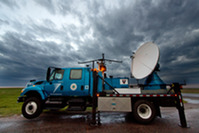
Did you know tornado formation can be observed in real time from mobile radar systems? NSF-supported advances in Doppler radar technology have improved storm prediction and warning time leads. |
|
 |
|
|
 |
|
Join the NSF Directorate for Geosciences for virtual office hours featuring updates on programs, funding opportunities, and other topics of interest to the earth science research community. Register
|
 |
|
Join the NSF Directorate for Biological Sciences for virtual office hours featuring updates on programs, funding opportunities, and other topics of interest to the biological sciences research community. Register
|
 |
|
Sept. 17, 12-1 p.m.
Sept. 30, 2-3 p.m.
NSF GRFP will host an applicant webinar for prospective applicants, providing information about the program and the application process. .
|
|
|
Sept. 23, 2-3 p.m.
NSF GRFP will host virtual office hours for prospective applicants, providing an opportunity for applicants to learn more about the GRFP and ask questions about the program and application process. Registration and additional event details will be available soon.
|
 |
|
Sept. 24, 9 a.m.-5 p.m.
Sept. 25, 9 a.m.-5 p.m.
The Astronomy and Astrophysics Advisory Committee is a federal advisory committee that provides advice and recommendations to NSF, NASA, and the DOE on issues within the field that are of mutual interest and concern to the agencies. Register.
|
|
|
Sept. 24, 12-1 p.m.
Oct. 5, 2-3 p.m.
NSF GRFP will host a reviewer information session webinar for prospective NSF GRFP reviewers, providing information about the GRFP review process and the role of reviewers. Registration and additional event details will be available soon.
|
|
|
In the coming weeks and months, NSF will be releasing exciting funding opportunities that emphasize the best of what the agency has represented for the past 76 years, along with new and ambitious ideas to reinvigorate America’s pioneering spirit of discovery.
NSF awarded more than $290 million to eight Quantum Leap Challenge Institutes that will take on some of the hardest scientific hurdles in the global race to create powerful quantum-based technologies
NSF announced $1.5 billion in new funding opportunities for foundational research that underpins U.S. leadership in science and technology, accelerating breakthroughs and opening new frontiers of knowledge.
NSF-supported researchers have captured an ephemeral state of matter using silver nanoparticles instead of atoms, providing a blueprint for future research using custom-shaped nanocrystals to engineer new materials for quantum technologies.
Innovations developed by NSF-funded researchers for the Indy Autonomous Challenge are improving the performance and safety of autonomous vehicles at high speeds.
NSF announced the NSF State and Regional Artificial Intelligence Infrastructure Hubs program, a $100 million initiative to transform research and workforce development by expanding access to compute, data, and other AI resources that frontier science now requires.
NSF is investing $108 million in six NSF Materials Research Science and Engineering Centers to advance materials with new properties and applications, from 3D-printed living tissue for medical treatments to more efficient mineral extraction.
|
|
Forbes:
NSF is investing $47 million to pilot a new four-year doctorate model that will provide more than 250 doctoral students nationwide with hands-on experience in industry research and development as part of their graduate education.
ExecutiveGov:
NSF has launched a $100 million State and Regional AI Infrastructure Hubs program to expand access to AI resources for researchers, students, and educators nationwide.
Quantum Insider:
Building on an NSF-hosted town hall in 2025, a coalition of researchers has published an industry-wide road map outlining the milestones needed to scale neutral-atom quantum computers toward practical applications.
Quantum Insider:
The Pittsburgh Supercomputing Center has received a $5 million NSF grant to build TangleLab, a hybrid quantum-classical supercomputing test bed in partnership with HPE and Rigetti Computing, with operations expected to begin in 2027.
Tech Times:
NSF–DOE Vera C. Rubin Observatory released Early Data Preview 2 dataset alongside a stunning deep image of the COSMOS field packed with more than 500,000 galaxies and 50,000 stars.
|
|
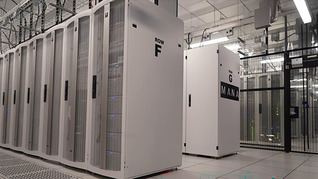
2000 - First awards for Information Technology Research Initiative (Sept. 13)
In 2000, NSF awarded the first grants through a new $90 million initiative to advance fundamental research and innovative applications of information technology, from software development and scalable information infrastructure to human-computer interfaces and workforce development. The initiative expanded NSF's investment in long-term information technology research at a time when computing and networking were rapidly transforming American society.
|
|
|
|
|
|