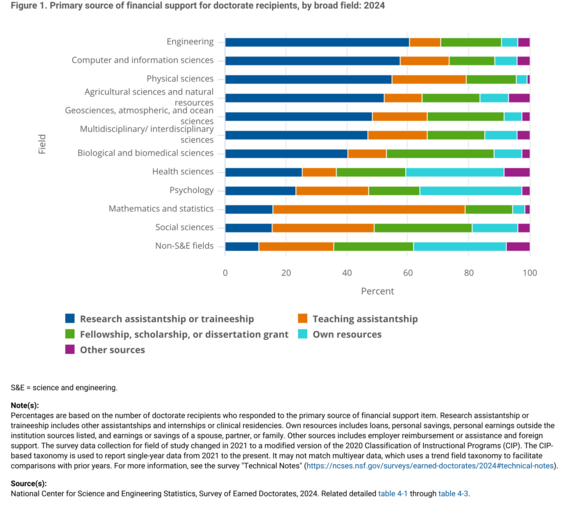
 The majority of doctorate recipients receive funding from research assistantships or traineeships; teaching assistantships; and fellowships, scholarships, or dissertation grants, but the primary financial support varies by broad field. In 2024, research assistantships or traineeships were the most prevalent primary source of financial support for doctorate recipients in most broad fields and particularly in engineering (61%); computer and information sciences (58%); physical sciences (55%); agricultural sciences and natural resources (52%); geosciences, atmospheric, and ocean sciences (49%); multidisciplinary/interdisciplinary sciences (47%); and biological and biomedical sciences (40%). Teaching assistantships were the most frequent primary funding in mathematics and statistics (63%) and social sciences (34%). About one-third of doctorate recipients in psychology (34%), health sciences (32%), and non-science and engineering fields (30%) reported that the most common primary funding was their own resources. The proportion of doctorate recipients reporting fellowships, scholarships, and dissertation grants ranged between 15% and 35% in each broad field.
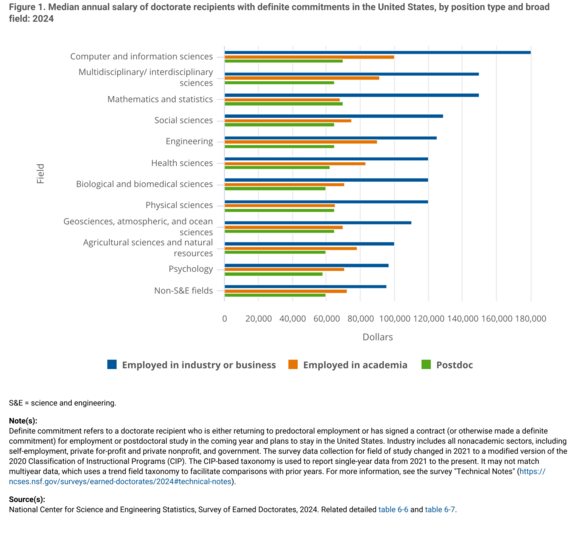 In 2024, doctorate recipients from U.S. institutions with definite commitments for employment or postdocs in the United States reported varied expected annual salaries. In every broad field, expected median salaries for doctorate recipients committing to non-postdoc employment in industry were higher than those committing to postdocs or to non-postdoc employment in the academic sector. In turn, expected median salaries were higher in non-postdoc employment in academia than in postdocs, except for the field of mathematics and statistics. In each category of employment, doctorate recipients in computer and information sciences had the highest expected median salaries. The range in expected median salaries across broad fields was the narrowest for postdoc positions, from $58,000 in psychology to $70,000 in computer and information sciences and in mathematics and statistics. The range was the widest in industry: expected median salary for computer and information sciences ($180,000) was nearly double the expected median salary in psychology ($97,000)—the lowest among science and engineering (S&E) fields—and non-S&E fields ($95,625).
|