|
|
Dear Polar community,
It’s hard to believe that it is already October! With the transition to fall in the U.S. we see the conclusion of the Arctic summer season and the start of the Antarctic field season. I am pleased to report that we had a very successful Arctic field season, which saw more than 100 science projects supported across the region. Unfortunately, there was a fire aboard USGCG Healy that cut short the planned summer cruises. Happily Healy is back on duty. The Summit Modernization and Recapitalization (SuMR) project is progressing well and was recently admitted into the NSF Major Facilities Design process. We’re very excited about the opportunities that will enable.
The Austral summer season is gearing up. The first flights have gone into McMurdo station, which will support more than 1,500 scientists and support staff across the continent over the coming season. Construction will continue around McMurdo Station, so please pay special attention to safety. The first cruises are underway to Palmer Station and flights to South Pole Station will start up soon. I want to thank the U.S. SCAR leadership and all of the researchers who engaged with us at the recent SCAR Open Science Conferences in Pucón, Chile. It was a great meeting! We enjoyed the chance to learn about progress in a wide range of research areas and to talk with so many members of the Antarctic science community. Thank you for the constructive and insightful conversations. We’re looking forward to the AGU meeting in December to continue those conversations and to engage with the Arctic science community.
Enjoy the OPP newsletter and have a safe and productive fall.
 Jean Cottam Allen
Acting Director, Office of Polar Programs
|
|
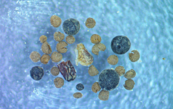
In 1966, drilling at Camp Century, Greenland, recovered 3.44 meters of sub-glacial material from beneath the ice. Despite the age of the ice core the sub-glacial material has not been well studied. NSF-funded researchers are changing that and using a multi-scale analysis to study the material, exposing the history of glaciated and deglaciated conditions in northwestern Greenland.
|
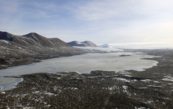
The McMurdo Dry Valleys, Antarctica experienced record high temperatures on March 18, 2022, exceeding average temperatures that day by nearly 30°C. This event is notable as it may be a harbinger of future climate conditions characterized by warmer temperatures and greater thaw in this region of Antarctica, which could influence the distribution, activity, and abundance of sentinel taxa. In their recent paper, NSF-funded researchers describe the ecosystem responses to this weather anomaly reporting on meteorological and hydrological measurements across the region and on later biological observations.
|
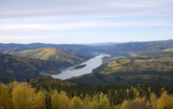
The continued, rapid warming of the Arctic threatens to destabilize mercury deposits contained within soils in permafrost regions. However, current estimates of the amount of mercury in soil vary drastically and how it will be released into the environment remains unknown. Using riverbank and floodplain sediments, NSF-funded researchers present new measurements of mercury content in permafrost in the Yukon River Basin in Alaska.
|
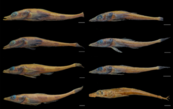
A new species of Antarctic dragonfish, Akarotaxis gouldae or Banded Dragonfish, has been discovered in waters off the western Antarctic Peninsula by NSF-funded researchers from William & Mary's Virginia Institute of Marine Science. The species, named in honor of the Antarctic Research and Supply Vessel Laurence M. Gould and its crew, exemplifies both the unknown biodiversity and fragile state of the Antarctic ecosystem.
|
Have an NSF-supported research highlight to share? Contact us.
Opinions, findings or recommendations of NSF awardees or their institutions do not necessarily reflect the views of the National Science Foundation.
|
|
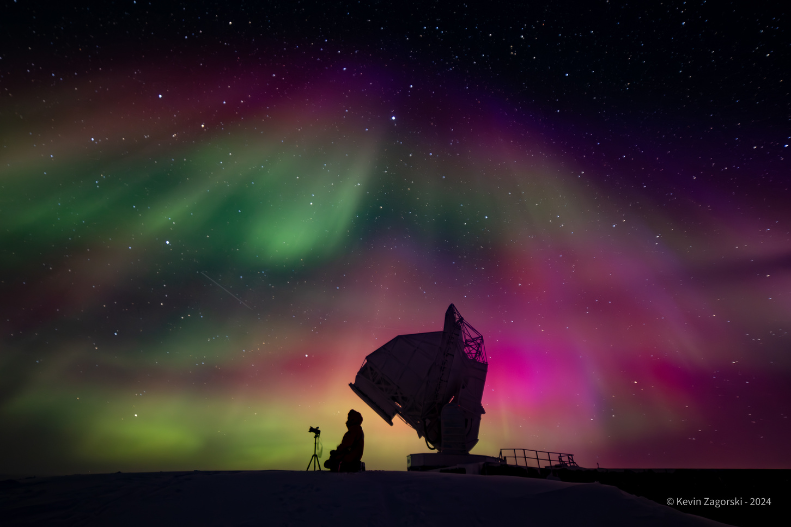 NSF South Pole Station winterover Joshua Veitch-Michaelis takes a photo of auroras with the South Pole Telescope in the background.
Photo Credit: Kevin Zagorski
|
|
OPP sections
Antarctic Infrastructure and Logistics (AIL)
AILs mission is to provide the operational and logistical platform necessary for the U.S. to conduct world-class science in Antarctica and maintain its active and influential presence on the continent.
Antarctic Sciences (ANT)
ANT supports cutting-edge research across all scientific fields that expands fundamental knowledge of Antarctic systems and processes; improves understanding of the interactions between the Antarctic region and global systems; and uses the unique characteristics of Antarctica as a science observing platform. ANT supports non-fieldwork-based analysis and modeling projects as well as Antarctic fieldwork for research that must be performed, or is best performed, in Antarctica.
Arctic Sciences (ARC)
ARC supports fundamental research at the forefront of understanding the Arctic, including its human and natural components and its global linkages. The section also works to develop and encourage good Arctic stewardship through education, training, dialogue, and planning. In addition to its scientific programs, ARC also includes a Research Support & Logistics program that improves the efficiency and safety of our research community.
|
|
Front Office Integration Team (FIT)
FIT supports the innovative scientific research, engineering, and education taking place in and about the polar regions. FIT provides administrative, policy, and communications support to the entire polar program, and ensures that research and related activities in the regions are environmentally sound.
Safety and Occupational Health (SOH)
SOH facilitates a culture of safety and health in support of research throughout the Polar regions. The protection of life and property are fostered through a coordinated risk-based approach with all stakeholders. Industrial hygiene and safety activities include research and project safety evaluations, incident reviews and investigations, and field assessments. Oversight of the occupational health and medical system contributes to deployment public health. All of these activities lead to continuous improvement initiatives.
Environmental Team (ENV)
ENV manages the Environmental Impact Assessment process for all U.S. Government activities in Antarctica, protects Antarctica’s unique environments through the administration of a permitting system, and participates in the consensus-based decision-making on the management of the Antarctic environment through the Antarctic Treaty’s Committee for Environmental Protection.
|
|
|
|
|