|
|
A newsletter from the NSF Division of Materials Research | July 2024
|
|
|
Dear Colleagues,
I have been reminded over and over recently how well collaborations serve our scientific community and that DMR is exceedingly fortunate in having dedicated partners in the federal government, academia, and industry who share our passion for materials research and commitment to the materials community.
This fiscal year, we saw our newest federal partner on the NSF INTERN program, the U.S. Army Combat Capabilities Development Command (DEVCOM), invite NSF-funded students, including some supported by DMR, into their labs for non-academic research experiences.
In May, we saw thirteen federal agencies come together for the DMR-led Polymers Interagency Meeting to facilitate dialogue and cooperation among federal agencies on polymer science and activities involving polymeric materials.
And just a few weeks ago, we saw more than 80 representatives of government agencies, academia, and industry gather at a DMR-organized workshop to take a census of the existing autonomous materials innovation infrastructure capable of accelerating materials experimentation and identify gaps in the instrumentation landscape.
I look forward to the positive outcomes of these collaborations for our community!
As we in DMR work to serve our community, we are grateful to have partners who share our commitment.
Germano Iannacchione
Division Director
NSF Division of Materials Research
|
|
2024 Polymers Interagency Meeting
On May 6 and 7, NSF hosted the 2024 Interagency Meeting on Polymers led by DMR Polymers Program Director Andy Lovinger. The meeting was one in a series of periodic meetings of federal officials involved in polymer-related activities. This spring's meeting brought together nearly fifty participants from thirteen agencies. Following a plenary presentation on CHIPS for America, the two-day meeting comprised presentations and discussions on the current state of polymer research and polymer-related activities across federal agencies, as well as panel discussions on sustainability and circular economy, data/artificial intelligence/machine learning, and infrastructure/instrumentation. Previous Polymers meetings have resulted in three major interagency-sponsored decadal workshops across polymer science and engineering.
On June 10 and 11, Program Director Cosima Boswell-Koller, co-chair of the Materials Genome Initiative (MGI) Autonomous Materials Innovation Infrastructure Interagency Working Group, hosted a workshop at NSF titled “Accelerating Materials Solutions to Meet National and Global Challenges” for more than 80 representatives of academia, industry, and the U.S. government in support of the MGI Strategic Plan released in 2021. The resulting workshop report will serve as an action plan for the implementation of the first two goals of the 2021 MGI Strategic Plan and outcomes of the workshop will be discussed at the upcoming MGI PI Meeting on July 30 and 31.
|
|
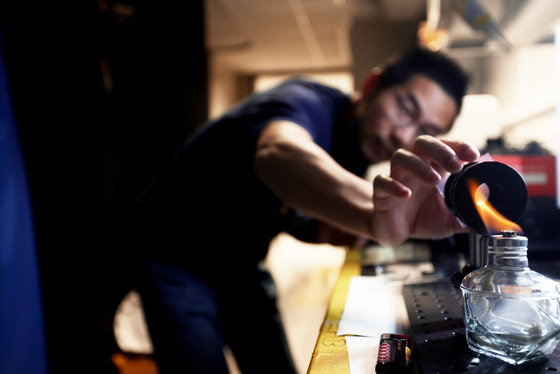 Measurements of polarization rotation in Nano-achiral complex composites for high temperature polarization optics. Photo Credit: Brenda Ahern
A team of scientists from the University of Michigan, Air Force Research Laboratory, and University of Sao Carlos in Brazil has shown how to create tough and strong nanocomposites with record-high polarization rotation that operate at temperatures exceeding 250º C.
A group at University of Houston have offered new insights into the reaction between solute and kinks in crystal growth. The team has identified a two-reaction process occurring when a solute molecule binds to a kink and posit that an intermediate state between these processes may influence crystallization.
The 2024 CHESS User Meeting held on June 5 and 6 attracted over 150 attendees who shared scientific talks, facility updates, awards, and a vibrant poster session. These sessions underscored the cutting-edge research and technological advancements happening at CHESS, fostering a deeper connection within the community of users including the Center for High Energy X-ray Science (CHEXS) funded by the NSF Directorates of Biology, Engineering, and Mathematics and Physical Sciences.
NSF's Partnerships for Research and Education in Materials program supports new pathways enabling students to pursue science addressing real-world needs of the Navajo community.
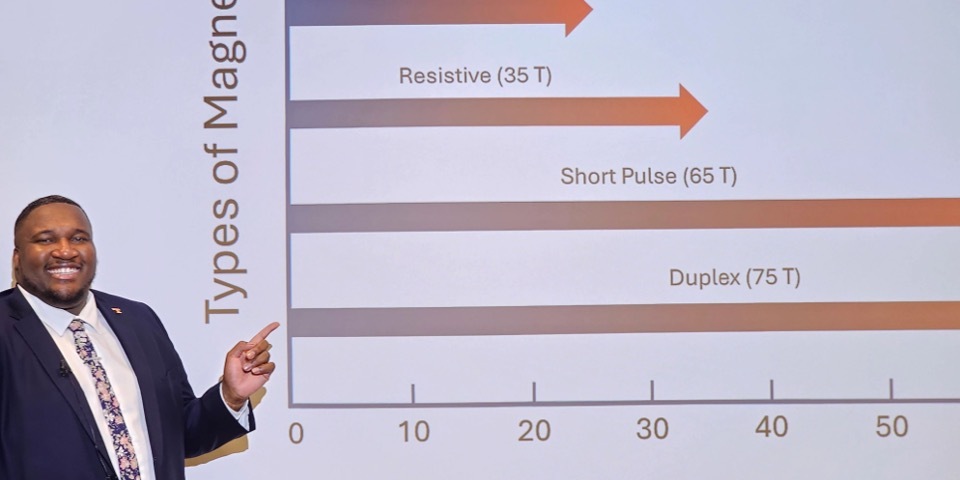 Picture from the dissertation defense of Avery Blockmon from the University of Tennessee. His thesis was entitled "Molecule-based quantum materials under extreme conditions." Photo Credit: Avery Blockmon
Congratulations to our 2024 AGEP-GRS graduates!
The MPS AGEP-GRS supplement provides a mechanism for current MPS research awardees to engage additional students in ongoing MPS-funded research projects. Congratulations to all of this year's AGEP-GRS-supported doctoral recipients, like Dr. Avery Blockmon, from the lab of Janice Musfeldt at the University of Tennessee, who successfully defended his dissertation on “Molecule-based quantum materials under extreme conditions” this spring and will soon be starting a new position at Argonne National Lab!
|
|
Opinions, findings or recommendations of NSF awardees or their institutions do not necessarily reflect the views of the National Science Foundation. |
|
DMR Solicitations
Supports fundamental materials research and education in the following areas: biomaterials, ceramics, condensed matter physics, electronic and photonic materials, metals and metallic nanostructures, polymers, and solid state and materials chemistry.
Supports fundamental research and education on hard and soft materials and related phenomena; the development of associated analytical, computational and data-centric techniques; and predictive materials-specific theory, simulation and modeling.
Other NSF Opportunities
Supports early-career faculty who have the potential to serve as academic role models in research and education and to lead advances in the mission of their department or organization.
Supports projects that harness computation and data to advance knowledge and accelerate discovery above and beyond the goals of the participating individual programs.
Seeks to enable funding opportunities that are flexible and responsive to the evolving and emerging needs in cyberinfrastructure (CI). The program continues to emphasize integrated CI services, quantitative metrics with targets for delivery and usage of these services, and community creation.
Supports foundational and transformative research to advance the design, engineering and fabrication of organoid systems that are capable of processing information dynamically while interfacing with non-living systems.
Supports the research of pre-tenure faculty in mathematical and physical sciences, with an emphasis on those at institutions that traditionally do not receive significant NSF funding, such as minority-serving, predominantly undergraduate or R2 institutions.
Supports postdoctoral fellows performing impactful research in MPS fields while broadening the participation of groups that are underrepresented in the mathematical and physical sciences.
Dear Colleague Letters
Announces the scientific focus of the next round of the Global Centers Program—Bioeconomy.
Encourages proposals focused on developing novel approaches to climate change mitigation and adaptation.
Inviting requests which foster interest in the pursuit of studies in the Mathematical and Physical Sciences; and broaden participation of high school students who are in groups that have been traditionally underrepresented and under-served in STEM fields.
Invites collaboration between U.S. and Indian research communities in semiconductor research, next generation communication systems, cyber-security, sustainability and green technologies, and intelligent transportation systems.
|
|
|
Appointment Type: Temporary / Rotator
The National Facilities program supports the operation of national user facilities: National Facilities are research facilities with specialized instrumentation available to the scientific research community, in general, and the materials research community in particular.
Appointment Type: Temporary / Rotator
The Condensed Matter Physics (CMP) Program supports research and education in the investigation of the fundamental physics underlying condensed matter systems.
|
|
|
DMR wishes to welcome Christopher Ober of the Cornell University Department of Materials Science and Engineering. Chris will be serving as Program Director for Polymers. Welcome, Chris!
|
|
DMR Programs
Nitsa Rosenzweig
Dan Savin
Nazanin Bassiri-Gharb
Daryl Hess
Robert Hoy
Alex Klironomos
Mun Chan
Tomasz Durakiewicz
Elizabeth Mann
Mohsen Asle Zaeem
Eugenia Kharlampieva
John Schlueter
Yaroslav Koshka
Paul Lane
|
|
Jonathan Madison
Cosima Boswell-Koller
Serdar Ogut
Cosima Boswell-Koller
Souleymane Omar Diallo
Leonard Spinu
Guebre X Tessema
Charles Ying
Andrew Lovinger
Christopher Ober
Debasis Majumdar
Shadi Mamaghani
Robert Meulenberg
Birgit Schwenzer
Division Director
Germano Iannacchione
Acting Deputy Division Director
Miriam Deutsch
|
|
|
|
|