|
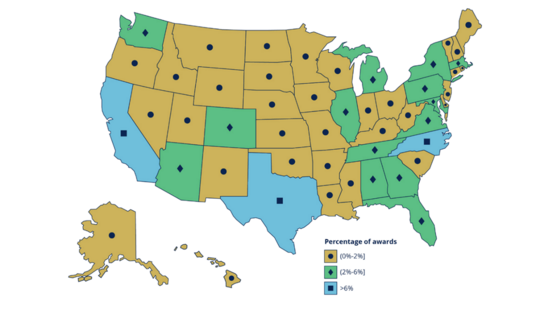
The U.S. National Science Foundation's (NSF’s) Evaluation and Assessment Capability section (EAC) recently published the report, Evaluation of NSF Grants to Broaden Participation in STEM: American Innovation and Competitiveness Act Section 305. Under Section 305 of the American Innovation and Competitiveness Act (AICA), Public Law 114–329, NSF is required to report on NSF activities designed to broaden participation of underrepresented populations in science, technology, engineering, and mathematics (STEM) fields. Between fiscal years (FYs) 2017 and 2022, NSF awarded over 3,200 grants through NSF programs focused on broadening participation (BP) in STEM. This report describes the geographic distribution of grants awarded under AICA, discusses the characteristics of lead principal investigators and institutions receiving awards, and reviews program-level evaluations.
Percentage of Total (Cumulative) Broadening Participation-focused Program Awards by State, FY 2017 – FY2022
 Key findings from the report include:
- BP-focused programs expanded and awarded over $3 billion from FY 2017 to FY 2022.
- Entities from all U.S. states, the District of Columbia, and three U.S. territories received at least one BP-focused program award between FY 2017 and FY 2022.
- Minority-Serving Institutions (MSIs) received 56 percent of awards between FY 2017 and FY 2022.
- Lead PIs receiving an award from a BP-focused program between FY 2017 and FY 2022 were collectively more diverse compared with the STEM workforce in 2021.
The report also includes summaries of program-level evaluations that highlight the successes and challenges faced in broadening participation and other outcomes for a subset of five BP-focused programs. Learn more about NSF’s Broadening Participation in STEM activities.
About the Evaluation and Assessment Capability (EAC) Team: EAC studies NSF programs and activities and their impact on the people who participate in and benefit from NSF investments. EAC also provides centralized resources and guidance for data collection, analysis, evaluation design, surveys, and enterprise analytics.
|