|
|
Dear Polar community,
I am delighted to be writing my first newsletter introduction as the Acting Director of the Office of Polar Programs. I have worked closely with OPP on astrophysics projects both in the Arctic and Antarctica over many years in my positions in the Division of Physics in NSF's Directorate for Mathematical and Physics Sciences. Now, I’m thrilled to be "on the inside" of OPP, leading a remarkable team that supports extraordinary science. I look forward to getting to know the polar science community and working together to continue the extraordinary work. I want to extend my thanks to Dr. Jim Ulvestad who retired in February after serving as the Acting Office Director for the past year and after a long and successful career with NSF.
Since our last OPP Newsletter, we completed the 2023-2024 Antarctic field season. I want to extend my thanks to everyone who worked so hard to make it a successful season. At the opposite pole, planning is underway for an ambitious Arctic season. It's amazing to see the diversity of great science being done in both locations. The International Thwaites Glacier Consortium successfully completed its 5th and final field season in Antarctica. The NASA long-duration balloon (LDB) GUSTO mission in Antarctica landed safely after a record-breaking 57-day flight. In Greenland coordination is underway for the second field season of the GreenDrill Project, which is studying the history of the Greenland Ice Sheet. Of course, there are many more science stories across the polar community, some of which can be found in the highlights below.
Please enjoy this newsletter, which includes recent announcements on the latest activities and planning in OPP. More information is on the OPP website. As always, please reach out. We welcome your stories and your questions.
 Jean Cottam Allen
Acting Director, Office of Polar Programs
|
|
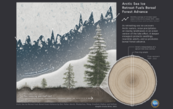
The Arctic continues to warm faster than the global average. As a result, the region is seeing melting ice and increased tree cover. NSF-funded research has linked tree line advances to decline in Arctic Ocean sea ice. Using a combination of field and remote sensing data from northern Alaska, the researchers found that distance to sea ice predicted tree growth and recruitment, as well as the probability of forest advance.
|
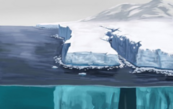
The Antarctic ice sheet is complex, supported by floating ice shelves that calve icebergs along large fractures called rifts. However, the scarcity of observations of rift propagation contributes considerable uncertainty to understanding rift dynamics. In this publication, NSF-funded researchers report the first-ever seismic recording of a multiple-kilometer rift propagation event. Remote sensing and seismic recordings reveal that a rift in the Pine Island Glacier Ice Shelf extended 10.53 km at a speed of 35.1 m/s, the fastest known ice fracture at this scale.
|
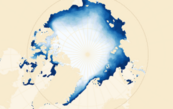
Anthropogenic warming in the Arctic is causing hydrological cycle intensification and permafrost thaw, with implications for flows of water, carbon, and energy from terrestrial biomes to coastal zones. NSF-funded researchers are working to better understand the impacts of these changes using models driven by data from atmospheric reanalysis and two global climate models for the period 1980–2100.
|
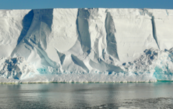
NSF-funded researchers are looking at the dynamics of the Ross Ice Shelf in Antarctica. Using seismographs and Global Navigation Satellite System, data has recorded guided elastic plate waves traveling in the ice as well as permanent displacement of the ice shelf. During the passage of the elastic waves, the entire ice shelf with an area of 500,000 square kilometers is displaced about 60 mm in a direction away from the Whillans Ice Stream.
|
Have an NSF-supported research highlight to share? Contact us.
Opinions, findings or recommendations of NSF awardees or their institutions do not necessarily reflect the views of the National Science Foundation.
|
|
 Research Wins OSTP Award
The ELOKA project was selected for their work creating opportunities for Arctic communities to contribute to the research process.
 NSF Brand Identity
NSF's updated brand manual provides instructions on logo usage and co-branding requirements.
|
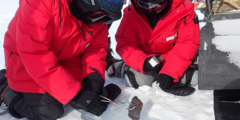 OPP's Latest Live Event
Did you miss our latest event about Antarctica Meteorites and the origin of our solar system? Check out a recording of the event.
 Arctic Stories
Explore interviews of native Arctic people, scientists, and people who live and work in the Arctic.
|
|
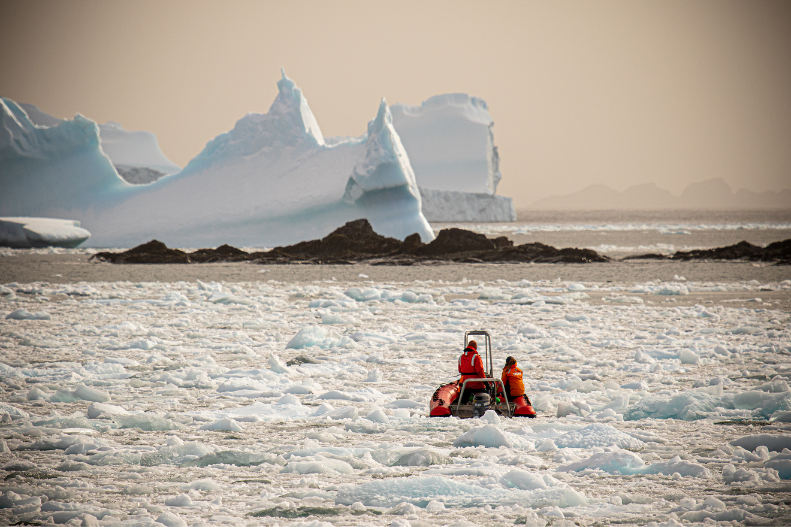 Science endures. Even as most science across Antarctica is hunkering down for the winter, scientists continue to head out from NSF Palmer Station for a long day of searching for humpback whales.
Photo Credit: Francis Sheil
|
|
OPP sections
Antarctic Infrastructure and Logistics (AIL)
AILs mission is to provide the operational and logistical platform necessary for the U.S. to conduct world-class science in Antarctica and maintain its active and influential presence on the continent.
Antarctic Sciences (ANT)
ANT supports cutting-edge research across all scientific fields that improves understanding of the interactions between the Antarctic region and global systems; expands fundamental knowledge of Antarctic systems and processes; and uses the unique characteristics of Antarctica as a science observing platform. ANT supports non-fieldwork-based analysis and modeling as well as Antarctic fieldwork for research that must be performed, or is best performed, in Antarctica.
Arctic Sciences (ARC)
ARC supports fundamental research at the forefront of understanding the Arctic, including its human and natural components and its global linkages. The section also works to develop and encourage good Arctic stewardship through education, training, dialogue, and planning. In addition to its scientific programs, ARC also includes a Research Support & Logistics program that improves the efficiency and safety of our research community.
|
|
Front Office Integration Team (FIT)
FIT supports the innovative scientific research, engineering, and education taking place in and about the polar regions. FIT provides administrative, policy, and communications support to the entire polar program, and ensures that research and related activities in the regions are environmentally sound.
Safety and Occupational Health (SOH)
SOH facilitates a culture of safety and health in support of research throughout the Polar regions. The protection of life and property are fostered through a coordinated risk-based approach with all stakeholders. Industrial hygiene and safety activities include research and project safety evaluations, incident reviews and investigations, and field assessments. Oversight of the occupational health and medical system contributes to deployment public health. All of these activities lead to continuous improvement initiatives.
|
|
|
|
|