|
Elementary and Secondary STEM Education
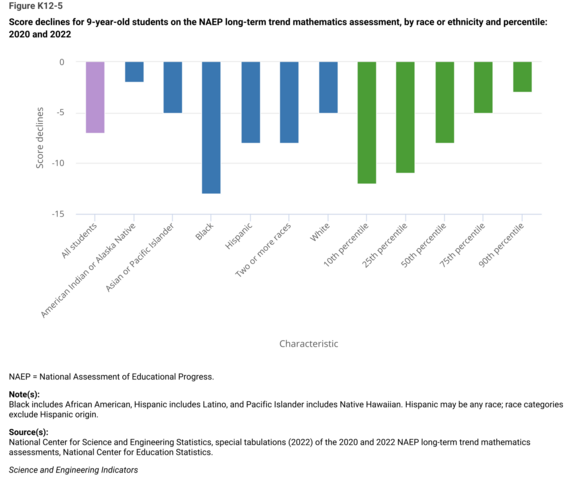
A national mathematics assessment in 2022 captured the largest decline in scores for 9-year-olds over the past 44 years, with disproportionate drops for students who are Black, Hispanic, from low-income families, or already scoring in the lowest 10th percentile.
These and other trends are in the Elementary and Secondary STEM Education report that the National Science Board published today as part of the 2024 congressionally mandated Science and Engineering Indicators suite of products on the state of the U.S. science and engineering enterprise. The reports are prepared by the National Science Foundation’s National Center for Science and Engineering Statistics under the Board’s guidance.
 Elementary and Secondary STEM Education is the second of 10 Science and Engineering Indicators reports that the NSB will publish over the coming months through spring of 2024.
|
|
NATIONAL SCIENCE BOARD
The National Science Foundation Act of 1950 charged the National Science Board (NSB) with two roles: governing board of the NSF and advisor to Congress and the President on policy matters related to STEM research and STEM education. Selected for their distinguished service and accomplishments in academia, government, and the private sector, the Board’s 24 presidentially appointed members are leaders in STEM research and education.
|
|
NATIONAL CENTER FOR SCIENCE AND ENGINEERING STATISTICS
The National Center for Science and Engineering Statistics (NCSES), within the National Science Foundation, is the nation's leading provider of statistical data on the U.S. science and engineering enterprise. As a principal federal statistical agency, NCSES serves as a clearinghouse for the collection, interpretation, analysis, and dissemination of objective science and engineering data.
|
|
|
|