| |
|
Dear Polar community,
There’s never a dull moment when you’re operating year-round in both polar regions! NSF is in the midst of ramping up the Antarctic field season with our Main Body deployment to the Antarctic continent. Simultaneously, Summit Station in Greenland is transitioning to winter operations.
We have seen success thus far with the new COVID protocols in place for the current Antarctic deployments, and are working closely with the medical team in response to changing CDC guidance and the approval of a new vaccine formulation. In addition, we have just received final approval of a new electronic system for managing Physical Qualification information following a successful testing period.
Last week, the National Academies (NASEM) released their report on the Future Directions for Southern Ocean and Antarctic Nearshore and Coastal Research. Discussions with the NASEM committee have already been useful in developing the concept for a next-generation Antarctic Research Vessel to maximize community science opportunities in the most cost-effective manner.
Speaking of research vessels, the icebreaking U.S. Coast Guard vessel Healy, carrying NSF-funded researchers, recently completed a successful mission servicing subsurface mooring arrays in the Arctic Ocean north of Russia.
NSF has been aggressively responding to concerns raised in last year’s Sexual Assault/Harassment Prevention and Response (SAHPR) report. We added reporting requirements for contractors and subcontractors, formed a SAHPR Incident Response Team, and developed new reporting and support mechanisms for community members. See the separate news item from the SAHPR Program Office. Also, thanks for your patience as the USAP Sexual Assault and Harassment Climate Survey is being finalized. We are still awaiting final approval for survey distribution and will keep the USAP community updated on the release date. We look forward to the survey participation of our deployers and sharing the findings with the community.
The NSF Office of the Inspector General (OIG) will be conducting two site visits to McMurdo in the coming month. An OIG Audit Inspection Team will look at USAP occupational health and safety, October 25 - November 2. An OIG Investigative Team will conduct a site visit November 6-17. Their principal focus will be laying the groundwork for OIG’s new responsibilities regarding sexual assault, stalking, and other criminal matters that fall within their investigative jurisdiction.
Finally, over the past few months, we have welcomed many new faces to OPP. Be sure to check out the staffing updates below.

James Ulvestad
Acting Director, Office of Polar Programs
|
|
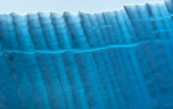
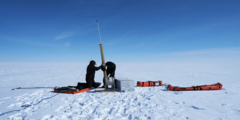
Projections of sea-level rise are impacted by the feedback between ice melt, glacier flow, and ocean circulation. However, most of these projections neglect to consider that glacier ice contains pressurized bubbles of air created during formation. NSF-funded researchers used laboratory-scale experiments and theory to show how the bursting of pressurized bubbles from glacier ice could be a source of discrepancy between models and observations.
|
NSF-funded researchers have discovered the most distant, dynamically relaxed cool core cluster. Using multiwavelength imaging and spectral observations, the researchers demonstrated that this system consists of a strongly cooling X-ray core. The extreme cooling and SFR of SPT2215 are rare among known cool core clusters, and the researchers note it is remarkable to observe these at such high redshift, when most clusters are still dynamically disturbed.
|
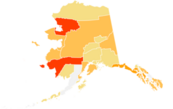
Vaccine hesitancy continues to be a barrier to levels of COVID-19 vaccination. NSF-funded researchers explored the decision-making among 58 adults living in remote Alaska based on three waves of online surveys and follow-up semi-structured interviews. The results showed that having a sense of agency appears to be important to interviewee decision-making, regardless of vaccination status and intention.
|
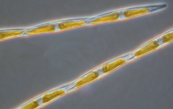
Photosynthetic carbon fixation by phytoplankton in the Southern Ocean plays a critical role in regulating air-sea exchange of carbon dioxide, and as a result, has an impact on global climate. However, in the Southern Ocean photosynthesis can be constrained by low iron, low temperatures, and low light intensities. NSF-funded researchers studied proton-pumping rhodopsins in marine phytoplankton in the Southern Ocean, a compound that provides an alternate iron-free, light-driven source of cellular energy.
|
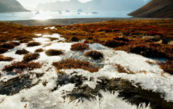
Snow is a critical component of northern ecosystems. However, climate change is decreasing the duration of the snow cover period in the Arctic, while the amount of snow falling has been increasing. Researchers are not clear how more snow will affect Arctic ecosystems, specifically greenhouse gas emissions from thawing permafrost. NSF-funded researchers found that more snow thawed permafrost and led to a four-fold increase in the amount of organic matter available for microbial decomposition.
|
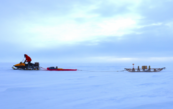
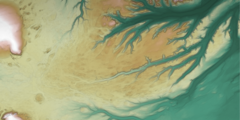
At Hercules Dome, Antarctica, NSF-funded researchers used three-dimensional radar technology to image the upstream origin of large subglacial basins that drain ice from the Antarctic interior into West Antarctic ice streams. The imaging revealed an ancient, alpine landscape with hanging tributary valleys and large U-shaped valleys.
|
Have an NSF-supported research highlight to share? Contact us.
Opinions, findings or recommendations of NSF awardees or their institutions do not necessarily reflect the views of the National Science Foundation.
|
|
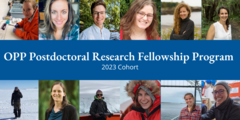
Meet the New PRF Cohort
OPP welcomes the 2023 cohort of the Postdoctoral Research Fellowship program.
New SAHPR Webpage
NSF has launched a new set of webpages outlining NSF resources and policies regarding sexual assault and harassment, including USAP-specific resources.
Antarctic Meteorological Data
The Antarctic Meteorological Research and Data Center Repository has been named the official meteorological data repository for the USAP.
|
|
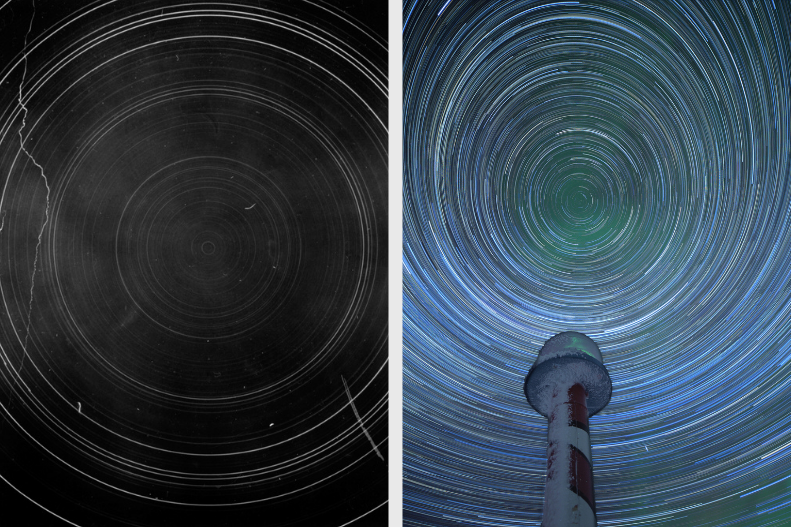
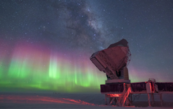
What a difference 66 years makes! These two time-lapse images of the night sky over the South Pole are as different as, night and...night. The photo to the left was taken in 1957, while the one on the right is from 2023.
Photo Credits: Paul Siple (left) and Kyle Ferguson (right)
|
|
OPP sections
Antarctic Infrastructure and Logistics (AIL)
AILs mission is to provide the operational and logistical platform necessary for the U.S. to conduct world-class science in Antarctica and maintain its active and influential presence on the continent.
Antarctic Sciences (ANT)
ANT supports cutting-edge research across all scientific fields that improves understanding of the interactions between the Antarctic region and global systems; expands fundamental knowledge of Antarctic systems and processes; and uses the unique characteristics of Antarctica as a science observing platform. ANT supports non-fieldwork-based analysis and modeling as well as Antarctic fieldwork for research that must be performed, or is best performed, in Antarctica.
Arctic Sciences (ARC)
ARC supports fundamental research at the forefront of understanding the Arctic, including its human and natural components and its global linkages. The section also works to develop and encourage good Arctic stewardship through education, training, dialogue, and planning. In addition to its scientific programs, ARC also includes a Research Support & Logistics program that improves the efficiency and safety of our research community.
|
|
Front Office Integration Team (FIT)
FIT supports the innovative scientific research, engineering, and education taking place in and about the polar regions. FIT provides administrative, policy, and communications support to the entire polar program, and ensures that research and related activities in the regions are environmentally sound.
Safety and Occupational Health (SOH)
SOH facilitates a culture of safety and health in support of research throughout the Polar regions. The protection of life and property are fostered through a coordinated risk-based approach with all stakeholders. Industrial hygiene and safety activities include research and project safety evaluations, incident reviews and investigations, and field assessments. Oversight of the occupational health and medical system contributes to deployment public health. All of these activities lead to continuous improvement initiatives.
|
|
|
|
|