|
|
Dear Polar Science Community,
It has been an honor and a privilege to return to NSF as the Director of Polar Programs! With the conclusion of my term on 1 February, I will return to Oregon State University’s (incredible!) College of Earth, Ocean, and Atmospheric Sciences. I leave OPP in the good hands of Dr. Jim Ulvestad, an accomplished NSF leader and facilities champion. As he notes below, Jim shares an appreciation for the opportunities and challenges of working in polar regions, and the criticality of high latitude science for our nation and our future. I am deeply grateful to, and inspired by, the entire OPP family, a high performing team. Their steadfast determination to support OPP’s mission, to sharpen our focus on diversifying the polar research community, and to create a safe and supportive research environment, is unwavering.
Alla prosima!
Roberta Marinelli
Outgoing Director, OPP
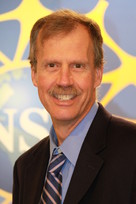
Dear all,
I’m writing to convey my greetings to the polar science community and to the many NSF partners in the ambitious program that we carry out in Antarctica and the Arctic. First, allow me to thank Roberta Marinelli for her stalwart leadership during her 18 months of service to NSF and to the community. It has been a challenging time for polar activities, and the community owes a debt of gratitude to Roberta for her efforts.
Although I have not carried out polar science programs myself, my engagement in NSF research infrastructure has given me considerable familiarity with the challenges associated with maintaining programs in remote locations. I am delighted to have the opportunity to work with the extremely capable NSF team in the Office of Polar Programs as they contribute to a bright and sustainable future for the polar science community, local Arctic communities, and our many interagency and international partners.
Sincerely,
Jim Ulvestad
Incoming Director, OPP
|
|
|
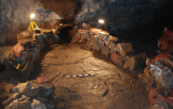
NSF-funded researchers have found orpiment, a rare mineral used as a pigment in the ancient world, in Iceland. Not occurring naturally in the area, the orpiment was discovered in a Viking-era structure inside Surtshellir cave. The discovery is also the third time orpiment has been identified in the Viking world, joining the tomb of Denmark's King Gorm and the Gokstad ship burial. Furthermore, the presence of orpiment represents the farthest-known occurrence of the mineral.
|
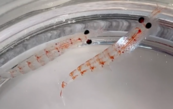
The survival mechanisms of Antarctic krill over the winter are poorly understood, especially for juveniles. NSF-funded researchers have examined the overwinter strategies of juvenile krill and how their reproductive development changes when energy input exceeds what is necessary for survival. From May to September 2019, researchers conducted lab experiments, representing different environmental conditions krill may experience in the Western Antarctic Peninsula during the fall and winter. Results suggest that juvenile female krill experience a trade-off between early reproductive development and condition.
|
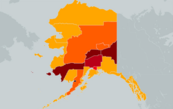
Indigenous communities worldwide are at higher risk of negative pandemic outcomes, and communities Indigenous to the Arctic are disproportionately affected compared to national majorities. NSF-funded researchers collected and analyzed interviews in three southeast Alaska island communities to learn about perceptions and experiences with the COVID-19 pandemic.
|
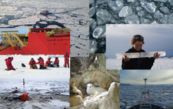
Understanding past, present, and future changes in Arctic and Antarctic sea ice is crucial to understanding a wide range of interconnected impacts. In the special issue of Past Global Changes Magazine, researchers describe novel proxies and reconstructions of sea ice at a range of timescales from both poles, highlighting some state-of-the-art knowledge in this field.
|
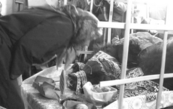
Human-wildlife interactions remain a complex interaction between conservation regimes and government relations with Indigenous practices. Current models of HWI are being reevaluated to better understand how humans and animals, including large carnivores, have learned to coexist. NSF-funded researchers have used interviews and Indigenous songs texts to describe the unique character of human-bear interactions among the elder generation of Siberian Khanty of Siberia.
|
Have an NSF-supported research highlight to share? Contact us.
Opinions, findings or recommendations of NSF awardees or their institutions do not necessarily reflect the views of the National Science Foundation.
|
|
 History of South Pole Stations
Learn about the four 'Stations' that have been erected at the bottom of the earth. Make sure to download the poster and postcards today.
 Science on the Ice
The fifth edition of Science on the Ice has been released, providing a broad introduction to U.S. research and operations in Antarctica.
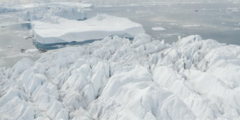 GreenDrill Breaks the Ice
If just 10% of Greenland's ice sheet melted, sea level rise would be catastrophic. Columbia University's GreenDrill is working to learn more.
|
|
R/V Sikuliaq at Sunset
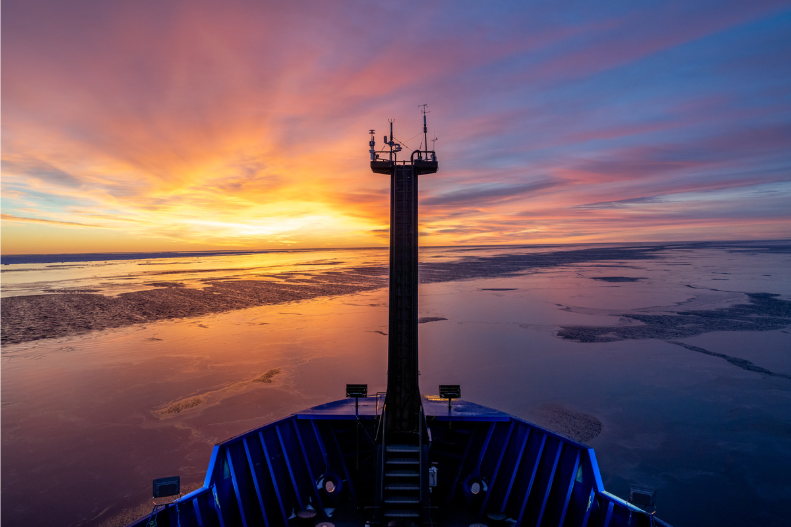 During November, R/V Sikuliaq traveled across the Arctic to conduct a rare late-autumn survey of the Beaufort shelf during freeze-up. Sampling in frigid conditions has provided a unique view of the formation of cold winter water. Learn more about the cruise from community observer Lloyd Pikok.
Photo Credit: Amanda Kowalski
|
|
OPP sections
Antarctic Infrastructure and Logistics (AIL)
AILs mission is to provide the operational and logistical platform necessary for the U.S. to conduct world-class science in Antarctica and maintain its active and influential presence on the continent.
Antarctic Sciences (ANT)
ANT supports cutting-edge research across all scientific fields that improves understanding of the interactions between the Antarctic region and global systems; expands fundamental knowledge of Antarctic systems and processes; and uses the unique characteristics of Antarctica as a science observing platform. ANT supports non-fieldwork-based analysis and modeling as well as Antarctic fieldwork for research that must be performed, or is best performed, in Antarctica.
Arctic Sciences (ARC)
ARC supports fundamental research at the forefront of understanding the Arctic, including its human and natural components and its global linkages. The section also works to develop and encourage good Arctic stewardship through education, training, dialogue, and planning. In addition to its scientific programs, ARC also includes a Research Support & Logistics program that improves the efficiency and safety of our research community.
|
|
Front Office Integration Team (FIT)
FIT supports the innovative scientific research, engineering, and education taking place in and about the polar regions. FIT provides administrative, policy, and communications support to the entire polar program, and ensures that research and related activities in the regions are environmentally sound.
Safety and Occupational Health (SOH)
SOH facilitates a culture of safety throughout the Polar regions to enhance the success of science by protecting life and property. SOH partners with stakeholders and integrates an effective risk management system through policy development, process and project plan evaluations, incident review and investigations, site safety evaluations, and a deployment medical system implementation.
Polar Programs Advisory Committee (AC)
The AC provides advice and recommendations to the NSF concerning polar research, education, infrastructure and logistics, and activities. Additionally, the AC Sub-Committee on Diversity and Inclusion has been tasked to identify, examine and recommend strategies to pursue enhanced diversity and inclusion in the polar sciences in both the near and long term.
|
|
|
|
|