 A message from the TIP directorate’s leadership
Welcome to the inaugural quarterly newsletter of the U.S. National Science Foundation’s (NSF’s) newly established Directorate for Technology, Innovation and Partnerships (TIP). Through this medium, we intend to share updates about our existing investments, new initiatives including specific funding opportunities, convenings and other events, job opportunities and more. We hope you will find these updates helpful and extend to your colleagues our invitation to join this mailing!
As you may know, NSF was pleased to establish TIP, the agency’s first new directorate in more than three decades, earlier this year. The establishment of TIP is a once-in-a-generation opportunity: we will strive to accelerate the pace of innovation and translation in emerging technologies, address the pivotal societal and economic challenges of our time, and engage the diverse talent that exists in our country. Working collaboratively with the rest of the Foundation, other federal agencies, state, local, and tribal governments, academics, the private sector, nonprofits, civil society, and investors, TIP will ensure the nation remains in the vanguard of competitiveness for decades to come.
And this week was just as momentous for us: President Biden signed into law the bipartisan CHIPS and Science Act of 2022, which officially authorizes the TIP directorate and a number of our investments, including the NSF Regional Innovation Engines program (see below for details on that effort).
We invite you all to join us as we embark on this new adventure – we stand on the cusp of a transformational moment for NSF, for the science, engineering and education enterprise that we serve, and for the nation. But ultimately, our ability to advance use-inspired and translational research will rest on the depth and persistence of your engagement; this endeavor requires all of us – researchers, practitioners, technicians, educators, entrepreneurs, and students – to iteratively co-design and co-create the new technologies and solutions of tomorrow.
Below you will find a snapshot of TIP’s newest efforts, including new funding programs and prize challenges, as we ramp up our efforts to engage across sectors and regions to accelerate use-inspired research and innovation. And please stay tuned – we look forward to sharing several exciting new announcements in the fall!
Lastly, if you have feedback – about the mission and vision for TIP, about our programs, or about our communications including this newsletter, please do reach out to us directly!
Erwin Gianchandani
NSF Assistant Director for Technology, Innovation and Partnerships
Gracie Narcho
NSF Deputy Assistant Director for Technology, Innovation and Partnerships
We’re hiring!
TIP Program Updates
NSF Engines: Explore data and collaborate with proposers across the U.S.
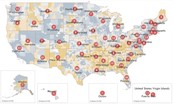
The NSF Regional Innovation Engines, or NSF Engines, program published nearly 700 concept outlines spanning all 50 states and four U.S. territories on an interactive map and collaboration tool. The published concept outlines represent all the regional teams that are advancing to the next step as outlined in the program's funding opportunity.
Advancing regional teams were invited to a virtual NSF Engines Proposers Day, held on August 1, 2022, that prepared and equipped more than 2,700 team members to develop compelling proposals. Recordings for several NSF Engines outreach events can be watched online.
If you are a part of a regional team, and especially if you are not (!), please check out the Concept Outlines Explorer to find potential partners and identify opportunities for enhancing regional innovation ecosystems throughout the country.
|
New funding opportunity for open-source ecosystem development
NSF’s Pathways to enable Open-Source Ecosystems, or POSE, program offers researchers with the resourcing and training to build open-source ecosystems (OSE) around their innovative research artifacts, be it software, hardware, models, data platforms, tools, and the like. This program illustrates a key goal for TIP, i.e., to build out new translational pathways allowing researchers to take their results to societal benefit broadly. NSF welcomes Phase II proposals to POSE by October 22, 2022. Each Phase II project will receive up to $1.5 million in POSE Phase II program funding for up to two years to establish a sustainable and robust OSE.
|
TIP + the Eddie Bernice Johnson NSF INCLUDES initiative
Through the Eddie Bernice Johnson NSF INCLUDES Initiative, TIP encourages submission of a wide array of projects aimed at broadening participation in STEM innovation and entrepreneurship at regional and national scale – Design & Development Launch Pilots (up to $600,000); Collaborative Change Consortia (up to $5 million); Alliances (up to $10 million); Network Connectors (up to $500,000); and Conferences (up to $100,000). NSF INCLUDES supports projects designed around four key principles: Broadening Participation in STEM, Enabling Sustainable Change in Systems; Scaling Up Outcomes in Ways That Advance Equity; and Building Collaborative Infrastructure.
Privacy-Enhancing Technologies Prize Challenge
Are you interested in building privacy-preserving artificial intelligence (AI) solutions to tackle financial crime or improve pandemic responses? If so, compete in the Privacy Enhancing Technologies Prize Challenges that NSF has just launched in collaboration with the National Institute of Standards and Technology and the Government of the United Kingdom. Organizers are interested in efficient and usable federated learning solutions that provide end-to-end privacy and security protections while harnessing the potential of AI for overcoming significant global challenges. Phase 1 abstracts and team registrations are due in September. The prize challenges offer about $800,000 in prizes.
|
Happy 40th birthday to the SBIR program!
After a successful start at NSF in 1977 by then-Program Director Roland Tibbetts, the Small Business Innovation Research (SBIR) program went government-wide in 1982. Every year, NSF and 10 other Federal agencies with extramural research and development budgets exceeding $100 million give approximately $3.2 billion to more than 5,000 innovative small businesses to stimulate technological innovation and entrepreneurship by all people – all thanks to NSF’s initial idea!
In the early 1980s, NSF seed funded industry giants like Symantec, a leader in cybersecurity, and Qualcomm, a leader in wireless technology and 5G. More recently, NSF funding has helped launch startups revolutionizing alternative proteins, synthetic biology, COVID testing and more. NSF-funded startups and small businesses saw around 200 exits and more than $14 billion in private investments during fiscal years 2016 to 2021. These figures were pulled from Pitchbook from 10/01/2015 to 09/30/2021 and include companies that received NSF funding prior to 2016.
|
Outreach updates
Check out what’s new on I-Corps™ and PFI websites
TIP refreshed two program websites: NSF Innovation Corps, or I-Corps™, and Partnerships for Innovation, or PFI. The redesigned websites provide a user-friendly browsing experience on the new NSF website template. Visitors can easily navigate to access information about funding opportunities, resources and how to engage with NSF staff.
|