|
|
Dear all,
The ecological impacts of climate change are a central theme in this second edition of our newsletter. These reports, from both the Arctic and Antarctic, underscore the extraordinary sensitivity of polar ecosystems to warming and highlight the urgent need for understanding and action.
NSF continues to respond to the climate crisis with bold action. Earlier this month, six new Science and Technology Center Awards were announced, including several that are responsive to crucial gaps in climate data and models. COLDEX, the Center for Oldest Ice Exploration, seeks to transform our understanding of the climate system by uncovering missing parts of the climate record contained in ancient Antarctic Ice. LEAP, the NSF Center for Learning the Earth with Artificial Intelligence and Physics, will couple climate and data science to enhance climate modelling capabilities and create societally impactful climate projections. These centers will draw upon the foundational work of many polar scientists while also demonstrating the power of convergent research and new partnerships to address pressing societal concerns. The centers also will work to increase the diversity of practitioners in the geosciences, and enhance climate literacy more broadly.
As always, OPP staff are working hard to advance NSF’s research mission. On the Antarctic side, we are gearing up for the summer research season, with WINFLY complete, main body on deck, and an abundance of COVID precautions, every step of the way. The Arctic staff have been focused on a collaborative effort with the Interagency Arctic Research Policy Committee to develop the next five-year (2022-26) research plan. The draft plan is available here, and includes research in priority areas that include system science, community resilience and health, sustainable economies and livelihoods, and risk management/hazard mitigation. Over the coming months, agencies will continue to review the plan and provide input into implementation. The research foci are well aligned with research currently funded through our core Arctic research programs and Navigating the New Arctic, one of NSF’s Ten Big Ideas.
As noted below, we are fortunate to have the infusion of new perspectives, with new additions to the OPP scientific staff. On the Arctic side, Olivia Lee and Rainer Amon have joined the Arctic Sciences Section, and Kelly Brunt will share her expertise between both the Arctic and Antarctic Science Sections. Antarctic Sciences, Doug Kowalewski, previously an IPA in Antarctic Earth Sciences, has returned to NSF in a new role, as the Section Head for Antarctic Sciences. Finally, we have a new AAAS Science and Technology Fellow aboard. Xoco Shinbrot will work within the Arctic Sciences Section over the coming year. As always, we encourage members of our community to consider future opportunities to join us in a rotational or visiting position.
Enjoy the fall transition, and stay safe and healthy!
 Roberta Marinelli
Director, Office of Polar Programs
|
|
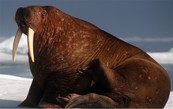
A new study shows that disappearing sea ice is a significant element of the food web supporting female walruses and their dependent young in the Chukchi Sea.
|
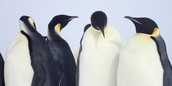
A new study shows that if current global warming trends continue, Antarctic sea ice decline will reduce emperor penguin numbers.
|
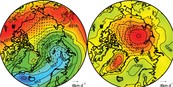
A region north of Greenland and the islands of the Canadian Arctic Archipelago have been termed the "Last Ice Area." But research suggests that parts of this area are showing a decline in summer sea ice.
|
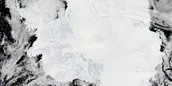
Warming waters and shrinking sea ice along the Western Antarctic Peninsula have altered the makeup of microscopic sea life.
|
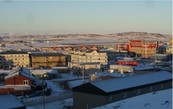
The Arctic provides unique insights into the COVID-19 pandemic that are important to government policies globally. Yet, experiences from the Arctic are missing from the global public-health debate.
|
Have an NSF-supported research highlight to share? Contact us.
Opinions, findings or recommendations of NSF awardees or their institutions do not necessarily reflect the views of the National Science Foundation.
|
|
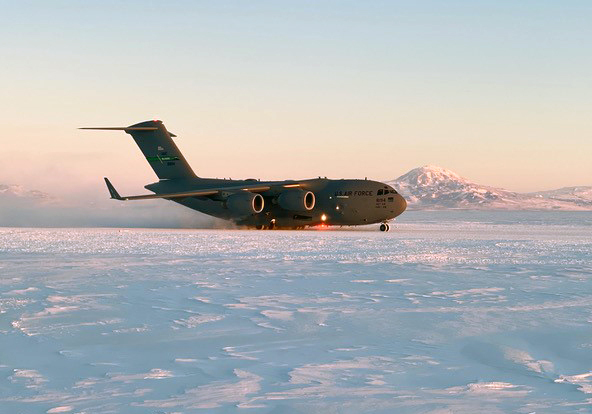 The Antarctic season has begun!
On August 29, 2021, the fifth and final WINFLY 2021 transport reached McMurdo Station!
Since 1967, WINFLY has been the transition period between the winter and summer seasons. During that time, planes deliver new people to the station, giving them enough time to prepare the station before the majority of researchers and workers begin to arrive in early October.
The WINFLYs transported 155 passengers and 277,000 pounds of cargo to McMurdo. They also brought 38 passengers back to Christchurch, New Zealand after a long winter deployment! A big thanks to the Air Force 304th Expeditionary Airlift Squadron from Joint Base Lewis-McChord for the flights.
Photo Credit: Randal Rhodes
|
|
OPP sections
Antarctic Infrastructure and Logistics (AIL)
AILs mission is to provide the operational and logistical platform necessary for the U.S. to conduct world-class science in Antarctica and maintain its active and influential presence on the continent.
Antarctic Sciences (ANT)
ANT supports cutting-edge research across all scientific fields that improves understanding of the interactions between the Antarctic region and global systems; expands fundamental knowledge of Antarctic systems and processes; and uses the unique characteristics of Antarctica as a science observing platform. ANT supports non-fieldwork-based analysis and modeling as well as Antarctic fieldwork for research that must be performed, or is best performed, in Antarctica.
Arctic Sciences (ARC)
ARC supports fundamental research at the forefront of understanding the Arctic, including its human and natural components and its global linkages. The section also works to develop and encourage good Arctic stewardship through education, training, dialogue, and planning. In addition to its scientific programs, ARC also includes a Research Support & Logistics program that improves the efficiency and safety of our research community.
|
|
Front Office Integration Team (FIT)
FIT supports the innovative scientific research, engineering, and education taking place in and about the polar regions. FIT provides administrative, policy, and communications support to the entire polar program, and ensures that research and related activities in the regions are environmentally sound
Safety and Occupational Health (SOH)
SOH facilitates a culture of safety throughout the Polar regions to enhance the success of science by protecting life and property. SOH partners with stakeholders and integrates an effective risk management system through policy development, process and project plan evaluations, incident review and investigations, site safety evaluations, and a deployment medical system implementation.
Polar Programs Advisory Committee (AC)
The AC provides advice and recommendations to the NSF concerning polar research, education, infrastructure and logistics, and activities. Additionally, the AC Sub-Committee on Diversity and Inclusion has been tasked to identify, examine and recommend strategies to pursue enhanced diversity and inclusion in the polar sciences in both the near and long term.
|
|
|
|
|