|
COMPUTER & INFORMATION
SCIENCE AND ENGINEERING |
|
|
A Message from CISE Leadership
Dear CISE community.
On May 28, 2021, the Biden-Harris Administration submitted to Congress the President’s Budget Request for fiscal year 2022. The Budget provides $10.17 billion for NSF, including $9.43 billion to support research across the spectrum of science, engineering, and technology; the establishment of a new directorate for technology, innovation, and partnerships to help translate research into practical applications; over $100 million for programs that aim to increase participation in science and engineering; $1.2 billion for climate and clean energy-related research; and investments for the continued construction of major NSF research facilities.
In addition, the American Rescue Plan (ARP) Act of 2021 provided NSF with $600 million to assist with the nation’s recovery from the pandemic. These funds will enable NSF to provide additional support for those most strongly affected by the pandemic, including those at vulnerable career transition points, and it will enable NSF to provide such support broadly. Specifically, CISE will receive $65 million of ARP funding to support programs and CISE’s scientific community whose careers and research were negatively impacted by the pandemic.
For more information on the NSF budget, please visit our webpage at https://beta.nsf.gov/budget.
We hope you enjoy this month’s newsletter, which highlights some of our investments in research to address climate change and cleaner energy, and our Rapid Response Research (RAPID) funding, which seeks to bolster research in response to the COVID-19 pandemic.
Best,
 Margaret Martonosi
NSF Assistant Director for CISE
Joydip Kundu
Acting Deputy Assistant Director for CISE
|
|
News & Announcements
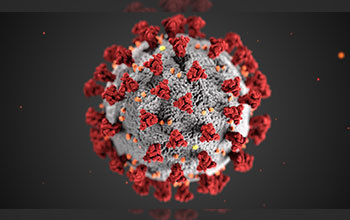
Predicting and preventing pandemics that have not yet happened is the focus of a new funding opportunity from NSF.
|

Task Force members will help develop a roadmap to democratize access to research tools that will promote AI innovation and fuel economic growth
|

"It is the newest resource in the PAWR program, a public-private partnership promoting wireless research through the development of multiple outdoor, large-scale wireless testbeds across the U.S."
|
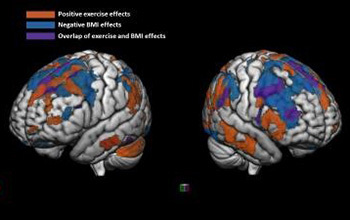
Data from 9- and 10-year-olds show effects on the developing 'connectome.'
|

"San Diego Supercomputer Center, particle physics powerhouse CERN team up to help researchers manage public cloud computing."
|
 |
|
"Research results will be dedicated to the public to help accelerate a low carbon future."
|

The Alan T. Waterman Award recognizes outstanding young researchers in any field of science or engineering supported by the National Science Foundation.
|

The National Medals of Science are awarded by the President of the United States to individuals deserving of special recognition by reason of their outstanding cumulative contributions to knowledge in the physical, biological, mathematical, engineering, or behavioral or social sciences, in service to the Nation.
|
Get more CISE News
|
|
Program Spotlight
Rapid Response Research Grants during the COVID-19 Pandemic
In light of the emergence and spread of the COVID-19 pandemic more than 1 year ago, in April 2020, NSF solicited proposals via the Rapid Response Research (RAPID) funding mechanism to conduct non-medical, non-clinical-care research that could be used immediately to explore how to model and understand the spread of COVID-19. The RAPID funding mechanism allows NSF to receive and review proposals having a severe urgency with regard to availability of or access to data, facilities or specialized equipment, as well as quick-response research on natural or anthropogenic disasters and similar unanticipated events.
Despite the challenges that the research community has faced during these unprecedented times, one year later we are now beginning to see the results of the scientific work funded under the RAPIDs, which is significantly contributing to our ability to understand and recover from the pandemic. The following research is an example of some of our RAPID-funded programs:
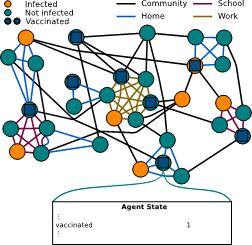
RAPID: Modeling COVID-19 transmission and mitigation using smaller contained populations
In epidemiological agent-based modeling, a contact network represents individuals in the population as nodes, and the interactions for possible viral transmission among them as edges. In this image, vaccinated individuals have a reduced transmission which will be reflected in their state. The colors represent four different types of contacts or individuals in the population.
The project, “RAPID: Modeling COVID-19 transmission and mitigation using smaller contained populations,” used data from Hawaii to provide a predictive understanding of the virus through modeling of spread and mitigation effects, focusing on a critical gap in understanding variability of COVID-19 spread within different communities. The project used advanced computational techniques to make the models readily available to the public and decision makers involved in the COVID-19 response strategy.
The team now collaborates with the Hawaii Pandemic Applied Modeling Work Group (HiPAM) and government officials to provide simulations for many urgently requested scenarios that directly affect policy decisions. The researchers’ work includes unique and specific features of Hawaiian environments, especially the effect of travel and restrictions implemented on different islands like Iceland and Japan.
For more information about these predictive models, please visit https://www.uhmdatascienceteam.com/
|
To learn more about the RAPID Response Research funding mechanism, visit our announcement page.
|
|
SciComm Corner: How CISE is Impacting Your Community
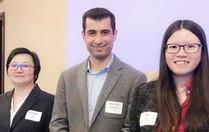
From left to right: Zhaoxia Pu (co-PI), Mostafa Sahraei-Ardakani (co-PI), and Ge Ou (PI). Photo provided by Dr. Ge Ou, University of Utah.
Extreme windstorms such as hurricanes and tornadoes often lead to vast and long-lasting blackouts, with serious social and economic consequences. A systematic investigation in power network resilience, appropriate preventive actions, and optimized post-windstorms restoration and repair planning, are expected to substantially alleviate such adverse impacts.
Researchers at the University of Utah seek to establish a data engine that can link abstract models with meteorological data to develop, evaluate, and compare innovative approaches to mitigate windstorm-induced power outages. Results of this project will enhance preparedness for windstorms, reducing the adverse impacts of windstorms on power systems, which represent billions of dollars in recovery costs and economic loss.
|

Dr. Thomas Anderson
Principal Investigator
University of Washington
When we think of energy efficiency and footprint, we immediately think of the energy we use at home, at work, or for transportation. But few know that the energy consumed by datacenters energy represents 1 to 2 percent of worldwide electricity consumption. Datacenter computing, such as cloud applications, are growing exponentially to match worldwide consumer need for access to computing technology. Therefore, it is imperative to conduct research that provides sustainable solutions to datacenter energy efficiency.
The Treehouse project seeks to create a basis for energy-aware cloud computing. We need to develop standard software mechanisms to track and control the greenhouse gas emissions from computing to make those visible to application developers and users so that they can make informed choices as to how to trade off performance and energy use, and to allow systems software developers to efficiently utilize cloud computing resources.
An outcome of this research will be to fundamentally change how application and system software developers think about their designs—not just to consider usability, security, or performance, but also the environmental cost of making certain design choices. The project plans to build upon several already-established outreach activities at four institutions to help improve diversity of the student population in computer science.
This is a collaborative research project between the University of Washington, Regents of the University of Michigan—Ann Arbor, Columbia University, and Massachusetts Institute of Technology.
|
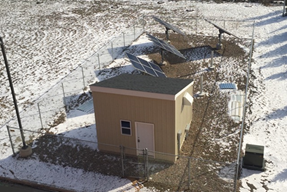
Experimental MassZero solar-powered micro data center located in Holyoke, Massachusetts. Photo credit: Prashant Shenoy.
This project focuses on designing a sustainable and reliable carbon-centric cloud-edge software infrastructure. The cloud’s exponential growth is resulting in rising energy demand that contributes to global carbon emissions. To address the problem, scientists in this project plan to elevate carbon-efficiency to a first-class metric in designing carbon-efficient clouds that can enable continued exponential growth.
The foundation of the project focuses on developing a software-defined energy virtualization layer that provides applications visibility into, and control of, their own energy and carbon usage. The project will then leverage this foundation to develop several higher-level systems abstractions for developing and supporting carbon-efficient applications. The project will deploy prototypes of its carbon-efficient systems and applications at the Massachusetts Green High Performance Computing Center , a production data center, and the MassZero testbed, a nearby experimental micro-data center powered by a co-located solar array and controllable Lithium-Ion batteries.
The project includes collaborations with the University of Massachusetts Amherst, Worcester Polytechnic Institute, the California Institute of Technology, and VMware, a technology company, on the topic of sustainable computing infrastructure. All software artifacts and datasets resulting from the project will be made available to the community in open-source form. The project will organize a summer outreach program for local middle and high school students at the partner institutions, and involve a diverse group of undergraduate students in the proposed research through the Research Experience for Undergraduate (REU) projects.
|
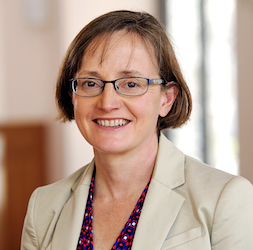
Dr. Margaret Martonosi
Assistant Director
CISE, NSF
Margaret Martonosi, Assistant Director for CISE, participated in an IBM-sponsored podcast on Quantum Information Science. The six-episode series entitled, “Forwards & Backwards: A History of Quantum Computing,” provides an oral history of the field of quantum computing, commemorating the 40th anniversary of the MIT-IBM Physics of Computation conference where a visionary group of computer scientists and physicists met to make the case that quantum phenomena could be used for computation --marking a defining moment for the field. On episode three, Dr. Martonosi talks about workforce and diversity.
|
Image Credit: Science Before the Storm
In the inaugural episode of the Science Before the Storm podcast, Dr. Martonosi spoke of NSF’s support for research responding to the COVID-19 pandemic and preparing for the future, as well as NSF’s pivot to a remote work environment, and what "business as usual" might look like going forward.
|
Faces of CISE: Dr. Madhav Marathe
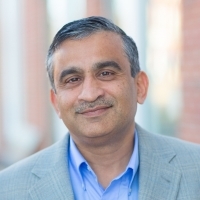
Dr. Madhav Marathe
Professor of Biocomplexity
University of Virginia School of Engineering
Madhav Marathe is a distinguished professor in biocomplexity, the division director of the Network Systems Science and Advanced Computing Division at the Biocomplexity Institute and Initiative, and a professor in the Department of Computer Science at the University of Virginia (UVA). His research interests are in network science, computational epidemiology, artificial intelligence, foundations of computing and high-performance computing. Over the last 20 years, his division has supported federal and state authorities in their efforts to combat epidemics in real time, including the H1N1 pandemic in 2009, the Ebola outbreak in 2014, and most recently, the COVID-19 pandemic. Before joining UVA, he held positions at Virginia Tech and the Los Alamos National Laboratory. He is a Fellow of the IEEE, ACM, SIAM and AAAS.
Leveraging the NSF-funded Expeditions in Computing project as well as ongoing RAPID grants, and NSF Prepare VO, Marathe and his colleagues at the University of Virginia, Princeton University, the Indian Institute of Science, and the University of Nottingham are working on a collaborative effort to address timely and challenging problems related to real-time epidemic science. The team’s project on global bio-surveillance has been selected as one of the finalists at the Trinity challenge.
|
|
|
Office of Advanced Cyberinfrastructure (OAC)
OAC supports and coordinates the development, acquisition and provision of state-of-the-art cyberinfrastructure resources, tools and services essential to the advancement and transformation of Science and engineering.
|
|
|
|
|