|
COMPUTER & INFORMATION
SCIENCE AND ENGINEERING |
|
|
A Message from CISE Leadership
Earlier this month, the Biden-Harris Administration submitted to Congress the President’s priorities for fiscal year 2022, which starts on Oct. 1, 2021. The request includes $10.17 billion for NSF, a 20% increase over current levels. This funding request includes investments to enhance fundamental research and development in all fields including CISE; tackle racial equity in science and engineering; address climate science and sustainability research; and strengthen U.S. leadership in emerging technologies including artificial intelligence, quantum information science, advanced wireless, and more. While more details are expected later this spring in the NSF fiscal year 2022 budget request to Congress, the release of this budget document marks the beginning of the annual budgetary process. In the meantime, the work that you all do continues to drive the frontiers of our field – and positively reinforces the value of federal investment in fundamental research, education, and infrastructure.
Additionally, with Earth Day on April 20, we want to take a moment to reflect upon the incredible and indispensable advances that our computer and information science and engineering community has made in all areas of sustainability. In CISE, we frame this both in terms of computing for sustainability—the ways that a host of CISE topics help advance society’s sustainability goals overall, and also sustainability in computing —the ways we can turn our attentions inward and mitigate the environmental and sustainability impacts of our field itself. These bidirectional synergies of ideas and techniques puts many CISE topics at the forefront of our societal attentions to this global grand challenge. From advanced sensing and cyber-physical systems, to intelligent systems and data analytics, to energy-efficient and sustainable materials and much more, the CISE research community plays a key role in many critical areas, including climate change, loss of biodiversity, extreme events, and more. Over the years, our investments pertaining to these important issues have permeated the CISE portfolio, spanning our core and crosscutting programs, the long running Expeditions in Computing program, and most recently, the National Artificial Intelligence Research Institutes program. We look forward to your continued ideas and vision in these topic areas as you consider your future research plans.
Finally, a couple important items in closing:
-
Earlier this year, we noted the launch of the CISE Graduate Fellowships (CSGrad4US), which seeks to increase the number of diverse, domestic graduate students pursuing research and innovation careers in CISE fields. We have extended the deadline of this program to April 27, 2021. Please help us spread the word about this new opportunity!
-
We note with joy and pride that the 35th anniversary of the formation of the CISE Directorate is fast approaching on May 1. CISE’s 35th birthday will be a focus of our next May newsletter. As we prepare for that, please share your stories, memories and highlights with us at cisehighlights@nsf.gov!
 Margaret Martonosi
NSF Assistant Director for CISE
Joydip Kundu
Acting Deputy Assistant Director for CISE
 Erwin Gianchandani
Senior Advisor, Office of the Director
|
|

The American Astronomical Society honors an unlikely astrophysics leader from UC Santa Barbara.
|

Novel pooled testing strategies can more efficiently identify COVID-19 infections, study finds.
|

Advances could boost recommendation algorithms and internet searches.
|

The $7 million, six-year renewable award will create a hub of research based at the University of Minnesota-Twin Cities, with the goal of deepening the understanding of the ecological processes in municipalities.
|
Get more CISE News
|
|
Project OVERCOME
CISE’s Division of Computer and Network Systems (CNS) has launched Project OVERCOME to expand broadband Internet access across the United States. Managed by US Ignite, Inc., Project OVERCOME (cOnnectiVity for undERserved COMmunitiEs) is funding multiple pilot efforts that combine innovative technical and community-engagement approaches to reach underserved and unserved populations.
This $2.7 million public-private partnership investment is supporting seven community deployments meant to uncover strategies for connecting underserved populations in ways that can be extended and replicated across the country. Collectively, the seven projects serve diverse communities reflecting a range of rural and urban environments, demographic characteristics, geographic regions, housing types, local and industry collaborations and technical approaches. The project management teams are also interdisciplinary and diverse in gender and ethnicity, and they comprise community, industry and academic partners. Below are brief descriptions of the seven community projects selected.
DigitalC – Cleveland, Ohio
Internet service to an underserved and historically Black neighborhood delivered through a combination of fiber and millimeter-wave technologies, with local technical support and device purchase assistance.
Missouri University of Science and Technology – Clinton County, Missouri
A Radio Frequency-over-Fiber deployment using intelligent routing and multiple last-mile wireless technologies to serve a rural community.
Libraries Without Borders – Loiza, Puerto Rico
A wireless mesh network deployed to three community centers providing digital skills training and health literacy information to low-income residents in underserved neighborhoods.
Onward Eugene – Blue River, Oregon
A resilient wireless link to rural McKenzie Valley combined with new fiber, a pilot citizens broadband radio service education network, and new incentives to attract further private broadband investment.
The Westchester County Association – Yonkers, New York
A citizens broadband radio service network in a digital opportunity zone supported by exceptional partnerships to ensure youth involvement and digital equity.
University at Buffalo – Buffalo, New York
Internet service delivered by citizens broadband radio service to an impoverished region known as the Fruit Belt neighborhood.
Allied Media Projects – Detroit, Michigan
A combination of fiber and fixed wireless infrastructure deployed and supported by a network of “digital stewards” employed at a neighborhood anchor institution.
Read more about Project OVERCOME here.
Visit the Project OVERCOME program solicitation for additional information.
|
|
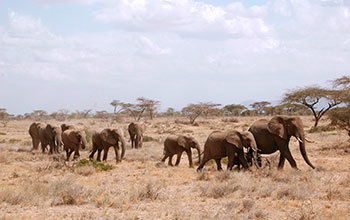
Image Credit: Shifra Goldenberg, Save the Elephants/Colorado State University
This Expedition in Computing project launches CompSustNet (http://www.compsust.net), a vast research network powered by eleven of America’s top university computer science programs, charged with applying the emerging field of computational sustainability to solving the world's seemingly unsolvable resource problems. Research focuses on cross-cutting computational topics such as optimization, dynamical models, simulation, big data, machine learning, and citizen science, applied to sustainability challenges. Computational sustainability projects include work innovating automated monitoring networks to protect endangered elephant populations from poachers, promoting the discovery of novel ways to harvest energy from sunlight, and designing algorithms to manage the generation and storage of renewable energy in the power grid.
|

Image Credit: Marcos Gasparutti/Flickr
Completed in 2018, this Expedition in Computing project significantly advanced key challenges in climate change by developing new data driven approaches that take advantage of the wealth of climate and ecosystem data now available from satellite and ground-based sensors, the observational record for atmospheric, oceanic, and terrestrial processes, and physics-based climate model simulations. These innovative approaches help provide an improved understanding of the complex nature of the Earth system and the mechanisms contributing to the adverse consequences of climate change, such as increased frequency and intensity of hurricanes, precipitation regime shifts, and the propensity for extreme weather events that result in environmental disasters. The approaches and formalisms developed in this research have also proven applicable to a broad range of scientific and engineering problems, which use modeling and simulations to analyze physical processes.
|
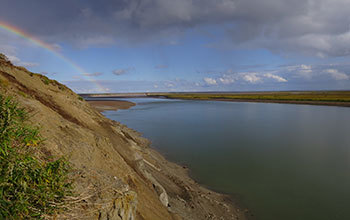
Image Credit: Pat Druckenmiller, University of Alaska Museum of the North
Led by a team at the University of Oklahoma, Norman, this AI Institute assembles researchers in AI, atmospheric and ocean science, and risk communication to develop user-driven trustworthy AI that addresses pressing concerns in weather, climate, and coastal hazards prediction. With AI certificate programs aimed at workforce skills, the institute is providing the research and training necessary for the future workforce to deliver the advances needed to deal with forecasting and prediction challenges.
|
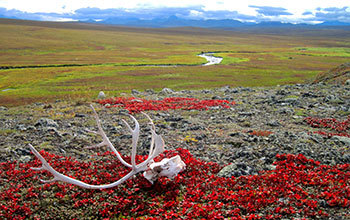
Image Credit: Courtesy Daniel Ackerman
Researchers from the University of Alaska, Fairbanks are bringing together local organizations engaged in land management and protection and disaster preparedness to develop place-based, data-driven community resilience indicators and interventions that will better enable Alaskans to predict and respond to weather and climate driven events such as thaw-related flooding, subsidence of thawed soils, and wildfire. Additionally, this project aims to determine the feasibility of using Low Power Wide Area (LPWA) networks, which requires less energy consumption than conventional sensor networks. The new LPWA networks are expected to serve as an alternative method for rural and suburban communities to collect data, leading to efficient resource consumption, disaster management, and better land use in world-wide cold regions.
|

Image Credit: kauai.gov
The University of Hawaii is conducting a project that develops a model for collaboration between university scholars, local non-profits, and indigenous community members to provide monitoring, observation capability, and training opportunities that enhance local resilience to climate change. This project contributes to the understanding of cultural, social, and contextual aspects of resilience, models collaborative processes to generate and assess locally relevant indicators of resilience over time, and tests applications of hydrological science and communication technology to climate change adaptation and planning.
|
|
|
Office of Advanced Cyberinfrastructure (OAC)
OAC supports and coordinates the development, acquisition and provision of state-of-the-art cyberinfrastructure resources, tools and services essential to the advancement and transformation of Science and engineering.
|
|
|
|
|