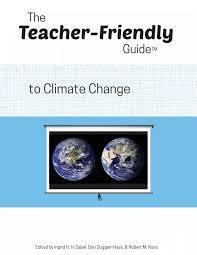
The Teacher-Friendly Guide to Climate Change: A Free Resource to Help You Teach Climate Change AND Stay Sane.
You can watch a video archive of last night's presentation.
(Due to a technical error during the broadcast, the video archive was split into two parts.)
|
When you're done watching please take less than a minute to complete our post webinar poll. - we look at all the results and read all the comments. They're really important for our program.
Viewing the archive is a great way to catch up on new content, but there's no substitute for attending a live broadcast and interacting with the presenter(s) in real time!
To receive information on upcoming webinars, book club meetings, workshops and free educational resources, sign up to our mailing list today!
You can get all the slides from tonight's presentation, and check out all our webinars and education resources since 2013 on the NOAA Planet Stewards Google Archive Web Site.
To access the Archive Web Site, you'll need to:
- Register with the Archive Web site using an email address linked to a Google account (note - a Google email address is not the same as a Google account!)
- Be logged into your Google account before accessing the Archive Web site. (note - setting up an account with Google is free and easy, just go to google.com for details. If you're unable, or have difficulty logging into the site, contact bruce.moravchik@noaa.gov.)
Applications to join the 2019
Stewardship Community are now open!
- Would you like to learn how to write a Federal funding proposal?
- Have the opportunity to receive up to $2,500 to carry out an environmental stewardship project?
- Meet educators from around the country who share your interest in STEM education?
Then you need to join the NOAA Planet Stewards Education Project's
2019 Stewardship Community!
Applications will be accepted until Midnight, December 2, 2018.
All Formal and informal educators working with
Kindergarten through college-age students are welcome to apply.
Want to Learn More? -
Join us for a special webinar on Tuesday, November 20 for a special webinar:
The Whats, Wheres, Hows and Whys of Joining the NOAA Planet Stewards 2019 Stewardship Community.
Space is limited!
After registering, you will receive a confirmation email.
 |
|
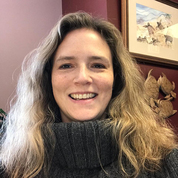
During the November 20 webinar Molly Harrison, Stewardship Project Coordinator as for a brief presentation where she will review the goals, processes and benefits of joining the Community. She'll explain where and how to apply, and answer your questions.
Important Information for participating in this Webinar
Seriously, read thefollowing and save it for your reference:
- Log into the webinar AT LEAST 5 minutes before the scheduled start time. GoToWebinar continually upgrades their software. We want to be sure you can access the broadcast when it begins
- Plan to use the VOIP (Voice Over Internet Protocol) option to listen to this presentation. All participants will be muted for the duration of the broadcast.
- If you have difficulty listening to the webinar using VOIP, you may dial 1- 213-929-4212 for audio. The access code is: 971-999-615. You will be charged for this call. No Audio Pin is needed to listen to the webinar
- If you have difficulty logging in to the webinar go to: https://support.logmeininc.com/gotowebinar/contactus?p=0 The ID Number for this Webinar is: 625-461-411
|
Join us on Monday, November 26, 2018 At 8 pm Eastern Time for a discussion of:
This discussion will be led by the book's author,
Lisa Gardinier
Space is limited!
To join the discussion Dial (toll free)
866-662-7513
When prompted, use the pass code:
1170791#
Scroll down for a description of the book and to see the questions for the discussion.
|
|
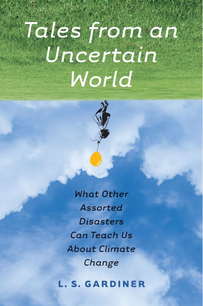 |
So far, humanity hasn’t done very well in addressing the ongoing climate catastrophe. Veteran science educator L. S. Gardiner believes we can learn to do better by understanding how we’ve dealt with other types of environmental risks in the past and why we are dragging our feet in addressing this most urgent emergency. Weaving scientific facts and research together with humor and emotion, Gardiner explores human responses to erosion, earthquakes, fires, invasive species, marine degradation, volcanic eruptions, and floods in order to illuminate why we find it so challenging to deal with climate change. Insight emerges from unexpected places—a mermaid exhibit, a Magic 8 Ball, and midcentury cartoons about a future that never came to be.
Instead of focusing on the economics and geopolitics of the debate over climate change, this book brings large-scale disaster to a human scale, emphasizing the role of the individual. We humans do have the capacity to deal with disasters. When we face threatening changes, we don’t just stand there pretending it isn’t so, we do something. But because we’re human, our responses aren’t always the right ones the first time—yet we can learn to do better. This book is essential reading for all who want to know how we can draw on our strengths to survive the climate catastrophe and forge a new relationship with nature.
“Given the advancing state of climatic disruption, humans are going to spend a lot of the foreseeable future dealing with disaster. This fascinating volume provides some memorable examples of how we’ve done so in the past, and as such helps concentrate our thinking on the necessary task of limiting the damage that’s coming our way.”—Bill McKibben
“Gardiner’s lively and fresh observations detail the actions necessary to head off the impending disaster of climate change, showing why forward movement has been so sluggish… Fresh insights about scientific literacy and generational shifts from techno-optimism to dystopian views of the future also cover new ground. Gardiner is not an alarmist. While relaying concern that international, governmental, and corporate actors need to do more—and quickly!—to prevent catastrophic climate change, she ends the book on an optimistic note, with concrete ideas for meaningful individual action.”—Foreword Reviews
Discussion questions:
Overall: What did this book make you wonder?
About coping and resilience: The bulk of the stories in chapters 2-7 are examples of how individuals cope with environmental change. What types of environmental change happen in your region and how have you coped with those? How is coping with small-scale change like coping with a large-scale change? How are they different?
About uncertainty in science: How people interpret and understand information that has some uncertainty is a recurring theme in this book. In chapter 8, the author tests her own ability to make decisions based on uncertain information by relying on a Magic 8 Ball’s wishy-washy answers for guidance. How do you deal with uncertain information in order to make decisions in your own life? How do your students think about uncertainty in science? How do you teach about scientific uncertainty?
About the natural and human-built world: Through the book’s examples of disasters, the choices that people make and the emotions they are feeling are often related to the way they see nature and their role in it. What stories and characters resonated with you? How would your students define nature? Would their definitions include the human-built world?
Envisioning the future: Chapter 9 explores past visions of the future and wonders about how we see the future today. Is it possible to look at the future with optimism when there are problems like climate change? Or does the future look like a dystopia? How do you teach about environmental problems that have long-term impacts without depressing students about the future?
Sign up to the NOAA Planet Stewards email list to receive information on upcoming webinars, book club meetings, professional development workshops, opportunities, educational resources and more!
|