New Right Whale Slow Zone and Extension: South of New York, NY and Cape Cod Bay, MA
Effective through November 29
On November 14, 2026, the Coastal New Jersey Slocum glider operated by the Rutgers University and Woods Hole Oceanographic Institution (WHOI) detected the presence of right whales south of New York, NY. In addition, the Cape Cod Bay buoy operated by WHOI redetected the presence of right whales in Cape Cod Bay, MA. The right whale Slow Zones are in effect through November 29, 2026.
Visit the Right Whale Slow Zones and Dynamic Management Areas website for a full list of active Slow Zones.
Voluntary Right Whale “Slow Zone” Areas
Mariners are requested to avoid or transit at 10 knots or less inside the following Dynamic Management Areas and Slow Zones where endangered right whales have been detected. Vessel strikes are one of the primary causes of injury and death for right whales. Slower speeds are known to reduce the severity of impacts to whales when strikes occur and may provide boat and vessel operators an opportunity to avoid a collision. Visit our website for more information.
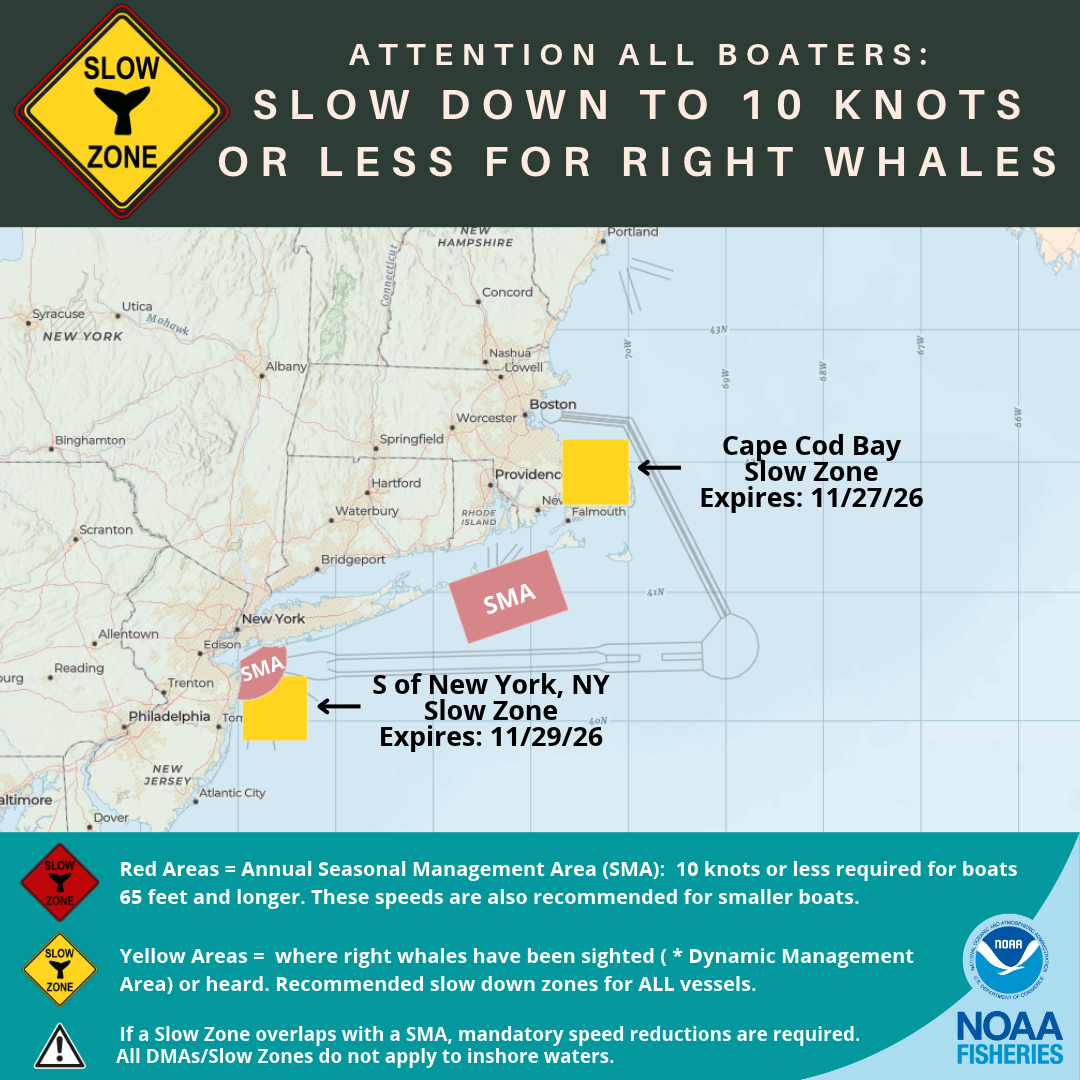 South of New York, NY Slow Zone: Effective November 14 - 29, 2026
Waters bounded by:
Northern Boundary: 40°21′ N
Southern Boundary: 39°50′ N
Eastern Boundary: 73°17′ W
Western Boundary: 73°57′ W
Cape Cod Bay, MA Slow Zone: Effective November 14 - 29, 2026
Waters bounded by:
Northern Boundary: 42°10′ N
Southern Boundary: 41°40′ N
Eastern Boundary: 69°59′ W
Western Boundary: 70°40′ W
Active Seasonal Management Areas
Mandatory speed restrictions of 10 knots or less (50 CFR 224.105) are in effect for most vessels 65 feet or longer in the following areas:
Mid-Atlantic U.S. SMAs (Nov 1 - Apr 30)
Southeast U.S. SMAs (Nov 15 - Apr 15)
North Atlantic right whales are on the move along the Atlantic coast of the United States. To protect right whales, regulations prohibit approaching or remaining within 500 yards (1,500 feet) of a right whale. That’s the length of about five football fields.
Endangered North Atlantic right whales remain highly vulnerable to extinction, as human impacts continue to threaten the survival of this species. There are approximately 380 individuals remaining, including about 70 reproductively active females.
In August 2017, NOAA Fisheries declared the increase in right whale mortalities an Unusual Mortality Event, which helps the agency direct additional scientific and financial resources to investigating, understanding, and reducing the mortalities. This work is done in partnership with the Marine Mammal Stranding Network, Canada’s Department of Fisheries and Oceans, and outside experts from the scientific research community.
All boaters from Maine to Florida, or interested parties, can sign up for email or text notifications about the latest Right Whale Slow Zones. You can also follow us on social media for announcements:
Share our video on Right Whale Slow Zones.
Attention Right Whale Slow Zone Subscribers
Email and text notification settings can now be filtered to include Right Whale Slow Zone announcements from specific regions. Access your subscriber preferences to update your existing notifications.
|