|
National
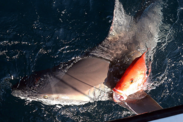
Reports of shark interactions have increased in recent years. A variety of theories have been put forth to explain the rise. NOAA is bringing science, state partners, and practical solutions together to understand and manage this issue.
|
|
|
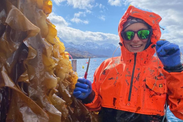
NOAA’s Tide to Table series profiles members of the aquaculture community. In this profile, meet a husband and wife homesteading duo who farm kelp and fish for salmon. They give an inside look at earning a living off the water on a remote Alaskan island. They even share a recipe for kelp pesto and smoked salmon pizza!
|
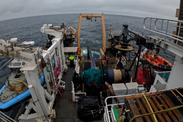
This summer, Teacher at Sea Guy Sturdevant joined scientists aboard NOAA Ship Oscar Dyson to survey Alaska pollock in the Eastern Bering Sea. In this blog post, he describes the process of deploying the trawl net to sample fish located by acoustic monitoring. Be sure to check out the simple video game that Guy created to help students try their hand at positioning and retrieving a net to maximize their sample.
|
|
|
New England/Mid-Atlantic
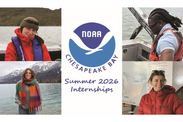
It’s summertime—but that doesn’t mean a vacation from learning! Four college students are spending this summer as interns at the NOAA Chesapeake Bay Office. These paid internships run for 12 weeks, giving them solid insight into a potential career path—and supporting our busy summer of work. Read about our dynamic interns and the projects they are working on.
|
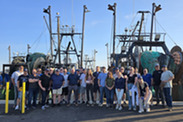
Last month, NOAA Fisheries hosted 16 members of the Scottish Fishermen’s Organisation in our first-ever international cooperative research knowledge exchange. The gathering featured vessel and industry tours and roundtable discussions. Conversations about trust, knowledge sharing, and common goals highlight why cooperative research is a key asset for the future.
|
|
|
Southeast
Restoring Injured Coral Habitats in the Gulf of America
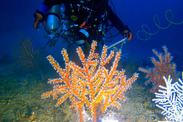
Deep in the Gulf of America lies the "mesophotic" zone—a vital but little-known habitat. It is home to coral ecosystems that are essential to the Gulf’s food web. In 2010, the Deepwater Horizon oil spill injured extensive areas of this delicate environment. Today, scientists are working to restore them.
Deep Diving and Innovation to Restore the Gulf's Mesophotic Corals
In spring 2026, a team of researchers aboard the NOAA Ship Nancy Foster set out on a mission to plant propagated mesophotic corals. Read this account of the restoration effort, which required expert technical diving and cutting-edge tools forged in our laboratories.
Photo Gallery: Mesophotic Coral Restoration
Explore this gallery to see the mission in action. Photos include sights from the deck of the Nancy Foster and the depths of the Gulf, along with the "coral torpedo" that safely transported the corals to the seafloor.
|
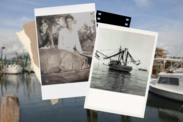
In the Gulf region, federal and state managers have collaborated for decades to sustain fisheries, innovate data collection, and support coastal communities for the future.
|
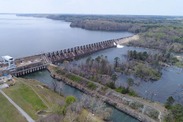
Long-term collaboration between NOAA Fisheries, Dominion Energy, and state and federal agencies resulted in a win-win for hydroelectric power generation and fish and mussel populations in North Carolina.
|
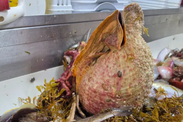
This summer, Teacher at Sea Amelia Black joined scientists aboard NOAA Ship Oregon II to survey groundfish in the Gulf of America. In this post, she features some of the interesting finds from the trawl survey, including a large queen conch shell that was hiding a common octopus. Amelia includes a video of scientists measuring the octopus before returning it (and its shell) back to the Gulf.
|
|
|
West Coast
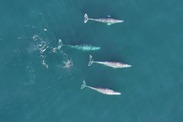
A new abundance estimate published by NOAA Fisheries indicates that the eastern North Pacific population of gray whales that migrates along the West Coast has increased since last year. The 2025 estimate was one of the lowest since counting began in the late 1960s. The reasons for the apparent increase remain an open question.
|
|
|
Upcoming Deadlines
July 27: Applications due for the Department of Transportation's Advanced Transportation Technology and Innovation (ATTAIN) Grant Program
August 6: Comments due on Amendment 62: Gulf Red Grouper Management Measures
August 7: Comments due on Amendment 4 to the Puerto Rico Fishery Management Plan: Reclassification of the Rainbow Runner as a Pelagic Fish
August 7: Comments due on the Proposed Rule for the Omnibus Management Flexibility Amendment to New England Fishery Management Council Fishery Management Plans
August 12: Comments due on Abbreviated Framework Amendment 5: Catch Levels for Blueline Tilefish
August 21: Applications due for the Western Pacific Regional Fishery Management Council's Advisory Panel and Fishing Industry Advisory Committee
August 21: Comments due on the Proposed Rule for Framework Amendment 14 to Modify the Catch Limit and Accountability Measure for Gulf of America Spanish Mackerel
August 24: Comments due on Amendment 22 to the Coastal Pelagic Species Fishery Management Plan
August 31: Applications due for the Department of Transportation's United States Marine Highway Grant Program
September 4: Applications due for NOAA Great Lakes Fish Habitat Restoration Partnership Grants
View more news and announcements
|
|
Upcoming Events
August 4: Educator Workshop: The Phenomenal Outdoors—Science Investigations with Elementary Students in Oxford, MD
August 8: Woods Hole Science Stroll in Woods Hole, MA
August 11–12: Caribbean Fishery Management Council meeting, hybrid format
August 11–13: Mid-Atlantic Fishery Management Council meeting in Philadelphia, PA
August 17: Atlantic Shark Identification Workshop in Manahawkin, NJ
August 17: Safe Handling, Release, and Identification Workshop in Vero Beach, FL
August 24–27: Gulf Fishery Management Council meeting in Biloxi, MS
September 16: Safe Handling, Release, and Identification Workshop in Kenner, LA
View more events
|
|
|
|