|
2026 On-Demand Gear Testing Haul Numbers are In
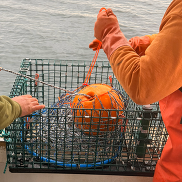
From February 1 through April 30, we worked with fishermen to conduct the 2026 experimental on-demand fishing gear testing. Gear testing occurs in state and federal waters when lobster and Jonah crab fishing using static vertical lines is restricted. This year, participating fishermen conducted 832 hauls on 17 vessels using three different on-demand gear brands. This is the fourth year of fully on-demand systems testing in restricted areas and the sixth year of testing on-demand gear more broadly across the Greater Atlantic region. Testing on-demand gear systems with fishermen under actual fishing conditions is key to developing systems and modifications that can reduce whale entanglement risk while retaining fishing access.
|
$2.3 million for Atlantic Mackerel Initiative with Fishing Industry
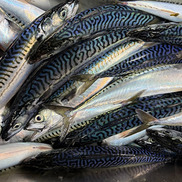
We announced $2.3 million for cooperative research to study Atlantic mackerel with the Northeast fishing industry. We are partnering with industry to learn more about mackerel population dynamics using advanced technology. We will work with more than 50 fishing vessels to collect management-relevant data on mackerel in New England and the mid-Atlantic. This research investigates industry observations of increasing abundance after a previous decline in spawning stock biomass. We will apply our findings to future Atlantic mackerel stock assessment, and other scientific products supporting management. The Atlantic mackerel fishery is worth up to $23 million, yet there has been limited research on this economically and ecologically important fish. The Atlantic Mackerel Cooperative Research Initiative is an opportunity for the fishing and science communities to work together to advance tools to monitor, understand, and manage this resource.
|
Why We’re Filling Coolers with SPAM for Science
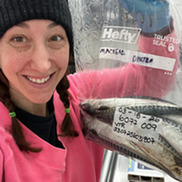
The Sampling Program for Atlantic Mackerel (SPAM) seeks to bridge a data gap by partnering with recreational and commercial fishermen. Together, we collect critical biological data on mackerel. Collaborating fishermen collect whole mackerel from Maine to North Carolina that we bring back to the lab to measure and weigh individual fish, as well assess reproductive maturity, sex, and age. This creates new data points to reduce assessment uncertainties and improve management for this economically and ecologically important forage fish.
|
Collecting Better Data with Advanced Technologies
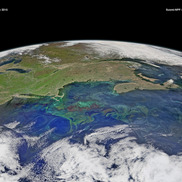
Advanced technology helps our science center collect better data about marine ecosystems. We use these tools to enhance traditional data collection, which leads to improved science for sustainable fisheries management and protected species conservation. At the Northeast Fisheries Science Center, we are applying optic technology, uncrewed marine systems, active and passive acoustics, genomic science, satellite technology, and machine learning across many different fields to achieve our mission.
|
Advancing Genomic Science in the Northeast
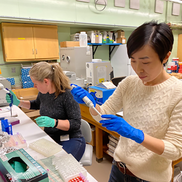
Genomic science examines animal or plant DNA directly, changing how we monitor marine ecosystems. While traditional genetics focuses on single genes, genomics allows us to study the entire genetic blueprint of organisms and their interactions with the environment. This advanced technology provides new lines of evidence-based fishery assessment and management. Examples of genomic science include environmental DNA, epigenetic ageing, population genetics and stock identification, and close-kin mark-recapture.
|
Peer Review of Herring and Haddock Stock Assessments
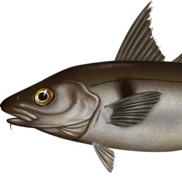
On June 29-30, an expert panel will review the latest population health checks for Atlantic herring and Georges Bank haddock. The public is invited to attend the presentations and discussions between the panel and our scientists. These stock assessments use mathematical and statistical models that depend heavily on data collected by and from commercial and recreational fishing operations. Through a rigorous scientific review, we ensure fishery managers get the best possible advice on fish sizes, ages, reproductive success, and total numbers.
|
Gulf of Maine Bottom Longline Survey Completes Spring Sampling
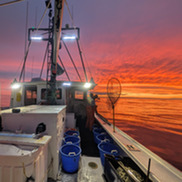
We completed the Spring 2026 Gulf of Maine Bottom Longline Survey on May 14, 2026. The survey focuses on assessing fish populations in the Gulf’s rocky depths. We conducted the survey aboard commercial vessels F/V Mary Elizabeth and F/V Tenacious II, targeting the central and southern Gulf of Maine. A team deployed and retrieved 45 bottom longline sets, collecting data on species such as haddock and white hake. Initial observations include: cooler bottom temperatures, low catch of groundfish and dogfish, and high catch of wolffish and cusk. The team successfully collected over 2,350 biological samples and is currently analyzing the data to inform future stock assessments and fisheries management.
|
Addressing Reasons for Fishing Survey Nonresponse
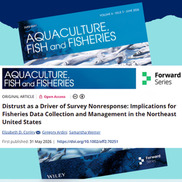
Our social scientists conduct a Commercial Fishing Cost Survey to better understand the costs associated with commercial fishing in our region. In 2022, a high number of vessel owners didn’t take the survey. To find out why, the team sent out postcards to non-responders—a first for the survey. The non-response postcards provided an opportunity to hear perspectives that normally wouldn’t have been captured. After analyzing the postcards, we found 43%—the top response—cited distrust in NOAA as the reason they didn’t participate in the survey. The second most selected reason was being too busy, at 28%. The results were published in Aquaculture, Fish and Fisheries. We will use non-responses as a diagnostic tool to improve the survey, identify barriers, and better understand values and beliefs.
|
NOAA Fisheries Launches New Passive Acoustic Reporting System
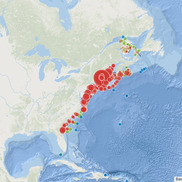
NOAA Fisheries announced the new Passive Acoustic Reporting System, with an updated release of the Passive Acoustic Cetacean Map. The reporting system is a centralized database to gather and share passive acoustic monitoring detection data generated using a variety of methods, instruments, and software by government agencies, universities, non-profits and industry partners. The data submitted to the reporting system can be viewed using the PACM data visualization tool, which allows the user to explore spatial and temporal patterns of cetacean detections from passive acoustic data collected worldwide. Built and managed by our science center’s Passive Acoustics Branch, the reporting system and map were created to support collaborative scientific research, management, and public awareness of marine species through the use of passive acoustic monitoring technologies.
|
Fish Use Connecticut’s Oyster Farms as Habitat
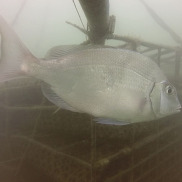
Habitat on the half shell! Our scientists used underwater video to compare fish abundance and community composition around two different types of oyster cages used for shellfish aquaculture in Connecticut. While the shelf and bag style oyster cages provide more space for fish to hide compared to the stacked tray cages, fish abundance and community composition were about the same around both cage types. Our team consistently saw the “core four” species around the cages at all three study sites: black sea bass, cunner, scup, and tautog. Oyster cages provide habitat for Long Island Sound’s temperate reef fish from late spring through fall. Read more about the study in Aquaculture Research.
|
Fishery Monitoring and Research Division Conducts Mid-Atlantic Outreach in May
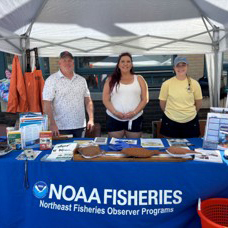
Staff from our Fisheries Monitoring Operations Branch conducted outreach across the Mid-Atlantic region from May 16-19, engaging fishing industry members and the public. We participated in Ocean Fun Days in Sandy Hook, New Jersey, providing hands-on education about the Northeast Fisheries Observer Program. Additional outreach included:
- Biological Port Sampling in Montauk, New York
- Point Pleasant and Barnegat Light, New Jersey
- Atlantic City, Sea Isle City and Cape May, New Jersey
The last two stops focused on helping seafood dealers understand sampling requirements and the value of portside data in stock assessments. We conducted observer safety outreach in Ocean City, Maryland, and Rehoboth, Delaware. We also explained the critical role of observer data in fisheries management and protected species conservation.
|
Director's Message
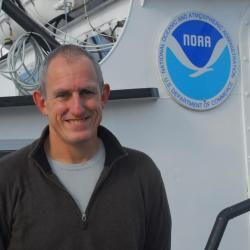
Our Social Sciences Branch continues to develop innovative tools to inform fishery managers and businesses throughout the Northeast. Below are four examples of our work.
2022 Vessel Profit Snapshots - A new tool uses the most recent (2022) Commercial Fishing Business Cost Survey data to calculate various fleet metrics, such as cost distributions, operating profit, total profit, and profit margins. Incorporating the most up to date cost information is critical to understanding how changes in expenses impact the economic performance of fishing fleets.
Commercial Port Fishing Activity Indicators - We developed new indicators of port activity to improve our understanding of fishing and fishing-adjacent activity in key ports. These indicators are included in the New England and Mid-Atlantic 2025 State of the Ecosystem Reports.
Community Environmental Variability Risk Indicators - Social scientists from the Northeast and Southeast Fisheries Science Centers collaborated to develop the Community Environmental Variability Risk Indicators for the Northeast and Southeast. They are currently working to expand the indicators nationally. These indicators connect data on species-level climate vulnerability of fish to the communities where those fish are landed. This allows decision-makers and communities to understand the social and economic vulnerabilities created by the impact of changing climate on fisheries.
Recreational Decision Support Tool - We continue to develop innovative cloud-based Recreational Decision Support Tools. These tools empower fishery managers from 8 states and two fishery management councils to use a mechanistic model of human behavior to design and test over 400 unique combinations of fisheries regulations for two fisheries during the 2026 management cycle. You can explore our Cod and Haddock and Summer Flounder, Scup, and Black Sea Bass tools on Fisheries Connect.
Incorporating economics and social sciences into science and decision making is essential for maintaining sustainable fisheries and healthy marine ecosystems. Our science center continues to lead the way.
|
|
|
Upcoming Events
Jun 29—30: Management track stock assessment peer review meeting
Aug 3—7: Longfin inshore squid research track peer review meeting
Nov 16—17: Flatfish Biology Conference
|
|
Upcoming Deadlines
Jul 1: Flatfish Biology Conference poster and oral presentation titles
|
|
|
|
|