|

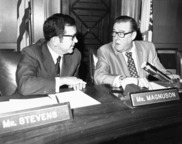
This month we commemorate the 50th anniversary since the signing of the landmark Magnuson–Stevens Fishery Conservation and Management Act. This foundational legislation—the primary law governing marine fisheries management in U.S. federal waters—is the driving mandate behind NOAA Fisheries' mission. Its core purpose is to prevent overfishing, ensure the biological and economic sustainability of our marine resources, and rebuild overfished stocks through rigorous, science-based management.
Over the past 25 years, NOAA Fisheries has been successful in rebuilding eight fish stocks and reducing overfishing for 32 stocks within the Southeast region.
We work every day towards this vision of sustainable fisheries management, leveraging innovation driven by our scientists and staff, and relying on meaningful partnerships with the region’s fishing communities to achieve our shared goals. On the science side, our staff are driving advancements in our data collection technologies such as environmental DNA, unmanned systems, electronic monitoring, and cloud infrastructure, as well as next-generation modeling platforms. Combined, these modernizations will allow us to keep pace with and better understand the changing environment and provide robust management advice.
Recent key activities include:
|
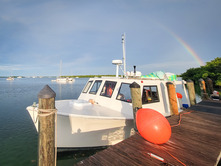
- Participation in the prestigious Miami Boat Show
- Engagement with the Marine Resource Education Program
- Publication of the crucial Shrimp Economic Snapshot Report
- Deployment of state-of-the-art science to inform bluefin tuna management at ICCAT
April is also citizen science month—a moment to celebrate and honor the invaluable contributions of all who actively participate in our scientific endeavors. To every individual who has supported our research over the years, we extend our deepest gratitude. From cooperative research initiatives to participation in vital recreational data collection, your input is not merely welcomed—it is fundamental to our success.
|
 |
|
Thanks for your continued support and interest, and keep reading!
Clay Porch, Ph.D
Southeast Fisheries Science Center Director
clay.porch@noaa.gov
|
|
|
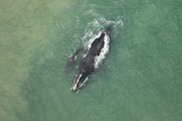
The 2026 North Atlantic right whale calving season has come to a close in the southeast United States. We are cautiously optimistic for the species, as we saw the highest number of right whale calves born in nearly two decades.
|
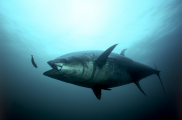
A 30-year study shows that conservation measures in the western Atlantic have created a vital haven, contributing to the recovery of bluefin tuna.
Credit: Tag A Giant
|
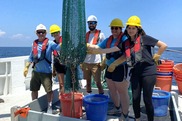
NOAA’s Southeast Fisheries Science Center offers volunteers the opportunity to help collect fisheries and oceanographic data at sea. Learn what to expect as a volunteer and how to apply.
|
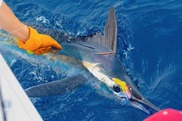
April is Citizen Science Month! To celebrate, we’re highlighting the anglers who make our cooperative tagging research possible—including our 2025 top taggers! Could you be the next top tagger?
Photo courtesy of Chris Jobes.
|
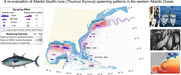
Larval and reproductive sampling from 1955 through 2021 reveals that bluefin tuna may have a nearly continuous spawning area from the Northwest Caribbean to the Slope Sea.
|
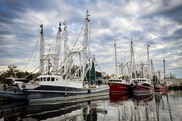
The U.S. shrimp harvesting industry is experiencing a long-term decline in profits and economic stability, including a $268 million revenue loss since 2021. This report is a first step in addressing barriers to restoring its competitiveness.
Photo courtesy of Kelsi Furman.
|
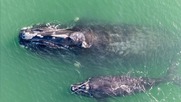
Scientists are acoustically tracking endangered North Atlantic right whales in the Southeast Atlantic. The data we collect help us understand their presence in their less-studied calving habitat. |
|
 |
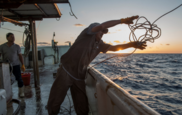
Fisheries management decisions are shaped not only by ecological data, but by people. A new working group is addressing this challenge by exploring how AI can support fisheries managers in making better use of qualitative data–descriptive information that captures people’s thoughts, emotions, and experiences. |
|
 |
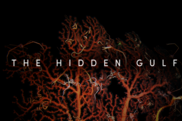
Deep beneath Gulf waters, entire ecosystems live with little to no sunlight. In a new documentary about the mesophotic and deep benthic communities restoration project, follow along as experts use cutting-edge technologies to restore deep coral habitats on the seafloor after the Deepwater Horizon oil spill in 2010. |
|
 |
|
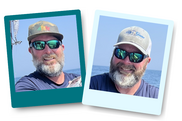
Recreational anglers and charter captains like the Bacon brothers are crucial for collecting data on bluefin tuna migration, behavior, and growth to ensure sustainable fisheries for the future.
Photo courtesy of Brian and Peter Bacon.
|
|
 |
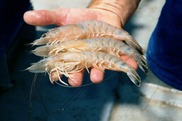
A new study describes how dissolved oxygen and other environmental factors affect the spatial distributions of brown and white shrimp off the coast of Louisiana. |
|
 |
|
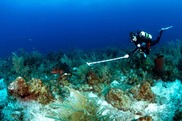
NOAA updated the National Coral Reef Monitoring Program Story Map to include 2025 data and provide a long-term platform for sharing annual accomplishments. Our team here in the Southeast is responsible for fish surveys that support the program mission.
Photo courtesy of Rob Waara.
|
|
 |
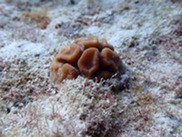
The “old rules” for recovering coral reefs might not work in places like Florida. A new study has identified a new culprit preventing recovery: long sediment-laden algal turfs. |
|
 |
 |
|
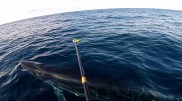
To track the movements of whales, scientists and emergency responders use electronic tags. These tags rely on the same technology—telemetry—that lets people navigate with GPS or find a lost smartphone.
Permit #14450-4
|
 |
|
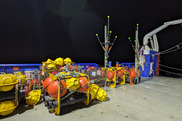
Tracking whales using sound helps scientists better understand the dive behavior of these elusive animals.
Credit: Marine Bioacoustics Research Collaborative, Scripps Institution of Oceanography
|
|
|
 |
|
NOAA Fisheries Assistant Administrator Eugenio Piñeiro Soler reflects on the legacy and the future impact of the Act. |
 |
|
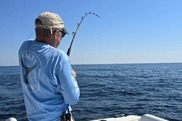
Alabama and Mississippi creel surveys certified as valid sources of data to inform recreational fishery management.
Photo courtesy of Beth Colla.
|
 |
|
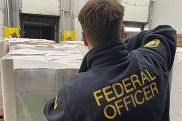
Following two successful NOAA investigations, seafood importers were issued thousands of dollars in fines for improperly labeling tuna cans as "dolphin safe" products. |
 |
|
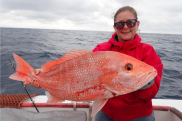
NOAA Fisheries announces a major collaborative step toward boosting red snapper recreational fishing opportunities in the South Atlantic. |
 |
|
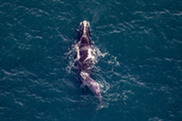
A new real-time messaging network uses a well-established maritime navigation safety technology—the Automatic Identification System—to reduce the risk of vessel strikes involving North Atlantic right whales.
Permit #27066
|
 |
|
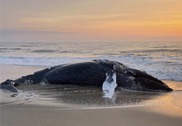
This report details marine mammal stranding rates, trends, and activities in the United States for 2024. In 2024, there were 8,028 confirmed marine mammal strandings in the United States.
Credit: NPS
|
 |
|
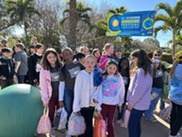
NOAA participates in the 14th Annual St. Petersburg Science Festival school day event. |
 |
|
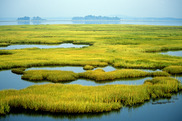
Learn why wetlands are so important to fish, wildlife, and communities, and how NOAA works to protect and restore them.
Credit: Kelly Fike/U.S. Fish and Wildlife Service
|
|
|
Mark Your Calendar
-
May 1, 2026: SEDAR 98 Gulf Red Snapper Assessment Webinar VIII – virtual
-
May 4–6, 2026: Atlantic States Marine Fisheries Commission Spring Meeting – Arlington, Virginia
-
May 5–7, 2026: Gulf Council’s Standing Scientific and Statistical Committee Meeting – Tampa, Florida
-
May 6, 2026: Gulf Restoration Live Stream: Technical Diving for Restoration – virtual
-
May 18, 2026: SEDAR 90 South Atlantic Red Snapper Assessment Webinar 6 – virtual
-
May 18, 2026: SEDAR 99 Gulf King Mackerel Topical Working Group Assessment Webinar I – virtual
-
May 20, 2026: SEDAR 103 U.S. Caribbean Application of Alternate Assessment Methods Data Webinar 4 – virtual
-
May 27, 2026: SEDAR 101 HMS Sandbar Sharks Post-Data Workshop Webinar – virtual
-
June 1–4, 2026: Gulf Council Meeting – St. Augustine, Florida & virtual
-
June 8–12, 2026: South Atlantic Council Meeting – Tampa, Florida & virtual
-
June 9, 2026 SEDAR 98 Gulf Red Snapper Assessment Webinar IX – virtual
-
July 20, 2026: SEDAR Steering Committee Meeting – virtual
-
July 21–23, 2026: Gulf Council’s Standing Scientific and Statistical Committee Meeting – Tampa, Florida
-
July 28–31, 2026: SEDAR 104 Atlantic Dolphinfish MSE Review Workshop – virtual
-
August 17–21, 2026: SEDAR 103 U.S. Caribbean Application of Alternate Assessment Methods Development Workshop – Miami, Florida & virtual
|
|
|
The mission of NOAA's Southeast Fisheries Science Center is to provide the scientific advice and data needed to effectively manage the living marine resources of the Southeast region and Atlantic high seas.
Visit our website
|
|
|
|
|