|
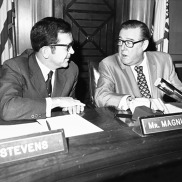
Magnuson-Stevens Act Turns 50
Righting the Course of Distrust
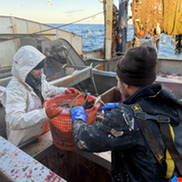
New research published by our social scientists found high costs and low profit in commercial fishing led to distrust in fisheries managers and management processes. Our new web feature highlights some of the ways we’re working to improve trust through collaborative research, creating on-ramps for industry input, and cultivating idea factories.
|
Collaborative Research to Improve Stock Assessments and Management
New Data Visualization Tool Available
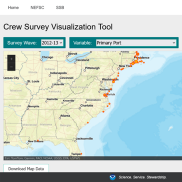
Scientists in our Social Sciences Branch conduct a Crew Survey to better understand the background and experiences of crew members and how fisheries management decisions impact them. Very little is known about the social and economic conditions of commercial fishing crews and hired captains in our region. Yet, they’re a critical part of our commercial fishing industry. We’ve launched a new app that lets the public visualize and download portions of data from our Crew Survey. It shows survey responses to questions regarding demographics, job satisfaction, attitudes about fisheries management, and more. Have a question about the app? Get answers by filling out their contact form.
|
Tell Us About Unusual On-The-Water Observations
Are you a commercial or recreational fisherman in our region? Have you recently seen any notable or unusual things like:
- Odd ocean conditions
- Unusually high or low fishing
- New or different species
- Shifts in migration timing
If so, our State of the Ecosystem team wants to hear from you! When you see these and other kinds of unusual conditions, please email the team at northeast.ecosystem.highlights@noaa.gov. Reported observations will be synthesized into annual reports for the New England and Mid-Atlantic Fisheries Management Councils and used to improve our understanding of the ecosystem.
|
Woods Hole Science Aquarium Update
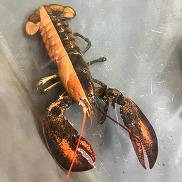
As we head towards summer, we wanted to give a quick update about our Woods Hole Science Aquarium. First, our aquarium will remain closed through early 2027 while construction and renovation activities continue. Next, we’re excited to introduce the newest addition to our aquarium—a 1 in 50 million lobster! We learned through our aquarium network that the Wellfleet Shellfish Company had a rare split-color (bilateral) female lobster they recently acquired from a lobsterman fishing off the coast of Cape Cod, Massachusetts. They were looking to rehome her so she could be shared with the broader community. After seeing photos, our aquarium staff quickly began preparations to pick her up. While construction continues, she and a few other of our former residents are vacationing with our friends at the Marine Biological Laboratory.
|
Branch Chief Recipient of University’s 10 Under 10 Award
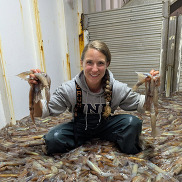
University of Rhode Island Foundation and the Interim Dean of the Graduate School of Oceanography selected Anna Mercer, Cooperative Research Branch chief, as one of their URI Graduate School of Oceanography’s 10 Under 10 Award recipients. They give this award to 10 alumni in recognition of their achievements in the first 10 years after graduation. Anna was selected for her dedication to the University of Rhode Island, her post-graduation work, and her commitment to the community.
|
Subscribe to Our Study Fleet eNewsletter
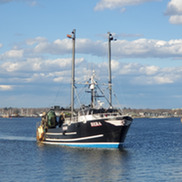
More than 150 fishing vessels have participated in our Study Fleet since 2007. The Study Fleet contributes data to a variety of scientific products. We’re starting a new outreach initiative designed to bridge the gap between scientific data collection and industry participation. The goal is to communicate program updates and scientific products to participants and provide a way to give feedback on the future direction of the program. Owners and captains of about 50 fishing vessels in the Study Fleet receive this eNewsletter quarterly. Interested in receiving this eNewsletter? Contact Katie Burchard to sign up today! |
|
 |
NOAA Seminar Series Highlights Climate Science
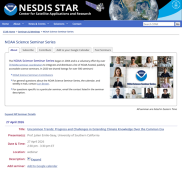
The NOAA science seminar series started in 2004 and hosts more than 500 seminars each year. It’s a great way for the public to learn about the different kinds of science NOAA and others conduct across the globe. If you’re interested in climate science, then check out the seminars that fall on the last Thursday of each month. You can subscribe to receive weekly seminar emails, add seminars to your Google calendar, and watch archived seminars. |
|
 |
Blog: Groundfish Refresh
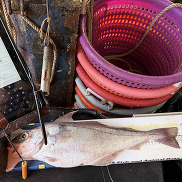
When fish are offloaded from a commercial fishing trip, scientists apply a conversion factor to the weight of gutted fish to convert it to a whole fish weight. Scientists can then use that to evaluate fish stock abundance. The conversion factors used for cod, haddock, and pollock haven’t been updated in a while, so they’re in need of a refresh. A new blog from field scientist Hannah Ciarametaro highlights the collaborative research she’s doing with commercial fishermen to refresh the groundfish conversion factors. This refresh is important because as the ocean changes, fluctuations in temperature and shifting prey availability can impact fish metabolism and physiology, potentially causing changes in average fish size and weight.
|
Director's Message
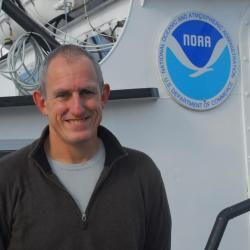
Cooperative research is a priority for us across our fisheries, protected species, and aquaculture activities. Cooperative research generates science to inform managers, help industry, and, most importantly, builds trust among the different groups and individuals with interests in marine resources.
In fisheries, our Cooperative Research Branch in collaboration with Cornell Cooperative Extension recently hosted the 2026 Northeast Cooperative Research Summit. The goal: share new project ideas, enhance collaboration, and improve cooperative research efforts in our region. We’ve recently published a couple web features highlighting some of our cooperative research projects, including outfitting fishing gear with oceanographic sensors and partnering with fishing vessels to design a shortfin squid study, and collecting fish and invertebrate lengths and other biological data to update conversion factors that help improve fisheries stock assessments and management. We also have our Gulf of Maine Bottom Longline Survey, which was initiated, co-designed, and operates collaboratively with members of the groundfish fishery in New England.
In our protected species portfolio, we continue to work with fishery industry members to develop new gear technologies. The intent of this work is to facilitate the development of new options for fishing in closed areas and potential options for responding dynamically to the occurrence of North Atlantic right whales.
In our aquaculture portfolio, we’ve partnered with USDA and oyster growers to advance selective breeding methods to develop disease-resistant oysters that are resilient in the face of current and changing environmental conditions.
These are just three examples of how we’re working cooperatively and collaboratively across our science activities.
|
|
|
Upcoming Events
Jun 29–30: Management track stock assessment peer review meeting
Nov 16–17: Flatfish Biology Conference
|
|
Upcoming Deadlines
Apr 30: Community input on 2027 Management Track assessments
Jul 1: Poster and oral presentation titles for Flatfish Biology Conference
|
|
|
|
|