|
Highlights
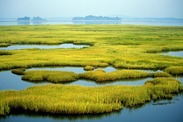
Wetlands—including marshes, mangroves, swamps, and floodplains—provide valuable benefits. They are habitat for the fish we eat, protect coastal communities from storms, and help filter pollution out of our water. Learn more about why wetlands are so important to fish, wildlife, and communities, and how NOAA works to protect and restore them.
|
|
|
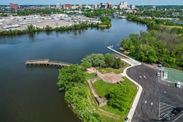
Habitat restoration projects that target lost recreational use are designed to create new or improved access for the public, making up for the time that the resource was unavailable. These projects often improve infrastructure to better conditions than before the incident, providing long-term benefits to local communities.
|
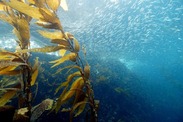
NOAA's Modeling, Analysis, Predictions and Projections program has awarded funding to seven new research projects that will advance its integrated capability for predictions in support of the Changing Ecosystems and Fisheries Initiative. This research will accelerate the development of high-resolution regional ocean models, directly supporting the sustainability and economic productivity of vital U.S. marine and freshwater resources.
|
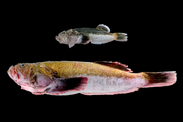
A new publication, co-authored by scientists from NOAA Fisheries, describes new insights about the freckled stargazer—a rarely seen deepwater fish. Fisheries biologists recently documented the species in locations along the East Coast, previously thought to be outside its range. Their work demonstrates how surveys and museum collections are continuously contributing to our understanding of U.S. fisheries.
|
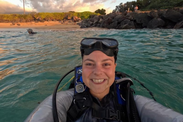
Rachel Roday recently completed her Knauss Fellowship with NOAA Fisheries’ Office of Science and Technology. An expert in fish ecology and physiology with a master’s from the University of Delaware, she worked as an International Fisheries Science Specialist during her fellowship. Learn more about Rachel’s experience as a Knauss Fellow!
|

Dr. Claire Gonzales recently completed her Knauss Fellowship with NOAA Fisheries’ Office of Science and Technology. An expert in marine spatial planning for the blue economy with a Ph.D. from UC Santa Barbara, she worked as a Species Distribution Mapping and Analysis Specialist during her fellowship. Learn more about Claire’s experience as a Knauss Fellow!
|
|
|
Alaska
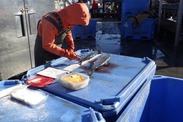
Scientists explored the effectiveness of shore-based observers in place of at-sea observers in a high-volume trawl fishery. By combining electronic at-sea monitoring with human observers onshore, researchers found this hybrid approach still delivers reliable species counts that support stock assessments. They also developed a structured approach to evaluate shoreside monitoring programs in fisheries that lack at-sea human observers.
|
|
|
New England/Mid-Atlantic
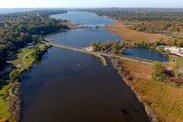
Muskegon Lake was officially removed from the U.S. Environmental Protection Agency’s Areas of Concern list. It was originally designated one of the most environmentally degraded sites in the Great Lakes 40 years ago. NOAA Fisheries’ Office of Habitat Conservation, the EPA, and other partners worked for decades to restore the area. This milestone marks a major achievement for the Muskegon community and for Great Lakes restoration efforts.
|
|
|
Pacific Islands

Looking for seafood in the Pacific? Some of the world’s most popular fish, like tuna, are freshly landed in the Pacific Islands region. Other species, like limu (algae), shrimp, and sea cucumber, are raised in loko i‘a—a modern adaptation of an ancient Hawaiian aquaculture practice that continues today. Choosing local seafood is a great way to eat well and support fishing livelihoods. And we have you covered with these tips on how to find it.
|
|
|
Southeast
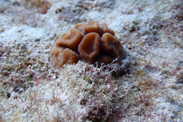
The traditional way scientists have understood the resilience and recovery of corals on reefs may no longer apply in explaining their decline in Florida. A recently published study has identified a new culprit hindering the recovery of corals in Florida: long sediment-laden algal turfs.
|
|
|
West Coast
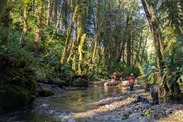
With funding from NOAA, the Quinault Indian Nation and its partners are using helicopters to build more than 130 log jams along 8 miles of habitat on the Queets-Clearwater watershed. Using helicopters to build them means the project team doesn’t have to build roads to bring in equipment and supplies, preventing further damage to the ecosystem. Thanks in part to restoration funding, the Quinault Indian Nation is also one of the region's largest employers for tribal members and other residents.
|
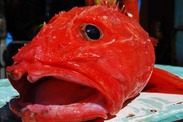
The West Coast groundfish fleet will benefit from a new emergency rule increasing catch limits for three key species that have proved more abundant than previously thought. This is the largest fishery by volume on the West Coast. The decision provides greater opportunity for the fishery, supplying more domestic seafood for the country.
|
|
|
Upcoming Deadlines
February 13: Applications due for the South Carolina Commercial Seafood Apprenticeship Program
February 15: Proposals due for the Western Pacific Regional Fishery Management Council: Regional Governance and Policy Coordination
February 15: Proposals due for the Western Pacific Regional Fishery Management Council: International Fisheries Coordination
February 24: Applications due for Department of Transportation's 2026 Better Utilizing Investments to Leverage Development Grant Program
February 28: Applications due for Department of Transportation Maritime Administration’s Port Infrastructure Development Program
March 23: Applications due for the Scallop Research Set Aside Program
March 31: Entries due for the 2026 Atlantic Highly Migratory Species student art contest
April 15: Applications due for United States Department of Agriculture’s Value-Added Producer Grants
View more news and announcements
|
|
Upcoming Events
February 2–11: North Pacific Fishery Management Council meeting in Anchorage, AK
February 3–April 7: Introductory Fisheries Science for Stakeholders course hosted online by Rutgers Cooperative Extension
February 10–11: Mid-Atlantic Fishery Management Council meeting, via webinar
February 11: Safe Handling, Release, and Identification Workshop in Marathon, FL
February 19: Atlantic Shark Identification Workshop in Melville, NY
February 26: Northeast Cooperative Research Summit in Riverhead, NY
March 2–6: South Atlantic Fishery Management Council meeting in Jekyll Island, GA
March 5: Atlantic Shark Identification Workshop in Wilmington, NC
March 5–9: Pacific Fishery Management Council meeting in Sacramento, CA
March 15–17: Seafood Expo North America in Boston, MA
March 17: Safe Handling, Release, and Identification Workshop in Houston, TX
April 10–16: Marine Resource Education Program Federal Fisheries Science & Management Workshop in Honolulu, HI
View more events
|
|
|
|
|