New Right Whale Slow Zone: East of Ocean City, MD
Effective through February 17
On February 2, 2026, the Ocean City buoy operated by the Woods Hole Oceanographic Institution and University of Maryland Center for Environmental Science detected the presence of right whales east of Ocean City, MD. The right whale Slow Zone is in effect through February 17, 2026.
As a reminder, four additional Slow Zones are also currently in effect. Locations and effective dates are listed below.
Voluntary Right Whale “Slow Zone” Areas
Mariners are requested to avoid or transit at 10 knots or less inside the following Dynamic Management Areas and Slow Zones where endangered right whales have been detected. Vessel strikes are one of the primary causes of injury and death for right whales. Slower speeds are known to reduce the severity of impacts to whales when strikes occur and may provide boat and vessel operators an opportunity to avoid a collision. Visit our website for more information.
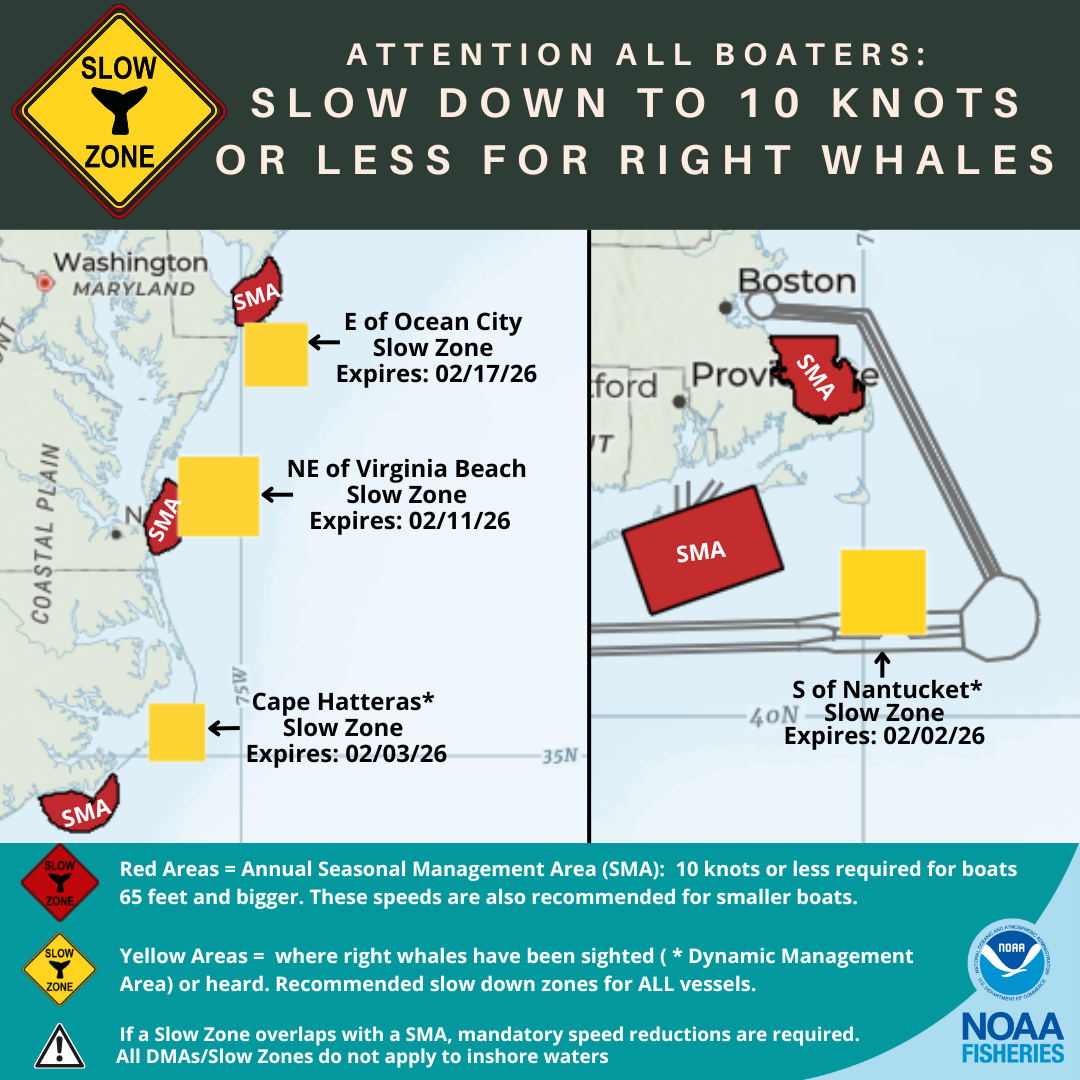 East of Ocean City, MD Slow Zone: Effective February 2 - 17, 2026
Waters bounded by:
Northern boundary: 38°34′ N
Southern boundary: 38°03′ N
Eastern boundary: 74°19′ W
Western boundary: 74°58′ W
Savannah, GA Slow Zone: Effective January 31 - February 13, 2026
Waters bounded by:
Northern Boundary: 32°04′ N
Southern Boundary: 31°34′ N
Eastern Boundary: 80°01′ W
Western Boundary: 80°37′ W
Northeast of Virginia Beach, VA Slow Zone: Effective January 27 - February 11, 2026
Waters bounded by:
Northern boundary: 37°29′ N
Southern boundary: 36°50′ N
Eastern boundary: 74°49′ W
Western boundary: 75°40′ W
Cape Hatteras, NC Slow Zone: Effective January 19 - February 3, 2026
Waters bounded by:
Northern boundary: 37°27′ N
Southern boundary: 34°57′ N
Eastern boundary: 75°22′ W
Western boundary: 75°58′ W
South of Nantucket, MA Slow Zone: Effective January 18 - February 2, 2026
Waters bounded by:
Northern Boundary: 40°59′ N
Southern Boundary: 40°29′ N
Eastern Boundary: 69°31′ W
Western Boundary: 70°11′ W
Active Seasonal Management Areas
Mandatory speed restrictions of 10 knots or less (50 CFR 224.105) are in effect for most vessels 65 feet or longer in the following areas:
Mid-Atlantic: November 1-April 30
Southeast: November 15-April 15
Cape Cod Bay: January 1–May 15
North Atlantic right whales are on the move along the Atlantic coast of the United States. To protect right whales, regulations prohibit approaching or remaining within 500 yards (1,500 feet) of a right whale. That’s the length of about five football fields.
Endangered North Atlantic right whales remain highly vulnerable to extinction, as human impacts continue to threaten the survival of this species. There are approximately 380 individuals remaining, including about 70 reproductively active females.
In August 2017, NOAA Fisheries declared the increase in right whale mortalities an Unusual Mortality Event, which helps the agency direct additional scientific and financial resources to investigating, understanding, and reducing the mortalities. This work is done in partnership with the Marine Mammal Stranding Network, Canada’s Department of Fisheries and Oceans, and outside experts from the scientific research community.
All boaters from Maine to Florida, or interested parties, can sign up for email or text notifications about the latest Right Whale Slow Zones. You can also follow us on Facebook (@NOAAFisheriesNEMA) and X (@NOAAFish_GARFO and @NOAAFisheriesSE) for announcements.
Share our video on Right Whale Slow Zones.
Attention Right Whale Slow Zone Subscribers
Email and text notification settings can now be filtered to include Right Whale Slow Zone announcements from specific regions. Access your subscriber preferences to update your existing notifications.
|