|
NOAA Fisheries Re-Opens Comment Period on Restoring American Seafood Competitiveness
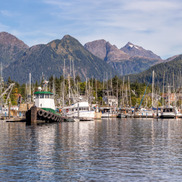
NOAA Fisheries reopened the comment period on the President’s Executive Order on Restoring American Seafood Competitiveness. It is open until December 15, 2025. Specifically, we’d like to hear your thoughts on: regulations governing fishing activities that may be suspended, revised, or rescinded; challenges specific fisheries are facing, suggestions for innovative improvements, and examples of existing federal fishery regulations that could be modified to enhance U.S. fishing businesses; ways to improve fisheries management and science; how to expand exempted fishing permit programs to promote fishing opportunities nationwide.
|
Longline Sampling Confirms Young Bluefin Tuna Spawn in the Slope Sea
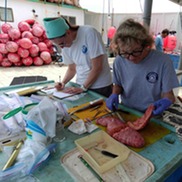
Atlantic bluefin tuna are prized by fishermen. They are challenging to study, because they migrate long distances. We recently embarked on a cooperative research project to understand bluefin tuna spawning in the Slope Sea. The longline sampling trip looked for spawning adult fish, while the second expedition collected the results of that spawning—larval bluefin tuna. Both were successful. For 2 weeks, scientists worked alongside the crew of the F/V Eagle Eye II to collect samples from commercial bluefin catch. These samples likely confirm that younger, smaller fish are spawning in the Slope Sea, providing a clearer understanding of bluefin reproductive ecology. The data provides critical information to improve how this valuable species is managed.
|
2025 Atlantic Sea Scallop Dredge Survey
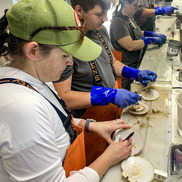
In July, we completed our annual Atlantic Sea Scallop Dredge Survey aboard the commercial fishing vessel F/V Selje. The crew and scientific team completed 84% of the planned stations, making this a fully representative survey. Excellent weather and the crew and scientific staff’s efficiency and hard work ensured the survey’s success. This year’s survey included sampling and station selection improvements and saw a very large catch of 48,000 young scallops estimated to be 2–4 years old at one of the fixed stations. Want to see more great photos from this survey? Check out our new photo gallery!
|
2025 Fall Gulf of Maine Bottom Longline Summary
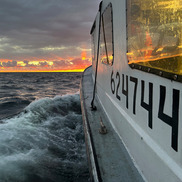
The 2025 Fall Cooperative Gulf of Maine Bottom Longline Survey successfully sampled all planned stations in the western and central Gulf of Maine, extending our time series of abundance and biological data to 12 years. Conducted aboard two commercial fishing vessels, the survey targets rocky habitats that are challenging to sample with trawl gear. This season we deployed a new data collection app, which increased efficiency by connecting scales and measuring boards via Bluetooth. Spiny dogfish was the most abundant species sampled, followed by: white hake, cusk, haddock, barndoor skate, red hake, Atlantic cod, thorny skate, and pollock.
|
Retro Recipe Rewind Your Holiday Menu with Seafood
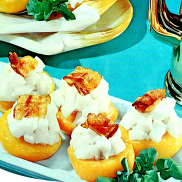
Retro rewind your holiday menu with seafood recipes from our archives! Hold on tight as we travel back to 1965 for some groovy recipes from our Legacy Test Kitchen Series. Want a breakfast recipe? Check out this peachy scallops recipe with Atlantic sea scallops, peaches, cinnamon, cloves, and mace. These warming spices just scream holidays. Or maybe you want to impress your guests, presenting them with a whole flounder stuffed with crab. Be sure to check our Instagram all month for more retro recipe highlights!
|
Director's Message

December is a time to reflect on the past year. Our science center has been extremely successful this year. We overcame challenges and made significant scientific advancements. Here is a small selection:
- Our scientists contributed to an Aquaculture Gear Guide that supports decision makers in conducting environmental reviews for aquaculture permitting. This guide will support the expansion of aquaculture in a sustainable manner.
- The recent annual North Atlantic Right Whale abundance estimate shows a continued slow increase in abundance, which is a good sign for the species. From the scientific point-of-view, the data and model used to generate this estimate are par excellence and result in accurate and precise information to track species status.
- Our Population Dynamics Branch continues to produce high-quality assessments and advance the science of stock assessments. The Woods Hole Assessment Model is used for an increasing number of stocks (Acadian Redfish transitioned in 2025) and we continue to develop it to improve the quality of assessments (a technical example).
- Our science center, partnering with Woods Hole Oceanographic Institution, continued to expand operational deployment of Long Range Autonomous Underwater Vehicles as part of Atlantic sea scallop surveys. Data collected from the LRAUVs this year were used in combination with other data to support scallop management (NEFSC Survey Report).
- Our observer program worked with the Greater Atlantic Regional Fishery Office to successfully merge observer operations with biological port sampling. Bringing these two programs together was a large administrative and organizational task that will lead to greater efficiencies and perhaps additional opportunities for fishery-dependent data collection (see website).
It is challenging to capture a year—especially a year like 2025—in five examples; there are so many examples of success and achievement across our science center. That said, these five illustrate our commitment to modernizing data collection and analytical practices to improve the ability of managers to respond to real-time conditions.
|
|
|
Upcoming Events
Jan 7-9: Northeast Aquaculture Conference & Expo and the Milford Aquaculture Seminar
|
|
Upcoming Deadlines
Jan 31: Applications due for Hollings Undergraduate Scholarship
|
|
|
|