|
Greetings everyone,
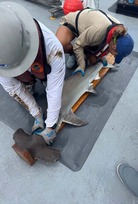
September is a busy month for us here at the Center. Besides wrapping up the usual end of fiscal year administrative closeouts and monitoring peak season hurricanes, we are always busy with a flurry of scientific activities. NOAA Ship Gordon Gunter is currently underway for the final leg of the Fall Plankton Survey and NOAA Ship Oregon II is out conducting the final leg of the Bottom Longline Survey. To the right, see a photo of our team measuring a hammerhead shark.
Photo credit: NOAA Fisheries/Annsli Hilton
|
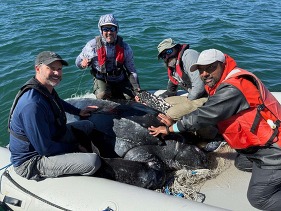
In October, the Oregon II will shift to the fall trawl survey and NOAA aircraft will be looking for whales as part of the Gulf of America Protected Species Aerial Survey. We also had a successful year tagging leatherback sea turtles. In the photo to the left, Chris Sasso and team are shown tagging one of nine they encountered off Nantucket Shoals.
Photo credit: NOAA Fisheries/Heather Haas, Permit #21233
Meanwhile, several of our scientists traveled to Spain to represent the United States during the International Commission for the Conservation of Atlantic Tuna’s Subcommittee on Research and Statistics (SCRS). Among other things, Atlantic bluefin tuna are once again a hot topic (see the article below). Fortunately, our folks are there to help ensure that the process remains unbiased and uses the best scientific information available.
|
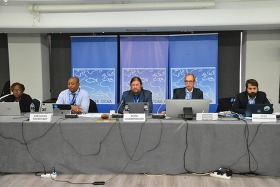
When Assistant Administrator Piñiero-Soler goes to the Commission meeting in November, he can be confident that the scientific advice coming out of the SCRS is sound. To the right is a photo of the Chair of the SCRS in action, our own Craig Brown.
Photo credit: ICCAT
|
We were also very fortunate to host a visit from acting Under Secretary of Commerce for Oceans and Atmosphere and NOAA Administrator Laura Grimm and several other members of the NOAA political team (see photo caption). She and the team very much appreciated the opportunity to see the breadth of science our team provides in support of fisheries and ecosystems, and the communities that depend on them.
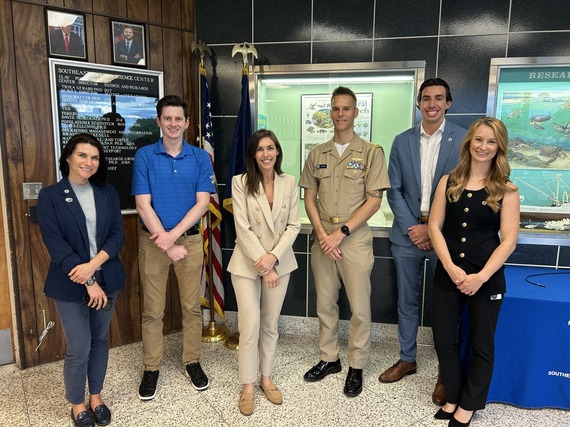 From left to right: Katia Kontar (NOAA National Environmental Satellite, Data, and Information Service), Keegan McLaughlin (Special Assistant), Laura Grimm, Lieutenant Commander Blair Delean (NOAA Office of Marine and Aviation Operations), Cole Mushegan (Special Assistant), Kim Doster (NOAA Communications Director). Credit: NOAA Fisheries
“It was valuable to observe your coral restoration operations and insightful to hear from your team on site about advances and priorities in cooperative research with fishermen, the application of AI for video analysis in fisheries science, and to discuss possible linkages between the challenges facing the shrimp industry and the Seafood Competitiveness Executive Order.” Laura Grimm
Of course these are just a few of the highlights this month. As always, there is a lot more going on at the Center so keep reading!
 |
|
Thanks for your continued support and interest,
Clay Porch, Ph.D
Southeast Fisheries Science Center Director
clay.porch@noaa.gov
|
|
|
Dive into our new StoryMap to explore the Gulf Fishery-Independent Survey of Habitat and Ecosystem Resources and how we’re using advanced technology and artificial intelligence to advance our survey enterprise. |
|
 |
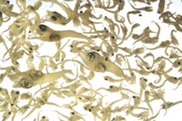
NOAA scientists are using new methods to try to solve the 40-year-old mystery of Atlantic bluefin tuna stock structure and spawning. |
|
 |
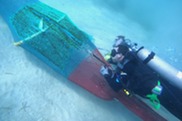
A recently completed restoration project finds that modifications to the bar spacing on turtle excluder devices can successfully exclude small turtles while maintaining shrimp catch. |
|
 |
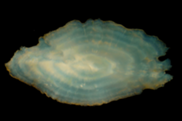
Fishery Biologist Andy Ostrowski shared a blog in North Carolina Sea Grant’s Hook, Line and Science about how NOAA Fisheries scientists use ear bones, scales, or spines to estimate a fish’s age. |
|
 |
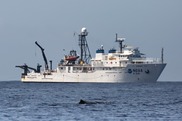
Scientists are at sea tagging endangered sperm whales to learn about their movements and behavior. |
|
 |
In partnership with the fishery, NOAA Fisheries scientists developed and tested modified turtle excluder devices (TEDs) with smaller bar spacing. These modifications successfully excluded small turtles and maintained shrimp catch. |
|
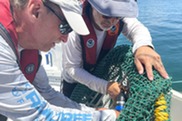 |
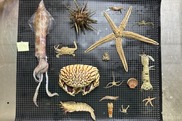
To celebrate National Intern Day, intern Michelle Rife describes her summer with NOAA Fisheries, both on land and at sea. |
|
 |
A semi-retired science teacher joins his former middle school student, now a NOAA employee, on a research survey with the Southeast Fisheries Science Center. |
|
 |
A NOAA scientist is joined by his former middle school science teacher on a research survey—the same teacher who inspired him to study marine science. |
|
 |
|
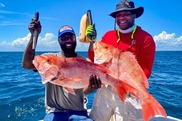
We selected six new partnerships and seven projects as part of a collaborative, state-federal initiative aimed at improving recreational fishing effort and discard data collection in the Gulf of America.
Photo credit: Captain Grayson Shepard
|
|
 |
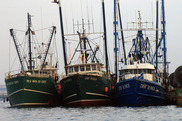
NOAA Fisheries is modernizing our Atlantic Coast logbook reporting systems for both commercial and for-hire fishermen to improve efficiency and lower costs. |
|
 |
|
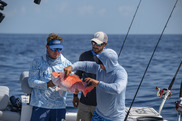
Return ‘Em Right is working to improve the survival of reef fish in the Gulf of America. A new video series highlights the many individuals dedicated to ensuring the enjoyment of anglers for decades to come.
Photo credit: Return ‘Em Right
|
|
 |
|
|
 |
|
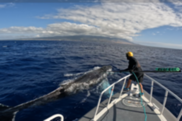
There were 95 large whale entanglement cases documented in 2024—an increase from 2023 and higher than the historical average. |
 |
|
NOAA identified 13 Aquaculture Opportunity Areas totaling more than 21,000 acres—including 4,500 in the Gulf of America. |
 |
|
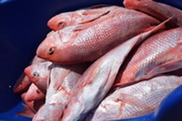
NOAA Fisheries offers new online marketplace to buy and sell Individual Fishing Quota privileges. |
 |
|
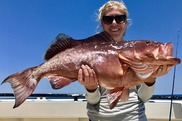
NOAA Fisheries is implementing an emergency rule that will increase the Gulf of America red grouper catch limits and extend the recreational fishing season. |
 |
|
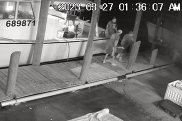
Following a successful NOAA investigation, the fisherman was sentenced to more than 1 year in jail and thousands of dollars in fines. |
 |
|
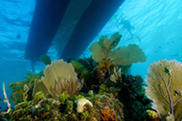
NOAA and its partners are restoring Florida’s coral reefs to protect marine life, boost the local economy, and support tourism jobs. We also give divers and businesses a hands-on role in saving these vital ecosystems. |
 |
|
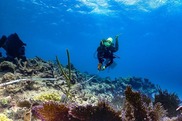
Researchers are implementing new strategies to future-proof Florida’s reefs. |
|
|
Mark Your Calendar
-
October 7–9, 2025: Gulf Council’s Standing & Shrimp Scientific and Statistical Committee Meeting – Tampa, Florida & virtual
-
October 15, 2025: SEDAR 90 South Atlantic Red Snapper Assessment Webinar
-
October 20, 2025: Registration opens for the People and Nature Symposium (February 10–11, 2026 in Gainesville, Florida)
-
October 21–23, 2025: South Atlantic Council’s Scientific and Statistical Committee Meeting – Charleston, South Carolina & virtual
-
October 27–30, 2025: Gulf States Marine Fisheries Commission 76th Annual Meeting – Biloxi, Mississippi
-
October 27–30, 2025: Atlantic States Marine Fisheries Commission 83rd Annual Meeting – Dewey Beach, Delaware
-
November 3–6, 2025: Gulf Council Meeting – Biloxi, Mississippi & virtual
-
December 3–4, 2025: 188th Caribbean Fishery Management Council Meeting – St. Thomas, U.S. Virgin Islands
-
December 8–12, 2025: South Atlantic Council Meeting – Kitty Hawk, North Carolina
|
|
|
The mission of NOAA's Southeast Fisheries Science Center is to provide the scientific advice and data needed to effectively manage the living marine resources of the Southeast region and Atlantic high seas.
Visit our website
|
|
|
|
|