Atlantic Coast Updates
NOAA Fisheries is modernizing Atlantic Coast logbook reporting systems for both commercial and for-hire fishermen to improve efficiency and lower costs.
“Combining five independent logbook systems into a single system for the Atlantic Coast will save costs and create opportunities, through economies of scale, to build a higher functioning system. The end result will be more and higher-quality data, which will allow for more agile management of fisheries,” states Torey Adler, software development manager at NOAA Fisheries Greater Atlantic Regional Fisheries Office.
We have updated our LPS web page to include more information on the estimate publication schedule and review procedures and status of the LPS redesign, among other updates.
Gulf Coast Updates
NOAA Fisheries and the Gulf States Marine Fisheries Commission announced six new partnerships and seven projects aimed at improving recreational fishing effort and discard data collection in the Gulf of America (formerly Gulf of Mexico). This effort represents a key investment in enhancing data quality and reducing data uncertainty to support sustainable fisheries management across the region.
The projects will receive $7.5 million from the Commission. They will focus on advancing innovative methods to collect more accurate, timely, and regionally relevant data on recreational fishing activities and released catch, commonly known as discards. These projects will address known data gaps and challenges in current reporting systems. They will contribute directly to better-informed stock assessments, management decisions, and conservation strategies.
Gulf Transition Plan
We collaborated with Gulf of America regional and state partners on an interim update and projected timeline (both products now live) to the Gulf Transition Plan. The plan provides a framework for:
- Transitioning to the effective use of Gulf state recreational fishing data in southeast stock assessments and Gulf Fishery Management Council management processes
- Making necessary research-informed survey improvements
- Producing estimates from different Gulf survey designs into the same scale (calibration) and/or producing a composite estimate that integrates the data from all the Gulf surveys
Hawai'i Updates
Strengthened State Partner Estimate Review Process
Hawaii has been added to our Procedures for State Partner Review of NOAA Fisheries’ Marine Recreational Information Program Estimates.
This process was implemented in 2024 to better leverage regional and state partner local fisheries expertise in MRIP estimate reviews. See more on this process below!
Hot Topic
Read the full article here.
Over the past year, NOAA Fisheries developed, refined, and launched a strengthened procedure for review of recreational fishing catch and effort estimates. This effort was in close collaboration with our Atlantic and Gulf of America state and interstate marine fishery commission partners. In summer 2025, we updated the process to include Hawaii state partners.
This is an evolving process that has benefitted greatly from our regional and state partners’ local fisheries expertise and knowledge in identifying estimates that appear inconsistent with expected fishing behavior patterns or past trends, including results that could have important implications for fisheries management.
This partner review process augments NOAA Fisheries’ existing internal data review quality checks. These include estimate reviews from regional experts at our regional offices and science centers.
To maximize efficiency, we request partners be as specific as possible when flagging estimates and include information such as the state, year, wave, fishing mode, area fished, catch type, and/or effort, and the rationale for flagging the estimate, referencing one or more scenarios outlined in the procedure. Scenarios include an unexpectedly high or low estimate for a high-profile species in comparison to other estimates in the year/season or the same 2-month wave over time; an estimate that unexpectedly exceeds an annual catch limit by a significant amount; an estimate that is significantly misaligned with seasonal or in-season projections; and landings for prohibited species or species landed out of season.
Positive Partner Response
Partner response to the strengthened review procedure has been positive.
Alex DiJohnson, Atlantic Coastal Cooperative Statistics Program recreational team lead, said, “It’s been really, really great so far,” adding that states feel a new sense of ownership in the estimate review process. “The states seem excited,” he noted. “They’re ready to get their hands dirty.”
Dawn Franco, Georgia Department of Natural Resources Coastal Resources Division marine biologist, agrees. “We greatly appreciate the open dialogue and the renewed emphasis on estimate review over the past year. The process has become more streamlined along the way.”
Additional Estimate Review and Tracking Tool Forthcoming
We are also developing a new online data review tracking tool to streamline and improve efficiency of data reviews. It will serve as a comprehensive, transparent record of estimate reviews and outcomes. A prototype is anticipated by the end of 2025.
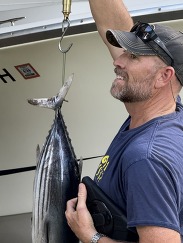
Meet Patrick Conley, Access Point Angler Intercept Survey interviewer with the Hawai’i Division of Aquatic Resources
APAIS is one NOAA Fisheries’ recreational fishing survey, and it gathers catch-per-trip information from anglers as they complete their fishing trips. The survey is conducted by specially trained state survey samplers at marinas, boat ramps, beaches, piers, and other public fishing access sites.
|
|
 |
- Time as an APAIS interviewer
- Patrick has been an APAIS survey interviewer with HDAR since 2004
- Educational background
- New England Culinary Institute, associate degree in Culinary Arts
- Favorite fishing activity and why
- Patrick loves snapper fishing in the winter on light wind days. He uses electric reels in water depths between 600 and 1,200 feet and targets long tail red snapper.
- “It’s a really fun challenge to fish on submerged prehistoric reefs. You have to know the fish’s behavior patterns and become really familiar with each spot. You also need to know the currents and have expert boat handling. It’s always fun to catch your bait first, like opelu or aku.”
- What I like most about my job
- "Talking to fishermen. I love learning from them, sharing tips and other fishing stories, and exchanging recipes. It’s great to be near the ocean every day, to see the weather fronts move through, experience the rhythm of the ocean, and see the tidal changes. When a school like big eye scad moves in near a survey interview location, it can get really exciting."
- Clearing up common misconceptions
- "When I first walk up to fishers, so many initially think I am law enforcement. Many fishers think providing their fishing data will shut down fisheries or lead to tighter restrictions. However, contributing to non-commercial data collection efforts helps support optimal fishing opportunities. Participating in surveys lets the fishing community have a little more voice and visibility. We all have the same goal: we want to keep catching fish and have a healthy ocean. If we have no idea what’s going on out there, it’s really hard to have good management."
In the News
Recent and Upcoming Key Meetings
-
Aug. 7, 2025 - NOAA Fisheries Office of Science and Technology virtually held their third quarter Transition Team Meeting with Gulf partners. During this meeting, Alabama and Mississippi state partners shared preliminary findings from their dockside and effort state creel survey pilot studies.
-
September 2025 - Desk peer review of the Fishing Effort Survey 2024 study report and improved design proposal (more info above). The peer review and report is anticipated in October.
-
Sept. 3 - 4, 2025 - Atlantic Highly Migratory Species Advisory Panel meeting.
-
Sept. 9 - 10, 2025 - Atlantic Coastal Cooperative Statistics Program Recreational Technical Committee meeting in Alexandria, Virginia.
-
Sept. 23 - 24, 2025 - Independent virtual peer review of the proposed FES calibration model methodology (open to the public, more info above).
-
Sept. 29, 2025 - MRIP Transition Team meeting with Atlantic, Gulf, and Hawai'i Transition Team subgroups to discuss the transition plan for effectively implementing the improved FES.
-
Oct. 14 - 16, 2025 - Pacific Coast Recreational Fisheries Information Network Technical Committee Meeting.
-
Oct. 20 - 29, 2025 - NOAA Fisheries New Council Member Training. The MRIP presentation is slated for Oct. 27.
-
Oct. 27 - 30, 2025 - Gulf and Atlantic states marine fisheries commissions annual meetings in Biloxi, Mississippi, and Dewey Beach, Delaware, respectively.
-
Nov. 17 - 21, 2025 - NOAA Fisheries OST will participate in the Southeast Marine Resource Education Program in St. Petersburg, Florida.
-
Nov. 19 - 20, 2025 - National State Directors Meeting in New Orleans, Louisiana.
-
Dec. 8 - 12, 2025 (TBD) - During the South Atlantic Fishery Management Council Meeting in Kitty Hawk, North Carolina, representatives from NOAA Fisheries Southeast Fisheries Science Center and OST will present considerations for how a potential private recreational permit for the snapper grouper fishery would be incorporated into MRIP survey methodology and recreational catch and effort estimation. This presentation request is in relation to Snapper Grouper Amendment 46 (recently paused by the Council to focus on de-regulatory actions).
- Fishing Effort Survey updates scheduled at the following meetings:
- Sept. 9 - 10, 2025 - Mid-Atlantic Fishery Management Council (MAFMC) Scientific and Statistical Committee (SSC) meeting, Baltimore, Maryland
- Oct. 7 - 9, 2025 - Gulf Council SSC meeting, Tampa, Florida; MAFMC meeting, Philadelphia, Pennsylvania
- Oct. 27 - 30, 2025 - Atlantic States Marine Fisheries Commission annual meeting, Dewey Beach, Delaware
- Dec. 8 - 12, 2025 - South Atlantic Fishery Management Council meeting, Kitty Hawk, North Carolina
- Dec. TBD - Western Pacific Fishery Management Council meeting
- Jan. 27 - 29, 2026 - New England Fishery Management Council meeting, virtual
|