|
Woods Hole Science Stroll August 9
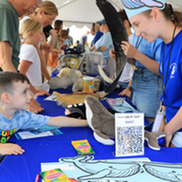
Mark your calendar for the Woods Hole Science Stroll, an annual outdoor open house featuring marine science institutions located in Woods Hole, Massachusetts—including our center’s Woods Hole Laboratory. Visitors learn about the big science that goes on in this small village on Cape Cod. Exhibits and demonstrations are arrayed all along the main street and waterfront park, from the Post Office to our laboratory. Many local science institutions and organizations will be participating this year, including the Woods Hole Oceanographic Institution, the University of Chicago Marine Biological Laboratory, the U.S. Geological Survey, Woodwell Climate Research Center, and the U.S. Coast Guard.
|
On-Demand Gear Pages Updated
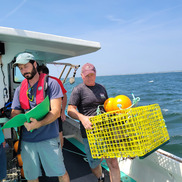
The science center’s gear research team recently updated their home, Gear Lending Library, and Developing Viable On-Demand Systems pages. The updates include more details about the specific gear available within the gear library. They also explain how the gear is used to reduce entanglements of critically endangered North Atlantic right whales and allow fishermen to fish within areas closed to static vertical buoy lines. These pages demonstrate the essential collaboration between NOAA scientists, commercial fishermen, gear manufacturers, and others that make this research possible. If you are a fisherman interested in trialing on-demand gear, you can find more information including how to contact the gear research team by checking out these updated pages!
|
2025 On-Demand Gear Testing Complete
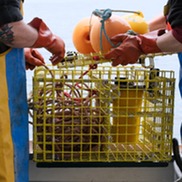
In May, we completed 2025 on-demand fishing gear testing in both state and federal waters when lobster and Jonah crab fishing using static vertical lines is restricted. This year participating fishermen conducted 913 hauls on 15 vessels. This is the third year of fully on-demand system testing in restricted areas and the fifth year of testing on-demand gear more broadly across the Greater Atlantic region. Now that the restricted area season is complete, we are onboarding new fishermen collaborators, starting sea trials with new and updated on-demand systems, and conducting research on digital gear marking and set location technologies.
|
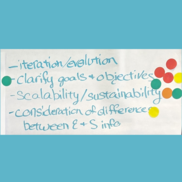
Ecosystem & Socioeconomic Profile Workshop Tech Memo Published
A new tech memo summarizing the 2024 Northeast Ecosystem and Socioeconomic Profile Workshop is now available on the NOAA Institutional Repository. Ecosystem and Socioeconomic Profiles are an Ecosystem-Based Fisheries Management tool that integrates ecosystem and socioeconomic information into fisheries advice for decision makers. This report summarizes the workshop discussions, provides additional information on integration with fisheries management, and discusses a Northeast roadmap. Workshop participants agreed that Ecosystem and Socioeconomic Profiles are a timely product, and committed to continued collaboration to ensure that they are accessible, interpretable, and actionable for scientists and decision makers. Ecosystem and Socioeconomic Profiles will continue to evolve as we adapt to changing priorities.
|
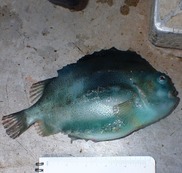
Northeast Observer Program Launches Streamlined Data App
Compass is a flexible web-based application developed to replace single purpose observer data systems in the Northeast. Compass streamlines data entry, editing, auditing, and reporting into a single platform. Its architecture adapts forms based on program attributes like gear type, ensuring efficiency and flexibility across monitoring programs. We launched phase one of a three phase rollout in May, marking a major milestone in modernizing observer data systems. When all phases are complete, Compass will significantly reduce the time between fishing trip and data availability; improving accuracy, accessibility, and long-term sustainability of fisheries data management.
|
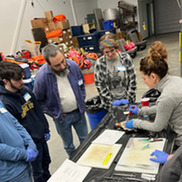
Science Center Staff and Fisheries Observers Collaborate on Marine Mammal Necropsies
In June, the Protected Species and Fishery Monitoring & Research Divisions collaborated on four marine mammal necropsies—animal autopsies—held June 10, 12, 24, and 26, at Woods Hole Oceanographic Institution’s Marine Research Facility. Led by Lauren Noble and Dr. Andrea Bogomolni, the team examined three harbor porpoises and one seal collected by fisheries observers deployed on commercial fishing vessels. Science center staff and fisheries observers participated in the necropsies, gaining firsthand insight into how their data informs larger scientific efforts. These necropsies strengthen collaboration and help connect at-sea observations to broader assessments of ecosystem health, enhancing our understanding of marine mammal mortality and informing conservation strategies.
|
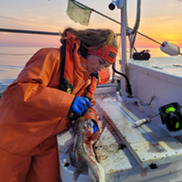
Blog: From Observer to Surveyor
A new blog from field scientist Hannah Ciarametaro shares her reflections on returning to sea aboard the F/V Mary Elizabeth for her first Gulf of Maine Bottom Longline Survey. We say “return” because Hannah actually started out as a fisheries observer and sailed on the F/V Mary Elizabeth years ago. Although the Mary Elizabeth was a familiar sight, participating in a fisheries survey differs A LOT from being an observer. How? Find out in Hannah’s blog!
|
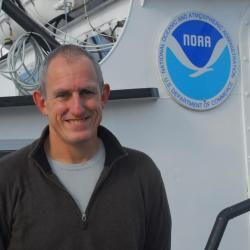
Director's Message
This summer, the Northeast Fisheries Science Center has 22 student interns working across all of our facilities, representing 5 different internship programs. These internships offer students the opportunity to participate in hands on science related to the NOAA Fisheries mission.
A perfect example of hands on science is a recent publication by Sara Vanaki, Deborah R. Hart, and Jui-Han Chang describing mathematical and statistical techniques to identify sand dollars from HabCam imagery and estimate abundance. Sara was an Ernest F. Hollings Undergraduate Scholar and worked as an intern with our scientists as part of the program. Another internship programs we support—the Maine Sea Grant - NOAA Fisheries Sea-run Fish Interns—was recently featured in a local news segment. Wade Hill, a student at Massachusetts Maritime Academy, was interviewed in this segment.
These are just two examples of the many student opportunities we offer at our science center. These internships contribute to developing future scientists and advance the mission of our science center and NOAA Fisheries.
|
|
|
Upcoming Events
Aug 5: Longfin Squid Research Track Working Group Meeting
Aug 9: Woods Hole Science Stroll
Aug 20: Northeast Region Coordinating Council Intersessional Meeting
|
|
|
|
|