|
NOAA Fisheries is announcing a final rule implementing specifications and management measures for the Atlantic Sea Scallop fishery for the 2025 fishing year (April 1, 2025 – March 31, 2026) that would result in projected landings of 18 million lb. Framework 39 will publish and become effective on Monday, April 21, 2025.
Framework 39 reopens the Northern Gulf of Maine (NGOM) fishery on 0001 hr, April 21, 2025.
Framework 39 also:
- Allocates effort into two rotational access areas (Area II and Area I);
- Modifies the timing of the existing seasonal closure in Area II to reduce bycatch of Georges Bank yellowtail flounder and northern windowpane flounder;
- Delays the opening of access areas, from April 1 to May 15, to optimize scallop yield;
- Close areas (Nantucket Lightship and Elephant Trunk) to scallop fishing to protect small scallops;
- Allows scallop vessels with a Limited Access General Category (LAGC) B permit to possess scallops and transit, with gear stowed, outside of the Northern Gulf of Maine scallop management area;
- Corrects an error, consistent with section 305(d) of the Magnuson-Stevens Fishery Conservation and Management Act, to clarify that trips harvesting research set-aside (RSA) pounds are not allowed to also harvest commercial non-RSA pounds; and
- Reopens the NGOM with an increased annual quota of 675,563 lb. The NGOM will reopen on Monday, April 21, and will be closed once we project the quota has been harvested.
Relative to the default measures that are currently in effect, Framework 39 provides an increase in projected scallop revenues of $180.8 million.
We work in partnership with the New England Fishery Management Council to manage the Atlantic scallop fishery to meet conservation objectives, use the best available scientific information, and provide sustainable levels of access to the fishery.
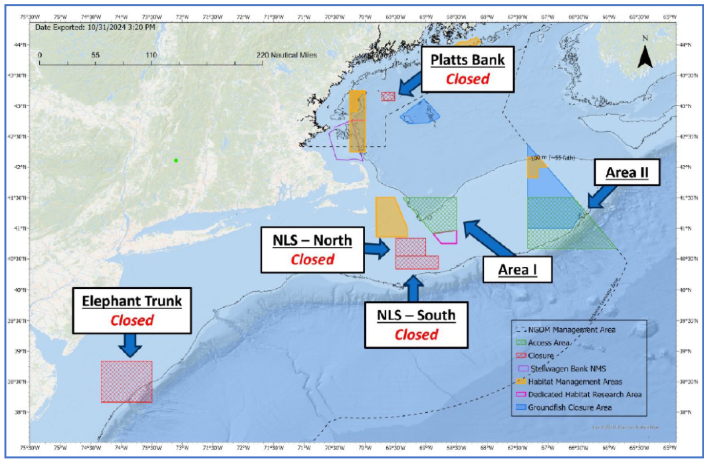 Summary of limited access rotational management alternatives.
For more information read the final rule as published in the Federal Register.
|