Our NOAA Fisheries West Coast Region Rockfish Newsletter is a great way to keep yourself informed on interesting and innovative work currently underway by NOAA Fisheries and our partners to research and conserve rockfish and their habitats in the Pacific Northwest.
In this edition, we discuss:
- Publication of the Five-year Review
- 10-year Anniversary of the Community Science Diving Program!
- Progress in Kelp Restoration
- A Chance Opportunity for Sampling a Yelloweye Rockfish
- NOAA Science Camp
We hope you'll enjoy reading! If you have an idea for an article, or questions about content, please email Jamey Selleck or Dayv Lowry, NOAA Fisheries West Coast Region.
|
How well have recovery efforts worked for the Endangered Species Act (ESA)-listed Puget Sound/Georgia Basin yelloweye rockfish (threatened) and bocaccio (endangered), and what more can be done? This year, NOAA Fisheries completed its five-year review for these species to address this question. The review found that yelloweye rockfish are slowly recovering, but a change in ESA status is not recommended for either species given threats the populations still face. These periodic reviews are critical benchmarks for evaluating the effectiveness of recovery efforts. Species must meet specific recovery criteria to be downlisted or delisted.
Both yelloweye rockfish and bocaccio have long lifespans, are slow to mature, and can quickly be depleted by intense fishing pressure, meaning that recovery efforts must be maintained to reach population viability and long-term resilience. Bocaccio present additional challenges because population abundance remains too low to be adequately assessed – only 15 individuals have been seen in U.S. waters of the Distinct Population Segments (DPS) over the last several decades. The review also highlights recent research on kelp and eelgrass, and conservation efforts to protect and restore important nearshore nursery habitats for these species. With greater community collaboration, continued fishing prohibitions, and increased use of descending devices, the population status of ESA-listed rockfish in the region should continue to improve! The efforts of NOAA Fisheries and partners will also indirectly benefit a number of other groundfish species, enhancing ecological stability of the Salish Sea.
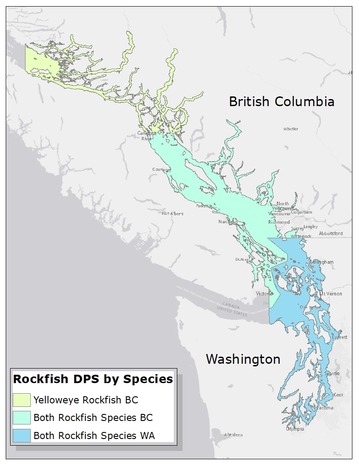 |
Map of the Distinct Population Segments (DPSs) for yelloweye rockfish and bocaccio, which overlap entirely south of Marina Island, Canada. The yelloweye DPS extends northward from there to Malcolm Island.
Community Science Diving Program Celebrates 10 years!
Established in 2014, the NOAA young-of-the-year (YOY) rockfish community-based volunteer science diving program has grown steadily, and recently celebrated its 10-year anniversary! Led by Adam Obaza at the Paua Marine Research Group (PMRG), this program provides invaluable data that supplements state and federal research surveys, and has outpaced the effort of scientists in recent years. Jamey Selleck (NOAA) recently presented up-to-date results at the 2024 American Fisheries Society conference, sharing the exciting news that five new sightings of YOY yelloweye rockfish have occurred in the past two years. Understanding where YOY appear informs our understanding of distribution and habitat use for this important early life history stage, while repeated sampling of these sites is planned over the next several years to confirm these are not chance occurrences. Adam and colleagues also recently published a review of the program, Evaluating the Investment Period in a Novel Citizen Science Program.
Over the course of the last decade, over 100 divers have contributed to the program. In 2023 alone, they conducted 3,898 transects, with a combined 39,647 minutes in survey time, at 130 unique sites across the Salish Sea, where they observed 6,996 YOY of various species! This effort has also been expanded into British Columbia, Canada, through engagement with the Marine Life Sanctuaries Society, enhancing transboundary efforts to protect and recover imperiled rockfish. If you’re interested in participating, contact Adam Obaza (PMRG), Dayv Lowry, or Jamey Selleck. Thanks to everyone for their continued support!
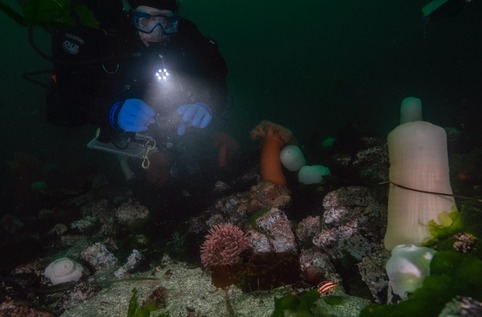
Jamey Selleck (NOAA) observing a YOY yelloweye rockfish (photo by Adam Obaza).
Kelp Restoration Sets a New Milestone
Following the completion of the Puget Sound Kelp Conservation and Recovery Plan in 2020, several monitoring, research, and conservation efforts have been implemented. Notably, the Puget Sound Restoration Fund began experimenting with bull kelp at the NOAA Manchester Lab, cultivating sporophytes and gametophytes of kelp, while also conducting studies on out-planting to potential recovery sites. These sites include locations that historically had canopy-forming kelp beds, but where none have been observed in recent years. After several years of various attempts at out-planting, the first successful appearance of naturally recruiting kelp has been observed! While genetics are being conducted to determine the origins of the kelp, the finding at a site that hasn’t seen kelp appear in years is cause for celebration. Our partners continue to conduct surveys, experiment with kelp aquaculture, and study this crucial habitat-forming species to facilitate ecosystem recovery efforts in the Salish Sea.
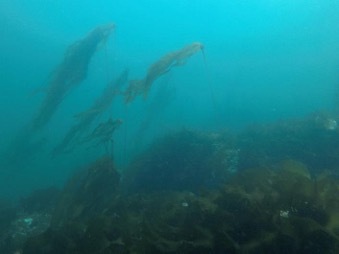 |
Young bull kelp rises from the sea floor, reaching towards the surface. These kelp are annual, and disappear in winter months in Puget Sound (photo by PSRF).
It Takes a Community to Collect Data
Last fall, a recently deceased adult yelloweye rockfish washed ashore on a beach in the San Juan Islands, showing signs of barotrauma. A rather large fish, it measured 2.44 ft long and over 12 lbs, even after being partially scavenged by gulls and other beach fauna. This was clearly an old fish, and an ESA-listed threatened species too. It was first observed by a resident on Orcas Island who reported it to the SeaDoc Society, who in turn contacted Rockfish Recovery Coordinator Dayv Lowry. Eager to gather biological information, but at a loss for how to retrieve the sample in a timely manner, Dayv enlisted the help of faculty at Friday Harbor Labs. Dr. Adam Summers, who also happens to be a pilot, was able to collect the specimen, pack it in ice, and deliver it to Olympia for processing!
While some decomposition/scavenging had occurred, the specimen was intact enough to get an accurate length measurement, determine the sex, and collect key biological samples. Otoliths, as seen in the photos, were extracted by Dayv and his teenage daughter. They were sent to the Washington Department of Fish and Wildlife for aging, and fin clips and tissue samples were sent to NOAA’s Northwest Fisheries Science Center for genetics and toxics analyses, respectively. This 62-year-old female from the listed DPS was estimated to weigh approximately 15.5 lbs when intact!
It takes a community of scientists and the public to collect this kind of rare and important data! NOAA Fisheries thanks all of our partners who continue to work together to recover rockfish in Puget Sound. If you ever find an interesting fish, please don’t hesitate to reach out to Dayv Lowry or Jamey Selleck.
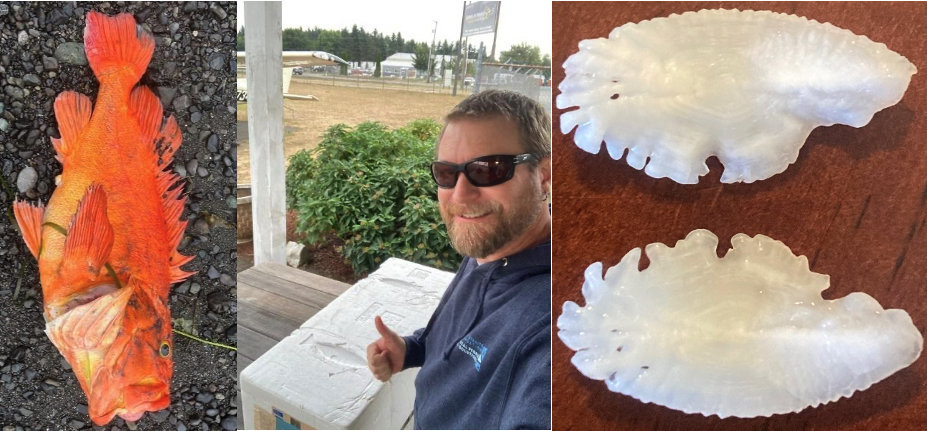 The yelloweye rockfish on a rocky beach, Rockfish Recovery Coordinator Dayv Lowry retrieving the fish from the local airport, and the otoliths extracted from the fish by Dayv and his daughter.
A New Science Curriculum for NOAA Summer Camp
NOAA Fisheries’ Protected Resources Division recently had the opportunity to engage with the next generation of scientists at the NOAA Summer Science Camp!
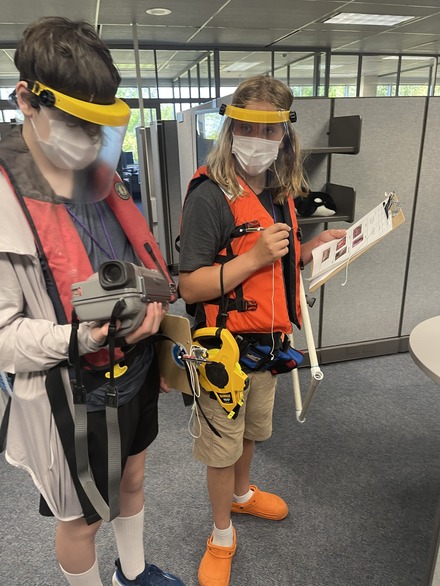
Held at NOAA’s Seattle Sand Point facility each July, NOAA Summer Science Camp offers hands-on science-learning opportunities for middle and high school students. In the rockfish recovery activity, students led their own rockfish survey and created a population assessment. They learned about the tools we use to study marine species, donned their survey gear, and went to work “swimming” through the NOAA offices counting (stuffed animal) rockfish with their dive buddies. This experience illustrated the physical and logistical challenges of collecting data in heavy, restrictive dive gear without the ability to talk to your partner (remember, we’re underwater), while not allowing themselves to get distracted by non-target species. Student comments after the exercise generally consisted of, “that’s a lot of gear!”, “it’s hard to find fish hiding in habitats”, and “where can I learn to scuba?”
Science Camp students also had the opportunity to engage with other NOAA Fisheries staff and learn about fisheries, whale entanglement, oceanography, aquaculture, and more. If you have a curious student interested in participating in future summer camps, you can email the Education Specialist, Maile Sullivan, or sign up to be notified when the next camp registration opens. We look forward to working with the next cohort of budding scientists!
Students participate in a “rockfish survey” at NOAA Science Camp, carrying and wearing a variety of mock scuba gear.
|