|
NOAA Fisheries announces the annual opening of Seasonal Management Areas (SMAs) in the Mid-Atlantic to protect North Atlantic right whales starting on November 1, 2023. All vessels 65 feet or longer must travel at 10 knots or less in this area to reduce the threat of vessel collisions with these endangered whales. The Mid-Atlantic SMAs are in effect through April 30, 2024.
Because vessels of all sizes can strike and injure a right whale, NOAA Fisheries also encourages vessels less than 65 feet in length to slow down to 10 knots or less within active SMAs.
Details and graphics of all of all vessel strike management zones currently in effect.
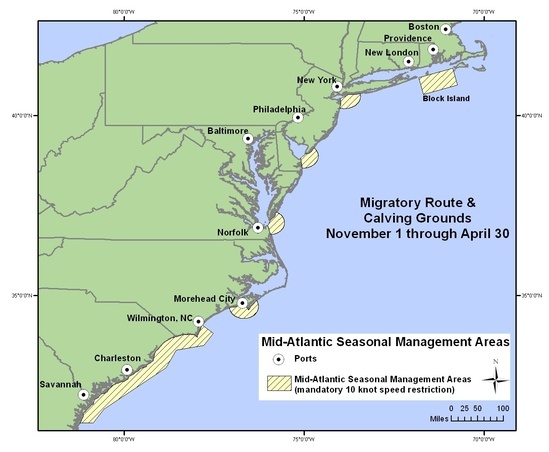
Mid-Atlantic SMA (Migratory Route and Calving Grounds) includes:
Block Island Sound waters bounded by:
40°51'53.7" N 070°36'44.9" W
41°20'14.1" N 070°49'44.1" W
41°04'16.7" N 071°51'21.0" W
40°35'56.5" N 071°38'25.1" W then back to starting point.
Within a 20-nm (37 km) radius of the following (as measured seaward from the COLREGS lines):
Ports of New York/New Jersey:
40°29'42.2"N 073°55'57.6"W
Entrance to the Delaware Bay (Ports of Philadelphia and Wilmington):
38°52'27.4"N 075°01'32.1"W
Entrance to the Chesapeake Bay (Ports of Hampton Roads and Baltimore):
37°00'36.9"N 075°57'50.5"W
Ports of Morehead City and Beaufort, NC:
34°41'32.0"N 076°40'08.3"W
Within a continuous area 20-nm from shore between Wilmington, North Carolina, to Brunswick, Georgia, bounded by the following:
A- 34°10'30"N, 077°49'12"W
B- 33°56'42"N, 077°31'30"W
C- 33°36'30"N, 077°47'06"W
D- 33°28'24"N, 078°32'30"W
E- 32°59'06"N, 078°50'18"W
F- 31°50'00"N, 080°33'12"W
G- 31°27'00"N, 080°51'36"W
and west back to the shore.
Give Right Whales Room
North Atlantic right whales are on the move along the Atlantic coast of the U.S. If seen, remember that approaching a right whale closer than 500 yards is a violation of federal and state law.
Right Whales in Trouble
North Atlantic right whales are protected under the U.S. Endangered Species Act and the Marine Mammal Protection Act. Scientists estimate there are fewer than 350 individuals remaining, making them one of the rarest marine mammals in the world.
In August 2017, NOAA Fisheries declared the increase in right whale mortalities an “Unusual Mortality Event,” which helps the agency direct additional scientific and financial resources to investigating, understanding, and reducing the mortalities in partnership with the Marine Mammal Stranding Network, Canada’s Department of Fisheries and Oceans, and outside experts from the scientific research community.
More Information
Download the Whale Alert app for iPad, iPhone, and Android for real time updates on Slow Zones, SMAs, and other right whale sightings.
Recent right whale sightings and real-time acoustic detections along the eastern seaboard.
Find out more about our right whale conservation efforts and the researchers behind those efforts.
Spread the Word!
All boaters from Maine to Virginia, or interested parties, can sign up for email or text notifications about the latest Right Whale Slow Zones. You can also follow us on Facebook (@NOAAFisheriesNEMA) and Twitter (@NOAAFish_GARFO) for announcements.
Share our video on Right Whale Slow Zones.
|