|
Feature Story
Meet Lalena Amiotte: West Coast Region’s New Tribal Relations Coordinator
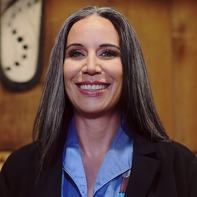
Ms. Amiotte has extensive experience in marine and freshwater aquatic species management built upon a career in the shellfish aquaculture industry. As NOAA’s West Coast Region Tribal Coordinator, Ms. Amiotte will be a point of contact for tribes and the Region on tribal matters and support staff and leadership in strengthening their own tribal relationships. She will ensure that tribes receive advance notification of NOAA Fisheries initiatives, decisions, and regulations that may affect tribal trust resources and co-management responsibilities.
Ms. Amiotte is a member of the Oglala Sioux Tribe of South Dakota. She holds a Bachelor’s of Science Degree from The Evergreen State College and is a fellow of Harvard University. Ms. Amiotte serves as a professional member of the American Indians in Science & Engineering Society and enjoys working with tribal youth Science, Technology, Engineering and Mathematics (STEM) programs. Learn more about Sovereign Relations on the West Coast.
Reach out to Lalena Amiotte, Tribal Relations Coordinator at lalena.amiotte@noaa.gov or (360) 519-4222.
|
New Research on European Green Crab
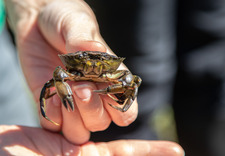
The European Green Crab (EGC) is an invasive species that is well adapted to the Pacific Northwest ecosystem and is spreading through the coasts and estuaries of Washington State despite ongoing trapping and removal efforts. EGC destroys important eelgrass habitats and eats bivalves, so shellfish growers and scientists have been looking for opportunities to reduce their threat level.
A new study by G. Curtis Roegner (NOAA Fisheries), Zach Forster (WDFW), and David Beugli (Willapa-Grays Harbor Oyster Growers Association) used acoustic monitoring to understand EGC movement differences between an active shellfish aquaculture farm and nearby public oyster grounds in Willapa Bay. The study suggests improved methods by increasing trapping efforts in shallow subtidal corridors and around aquaculture infrastructure. Rearranging farming elements, such as the spacing of bags, also reduces the attractiveness of aquaculture infrastructure for EGC. In addition, due to the EGC’s transient nature, the long-term benefits of trapping will be best served with a system-wide effort rather than focusing on one specific area. If you'd like a copy of the study contact curtis.roegner@noaa.gov.
|
|
|
Announcements
The Pacific Coast Shellfish Growers Association (PCSGA) is hosting their annual conference this September 19-21st. The event will take place in Seaside, Oregon at the Seaside Civic and Convention Center and bring together growers, industry partners, researchers, agency stakeholders, and students.
Learn more and register.
Important USDA Disaster Assistance Program Eligibility Requirements for Shellfish Growers; Sept. 30 Deadline Fast Approaching
Shellfish growers who suffer losses from a qualifying natural disaster event may be eligible for assistance through the Farm Service Agency’s (FSA) Emergency Livestock Assistance Program (ELAP) and the Non-Insured Crop Disaster Assistance Program (NAP). To be eligible for ELAP and NAP for the 2024 crop year, both programs require applicants to file an acreage report with FSA by Sept. 30, 2023.
An acreage report documents the type of shellfish grown, the surface acres of water where the crop is grown, and the intended use of the shellfish once they are harvested. To file an acreage report, producers need to provide FSA with the following information:
- Crop type or variety such as mollusk, oyster;
- Intended use of the crop such as fresh or processed;
- Surface acres of water where the crop is being grown;
- Map with approximate boundaries for the crop;
- Seeding dates, if applicable;
- Producer shares; and
- Other information as required.
For more information on ELAP, NAP, and acreage reporting, please visit farmers.gov or contact your local county FSA office.
|
|
|
|