|
Harmony Coast Aquaculture Institute Builds on Cayucos Abalone Farm's Legacy
 Outdoor basket tanks at Harmony Coast Aquaculture Institute in Cayucos, CA
Many locals know about The Abalone Farm in Cayucos, just out of sight of Highway 1, nestled into the rolling coastline of Alexander Ranch. But few visitors who drive by are aware of the newest iteration of this Central Coast landmark. As of 2022, the closed facility has been renamed Harmony Coast Aquaculture Institute (HCAI), a hub for commercial, experimental, and educational low-trophic aquaculture. The new 501(c)3 nonprofit formed to steward the facility is a spin-off of Creek Lands Conservation. Founded in 1983 to raise chinook salmon in net pens off the coast of Avila Beach, they pivoted 15 years ago to focus on habitat restoration for steelhead. With roots in marine aquaculture and a solid reputation in habitat restoration, Creek Lands Conservation sees an opportunity to repurpose the old Abalone Farm for economically and ecologically sustainable aquaculture.
Creek Lands Conservation Executive Director, Don Chartrand, said the idea for HCAI began after the organization struck up a relationship with the Abalone Farm operators in 2018. With a grant from The Nature Conservancy, Creek Lands hosted two separate aquaculture summits in 2019: one for the White Abalone Recovery Project, and another for conservation aquaculture. This allowed for productive discussions with subject matter experts about the facility's future. Fast-forward three years, and HCAI brokered a 30-year lease and acquired The Abalone Farm assets. HCAI is happy to have retained Dale Wiggins, , who ran The Abalone Farm’s day-to-day operations for many years, to continue managing the facility. Following facility upgrades, HCAI expects to sublet portions to subtenants for low-trophic conservation and commercial aquaculture. Chartrand’s partners in HCAI include Dr. Mike Graham, of Moss Landing Marine Lab and Monterey Bay Seaweeds, and Dr. Ben Ruttenberg of Cal Poly San Luis Obispo’s Center for Coastal Marine Sciences. HCAI welcomes collaboration with like-minded, low-trophic tenants, with special interest in educational components and tribal resources.
|
|
New Aquaculture Planning Tools Shared at Oregon Conference
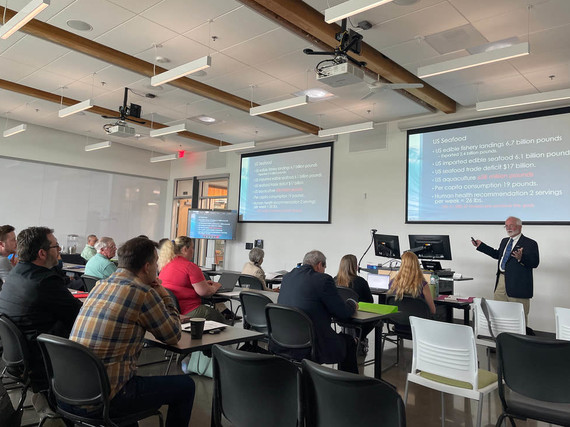 Conference attendees watch a presentation at Chemetka Community College
The first week of October, aquaculture enthusiasts and professionals attended the Oregon and Pacific Northwest Aquaculture Development Conference, held on the Chemeketa Community College campus in Salem, Oregon. The theme of the gathering was "Investing in the Future of Seafood”. The organizers emphasized that Oregon has an immediate need to establish a conducive environment for aquaculture investment, and that "the aim of the Conference is to highlight these opportunities while making a realistic assessment of how success can be achieved and avoid pitfalls that often lead to failure".
The Conference also highlighted the recent release of online aquaculture planning tools including the Oregon Aquaculture Explorer and the Estuary Shellfish Mariculture Explorer. These tools are designed to facilitate investigations on location sites for starting new aquaculture operations. With the stage set for increasing participation in growing seafood, the Conference featured training on growing methods and technologies, a forum on tribal aquaculture opportunities along with discussions on marketing, business planning, and workforce development. The attendees also discussed the concept of creating a Pacific Northwest Aquaculture Innovation Center as a way to further spark the production and diversification of seafood along the Pacific Coast.
|
|
Panelists Recommend Fab Ways to Collab on HABs
This year’s 11th Annual U.S. Symposium on Harmful Algae finished with a panel highlighting collaborations between shellfish harvesters and Harmful Algal Bloom (HAB) researchers. Liz Tobin and Neil Harrington, who work for the Jamestown S’Klallam Tribe, represented the West Coast. Tobin and Harrington collaboratively run a unique HAB monitoring and alert system operating in Sequim Bay, WA. They began by acknowledging that while they work in separate departments, they unite in their mission to protect the treaty harvest rights of the tribe. Neil's department conducts daily HAB monitoring and will be the first to know if toxin counts are on the rise. A quick text to Liz kicks off a chain of communication, quickly notifying farms and tribal food programs to cease harvest until biotoxin results return. Staff also post weekly biotoxin reports in local buildings. These proactive measures ensure that the tribal community avoids illness and costly recalls. Going forward, Liz and Neil plan to continue advancing early detection and mitigating the effects of algal toxins through their current projects, partnerships like SoundToxins, and future proposals.
As the panel concluded, the room discussed how to replicate the partnerships on the panel. If harvesters find it difficult to find a researcher, they can look for partners through their state’s Sea Grant Extension Specialists, connect with graduate students (who often have more time than professors), and attend industry associations. They should focus on telling the researchers what they’re seeing on their farm, and what they want to know. For researchers, it is essential to avoid being too prescriptive and to focus on listening. The panel heartily encouraged both parties to meet in person as much as possible, preferably at lunch, over a beer or two!
|
|
|
|
NOAA published its first-ever 5-Year Strategic Plan for Aquaculture to guide the agency’s work from 2023-2028. The plan lays out a framework to support a thriving, resilient, and inclusive U.S. aquaculture industry as part of a resilient seafood sector.
|
|
|
|
|