|
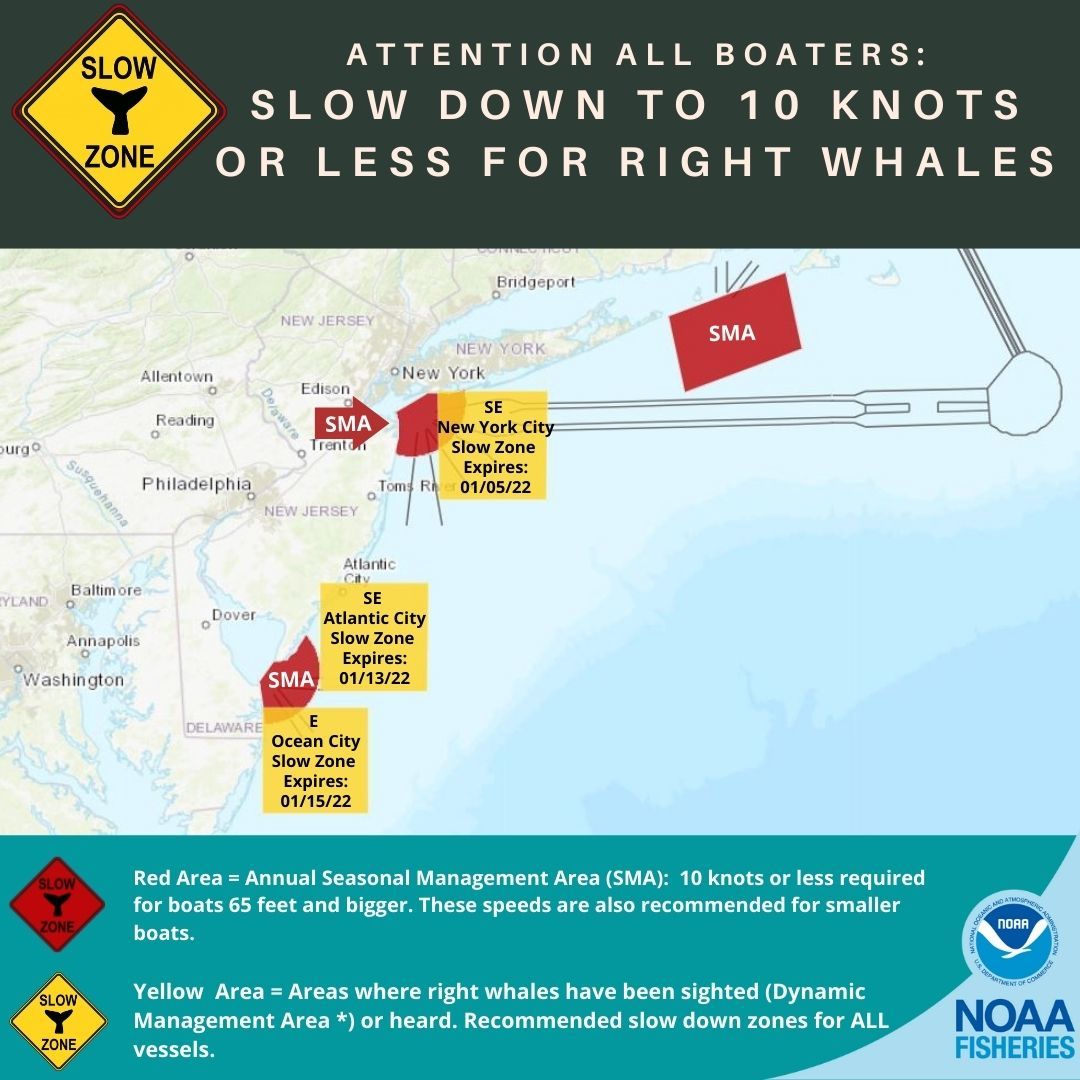
On December 31, 2021, the University of Maryland Center for Environmental Science and Woods Hole Oceanographic Institution's acoustic array redetected the presence of right whales East of Ocean City, MD. The right whale Acoustic SLOW Zone is in effect immediately and expires on January 15, 2022.
As a reminder, on December 29, 2021, NOAA Fisheries announced an Acoustic SLOW Zone Southeast of Atlantic City, NJ. The Slow Zone expires on January 13, 2022.
Lastly, on December 21, 2021, NOAA Fisheries also announced an Acoustic SLOW Zone Southeast of New York City, NY. The Slow Zone expires on January 5, 2022.
VOLUNTARY Right whale "Slow Zone" AREAS
Mariners are requested to avoid or transit at 10 knots or less inside the following areas where persistent aggregations of right whales have been detected. Please visit www.nmfs.noaa.gov/pr/shipstrike for more information.
East of Ocean City, MD Acoustic SLOW Zone: Effective December 31, 2021-January 15, 2022
Waters bounded by:
NORTHERN BOUNDARY: 38°38' N
SOUTHERN BOUNDARY: 37°58' N
EASTERN BOUNDARY: 74°13' W
WESTERN BOUNDARY: 75°04' W
Southeast of Atlantic City, NJ Acoustic SLOW Zone: Effective December 29, 2021-January 13, 2022
Waters bounded by:
NORTHERN BOUNDARY: 39°25' N
SOUTHERN BOUNDARY: 38°44' N
EASTERN BOUNDARY: 73°44' W
WESTERN BOUNDARY: 74°36' W
Southeast of New York City, NY Acoustic SLOW Zone: Effective December 21-January 5, 2022
Waters bounded by:
NORTHERN BOUNDARY: 40°35' N
SOUTHERN BOUNDARY: 39°56' N
EASTERN BOUNDARY: 72°47' W
WESTERN BOUNDARY: 73°40' W
Give Right Whales Room
North Atlantic right whales are on the move along the Atlantic coast of the U.S. NOAA is cautioning boaters and fishermen to give these endangered whales plenty of room. We are also asking all fishermen to be vigilant when maneuvering to avoid accidental collisions with whales and remove unused gear from the ocean to help avoid entanglements. Commercial fishermen should use vertical lines with required markings, weak links, and breaking strengths.
Right Whales in Trouble
North Atlantic right whales are protected under the U.S. Endangered Species Act and the Marine Mammal Protection Act. Scientists estimate there are only about 400 remaining, making them one of the rarest marine mammals in the world.
North Atlantic right whales are NOAA Fisheries' newest Species in the Spotlight. This initiative is a concerted, agency-wide effort to spotlight and save marine species that are among the most at risk of extinction in the near future.
In August 2017, NOAA Fisheries declared the increase in right whale mortalities an “Unusual Mortality Event,” which helps the agency direct additional scientific and financial resources to investigating, understanding, and reducing the mortalities in partnership with the Marine Mammal Stranding Network, Canada’s Department of Fisheries and Oceans, and outside experts from the scientific research community.
More Information
Long-term acoustic detections across the western North Atlantic, as well as real-time detections along the eastern seaboard, including Cape Cod Bay and the Boston TSS.
Recent right whale sightings
Find out more about our right whale conservation efforts and the researchers behind those efforts.
Download the Whale Alert app for iPad and iPhone.
Details and graphics of all vessel strike management zones currently in effect.
Reminder: Approaching a right whale closer than 500 yards is a violation of federal and state law.
Spread the Word!
All boaters from Maine to Virginia, or interested parties, can sign up for email or text notifications about the latest Right Whale Slow Zones. You can also follow us on Facebook (@NOAAFisheriesNEMA) and Twitter (@NOAAFish_GARFO) for announcements.
Watch our video on Right Whale Slow Zones.
Recent Feature Stories about Right Whales
Listening for Right Whales in the Gulf of Maine
Make Way for Right Whales
10 Things You Should Know About Right Whales
|
| |
Questions?
Media: Contact Allison Ferreira, Regional Office, 978-281-9103
|