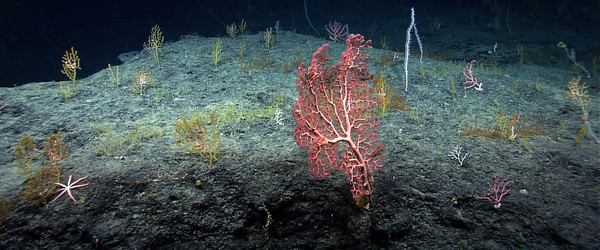
Deep sea coral and sea stars on the Florida Escarpment in the Gulf of Mexico. Credit: NOAA Office of Ocean Exploration and Research
Bringing Together Experts to Plan Innovative Deep-sea Habitat Restoration
The Open Ocean Trustees are bringing together a wide range of deep-sea experts and stakeholders to participate in restoration planning for injured mesophotic and deep benthic communities. The convenings are supporting restoration projects approved in the 2019 Open Ocean Restoration Plan 2. That plan approved approximately $126 million for four projects to restore these communities impacted by the Deepwater Horizon oil spill.
2021 Engagements With Experts
Over the past year, teams from NOAA and the Department of the Interior collaborated with researchers and resource managers to inventory and compile existing data and information. This effort contributed to building a Gulf-wide database to assess the state of the science and identify priority information gaps.
Experts from academia, federal and state agencies, fishery management and sanctuary councils, non-governmental organizations, and the private sector—many who assisted with the inventory—will come together this fall. They’ll provide their expertise and identify priority areas, additional critical information needs, and best practices for deep-sea habitat restoration.
Learn More and Attend Our October 28 Webinar
To learn more attend an October 28 deeper dive webinar into Mesophotic and Deep Benthic Communities restoration. That webinar will follow the Open Ocean annual meeting.
The Gulf of Mexico has a vast and unique deep-sea environment that supports the health and diversity of the broader ecosystem. These mesophotic and deep benthic communities are a foundation of the Gulf of Mexico food web and were injured across a large area by the 2010 oil spill. These Deepwater Horizon restoration projects are harnessing a range of expertise, local knowledge, and state-of-the-science to overcome challenges to restore this important habitat.