|
New State of the Ecosystem Reports
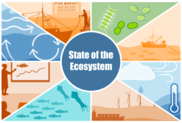
The Northeast U.S. Shelf is one of the most productive marine ecosystems in the world. Two newly released reports provide a snapshot of the Northeast U.S. Shelf, one focusing on Georges Bank and the Gulf of Maine, and the other on the waters of the Mid-Atlantic Bight. Changes are being observed in climate, coastal and ocean processes, and human uses.
|
Northeast Observer Waiver Extended
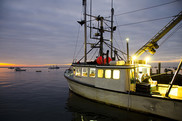
NOAA Fisheries is extending the waiver granted to vessels with Greater Atlantic Region fishing permits to carry human observers or at-sea monitors for an additional two weeks, through May 16, 2020. This action is authorized by 50 CFR 648.11, which provides the Greater Atlantic Regional Administrator authority to waive observer requirements, and is also consistent with the criteria described in the agency's emergency rule on observer waivers during the COVID-19 pandemic.
|
Fisheries Tell Many Stories
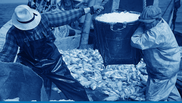
Check out the newly revamped NOAA Voices Oral History Archives—a repository for archiving and disseminating oral history interviews related to our fisheries, oceans and coasts in the United States and its territories. Our collections include oral histories with fishermen, their spouses, processing workers, shoreside business workers, scientists, marine resources managers, and many others. These stories expand our knowledge and enrich our understanding of the nation's fisheries and their impacts.
|
Woods Hole Science Aquarium Update
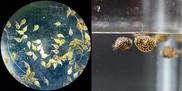
While our Woods Hole Science Aquarium is closed to help slow the spread of COVID-19, our aquarium staff still work daily to care for all the fish and invertebrates on and off exhibit. They wanted to share a quick behind-the-scenes update on the baby striped burrfish they’re caring for. The photo on the left, taken when they were less than 2 weeks old and about the size of a grain of rice, was shared at the end of February. The photo on the right was taken April 9. They’re now the size of mini Cadbury eggs! Stay tuned for more Science Aquarium updates, educational content, and behind-the-scenes views.
|
Commercial Red Hake Data Used in Fisheries Assessment
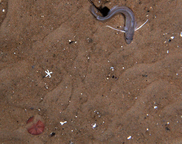
As part of a new research track assessment, Center scientists and regional partners conducted an assessment of red hake stock structure. The goal of this assessment was to determine if the current stock structure was consistent with the best scientific information available. Red hake catch data from the Cooperative Research Branch’s Study Fleet was presented, and information from recent collaborative catchability experiments carried out by the Northeast Trawl Advisory Panel was included. This work is part of a broader effort at the Center to incorporate industry data and recent industry-based experiments into the stock assessment process. The final report will be available to the public in the coming weeks.
|
Meet Glenn Chamberlain, Fisheries Sampling Branch
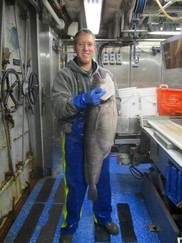
Time spent as a child outdoors in nature and exploring the coast of Cape Cod and Maine led Glenn Chamberlain to a career in the natural sciences. It also provided opportunities to learn new skills and seek new challenges. After working as an observer aboard commercial fishing vessels, he now works ashore with the herring, lobster, and squid fisheries as a member of the center’s Fisheries Sampling Branch. In addition to supporting those in the field, Glenn is preparing for a new industry-funded monitoring program in the Atlantic herring fishery.
|
Fisheries Stock Assessments Update
Wind Team Biologist Joins Center
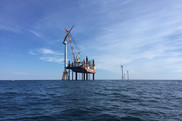
Curiosity and being by the ocean—her happy place—have guided Elizabeth (Lisa) Methratta’s career as a marine ecologist. As the fishery biologist for the Northeast Fisheries Science Center’s offshore wind team, she brings academic training and professional experience in ecological research to bear on the study of offshore wind interactions with fish and fisheries. Working with offshore wind farms creates many opportunities for innovation and collaboration and a chance to advance offshore wind science.
|
Bringing NOAA Sciences Home
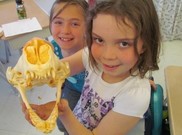
Attention parents, teachers, and educators! Get kids interested in science learning through NOAALive! webinars. While they’re geared for students in grades 2-6, children and adults of all ages can enjoy them. Recent center-related webinars focused on whales and Atlantic salmon, some of our region’s endangered species. Webinars are hosted by Woods Hole Sea Grant, NOAA’s Regional Collaboration Network, and our Science Center.
|
Student Awarded at National Science Competition
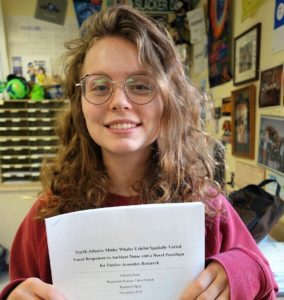
An Ossining NY high school senior placed second in the 58th National Junior Science and Humanities Symposium for a project on passive acoustic monitoring of minke whales. One of 230 students nationwide to participate in the virtual competition, Caroline Reed developed an algorithm that cuts recordings of vocalizations from whales into pieces so that scientists can distinguish between minke whale vocalizations and boat noises. The whales were recorded using underwater microphones. The project earned her an $8,000 college scholarship, plus $2,000 at the state competition. Genevieve Davis, an acoustical researcher at the Center’s Woods Hole Laboratory, served as Reed’s mentor.
|
A Spotlight on Alex Creed, NOAA Corps Officer
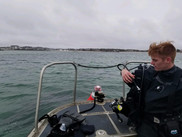
Alex Creed lived one block from Raritan Bay in Cliffwood Beach, New Jersey growing up. That meant he spent lots of time going to the beach, surfing, fishing, and scuba diving as a child. From first grade through high school, he explored the nearby marine environment and has always loved the water. Today he is a NOAA Corps officer, assigned to the Northeast Fisheries Science Center’s R/V Gloria Michelle. Being involved and seeing the research being conducted by NOAA scientists and facilitating that research by running an operational platform are among his favorite parts of the job.
|
New Deputy Director to Focus on People
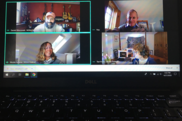
After a lifetime on the move, it's hard to imagine that Nicole Cabana would be content settling into one of NOAA Fisheries' most challenging leadership roles. She says the change is exhilarating, and right for her at this point in her life. Cabana was a NOAA Corps officer for 20 years, and retired in 2020 at the rank of Commander. She has been a deck officer on NOAA research ships and a scientific diver. For the majority of her career she was an aircraft pilot. Cabana flew research aircraft on missions from the Arctic to the equator, conducting mammal research, atmospheric research, and coastal mapping.
|
Social Distancing Affects Wildlife, Too
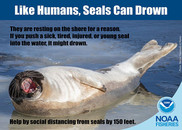
Social distancing has slowed the pace of society and encouraged more people to get outdoors. With springtime weather, increasing numbers of people throughout the Northeast are out enjoying and exploring local coastal habitats. At the same time, many species of seals, dolphins, and whales are also using these areas. We need to share the shore and coastal habitat with these animals and respect their need for social distancing from us.
|
|
|
Upcoming Events
COVID-19: We continue to plan events, but they may be delayed, cancelled, or moved to a virtual platform closer to their date.
May 27 Fall Management Track Assessment Oversight Panel Meeting, Woods Hole, MA
June 22-26 Spring Management Track Assessment Peer Review, Woods Hole, MA
|
|
|
|
|