|
|
Science Highlights
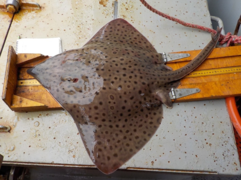 Northeast Fisheries Observer Data Supports Barndoor Skate Fishery
Landings of barndoor skate were prohibited after their status was declared overfished in 2003. In 2016, the New England Fisheries Management Council began seeking ways to allow possession of barndoor skate after the stock was declared rebuilt. Fisheries observer data collected in 2012-2016 showed that barndoor skate composed 25% of the combined skate catch. This information helped reopen the fishery and establish new barndoor skate possession limits. This is a great example of how fisheries observers and fishermen work together to help ensure the sustainable management of commercial fisheries. Click here to learn more
|
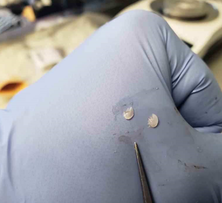 What Fish Ear Bones Tell Us
Did you know that fisheries scientists spend hundreds of hours looking at fish ear bones? These ear bones, called otoliths, have growth rings just like rings in a tree trunk, and these give scientists important information about the age, growth rates, overall health of a fish population, and what was going on in the environment. This allows fisheries scientists to track and predict changes in a fishery—information managers need to ensure the fishery is sustainable. At the Northeast Fisheries Science Center (NEFSC), we examine 60,000-80,000 samples in a given year.
Now that our fisheries fall bottom trawl survey is over, it’s time to process all the samples collected to tell us more about age and growth of fishery species. These frozen samples will be examined before the spring bottom trawl survey begins. We always start with the young-of-year (YOY), which are taken from fish that spawned earlier in the year—as small as 4 cm. Despite the difficulty of identifying YOYs on the busy ship, we’ve corrected fewer than 10 misidentified YOYs in the last 3 years! Depending on the year, about 700-1200 YOY samples are collected each spring and fall and will take about 4-5 days to process. Click here to learn more
|
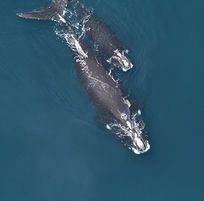 Right whale recovery constrained by humans
A new study led by Peter Corkeron at the NEFSC lab in Woods Hole indicates that human-caused deaths of North Atlantic right whales have impeded their recovery since the early 1990s. This study compared the North Atlantic right whale rate of recovery from whaling with that of a closely related species, the Southern right whale. Since whaling has stopped, Southern right whales have been largely unaffected by human-caused mortalities, and show an annual rate of increase about triple that of the North Atlantic right whale. The study shows that North Atlantic right whales could increase at 4% per year, about twice that observed, and that the primary driver for this difference is deaths of adult females. Click here to learn more
|
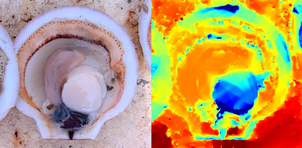 Photos Reveal Spawning and Maturity in Scallops
The Northeast Fisheries Observer Program is collaborating with the Woods Hole Oceanographic Institution on a pilot sea scallop research project to collect image data from observed sea scallop trips. The images will be used to measure sexual maturity, important for understanding spawning and estimating future stock sizes. The industry-funded sea scallop observer program is a key partner in this effort. This collaborative project supplies observers with 3D cameras to photograph shucked sea scallops during their observed trips. The Atlantic sea scallop is one of the most valuable seafood resources in the United States, with commercial landings of 51.5 million pounds in 2017 that were valued at $506.5 million. Learn more about research surveys on sea scallops
|
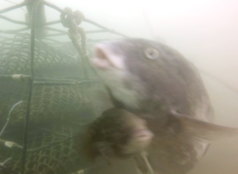 Window to an Underwater World
If you haven’t heard the buzz about the NEFSC Milford Laboratory’s latest project: scientists are using GoPro cameras to determine if oyster cages used in shellfish aquaculture provide habitat for fish similar to that provided by naturally occurring rock reefs. Oyster growers often cultivate oysters in off-bottom vertical cages under water. These cages have a relatively small footprint and keep valuable product inside safe from predators. Many fish are attracted to structure, whether natural or artificial, and aquaculture farms have long reported finding fish and invertebrates around their cages. Click here to learn more
|
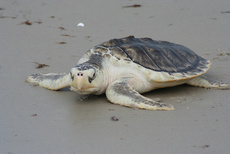 Cold Stunned Sea Turtles Fly South for the Winter
Twelve Kemp's ridley sea turtles that were cold-stunned and found on Cape Cod beaches in recent weeks were loaded onto a NOAA aircraft on November 30 at U.S. Coast Guard Air Station Cape Cod for a flight to Georgia, where they will be released into warmer waters. The turtles were taken into care and pronounced recovered by the New England Aquarium. The aircraft, a Twin Otter used in the Northeast for large whale surveys by the NEFSC, had a planned trip south and the pilots offered to take turtles with them to Georgia. On the way, they stopped briefly in Newport News, VA to load loggerhead turtles that were ready to return to the wild after care at the Virginia Aquarium & Marine Science Center. The release will be managed by the Georgia Sea Turtle Center, and the Twin Otter is now back surveying waters off the Northeast for right whales and other large whales. Click here to learn more
|
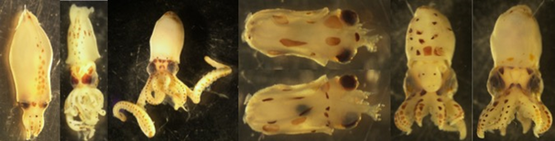 How to Identify Baby Squid and Octopus
Most people can picture squid and octopus or tell stories about them. These marine mollusks are known to scientists as cephalopods, which means “head foot”. Baby cephalopods, or paralarvae, are tiny and spend the first few weeks of their lives developing the characteristics we recognize in adults. Paralarvae are identified by their pigment patterns, photophores (organs that produce or reflect light), and the length, shape, and patterns of sucker disks on their arms and tentacles. Up to 20 kinds of paralarvae are collected in plankton samples on our NOAA Fisheries Ecosystem Monitoring Survey cruises, including the two commercial species, longfin inshore squid (Doryteuthis pealeii) and shortfin squid (Illex sp.). The more we know about the babies, the better we can manage the adults. A step in this direction was taken at a recent workshop during the 2018 Cephalopod International Advisory Council Conference where researchers started a process to update the 25-year-old book used by many scientists to identify cephalopod paralarvae.
|
 NEFSC Sandy Hook Lab Partners with Minority Serving Universities
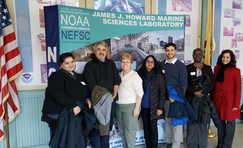
NEFSC staff met with faculty and students from the City University of New York (CUNY) at the NEFSC James J. Howard Marine Sciences Laboratory in Sandy Hook, NJ to strengthen collaborations between the lab and NOAA-supported university programs. The discussion focused on increasing research internships at NEFSC labs for undergraduate and graduate students in CUNY's Center for Earth Systems Science and Remote Sensing Technologies (CREST). Other topics included opportunities for CREST graduates in the NEFSC's recently established hiring program, Talent for the 21st Century. The CUNY delegation was led by Dr. Shakila Merchant, assistant director of the NOAA-CREST program. Click here to learn more
|
 NEFSC 2018 Fall Bottom Trawl Survey Completed
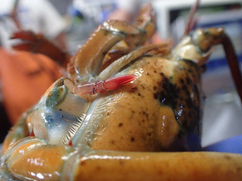
The NEFSC 2018 Fall Bottom Trawl Survey aboard the NOAA Ship Henry B. Bigelow has been completed. The survey began on September 4 as scheduled and ended on November 13, finishing 83 percent of planned stations (314 of 377). The NOAA Ship Henry B. Bigelow supports a variety of marine research. The NEFSC's twice-yearly bottom trawl survey of fish and invertebrates is the longest running of its kind in the world, and collects data used to understand changes in marine life and their habitats over time—critical information needed by scientists and managers to promote sustainable fisheries practices. Click here to learn more
|
 Holiday Inspired Smartphone Wallpapers
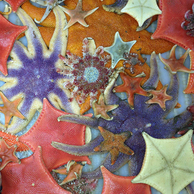
Happy holidays from the NEFSC! Enjoy our selection of smartphone wallpapers—backgrounds for your home and lock screens that blend the marine life of our region with the holiday season. View and download your favorite
|
|
|
|
|
|
|