Watch out for Whales!
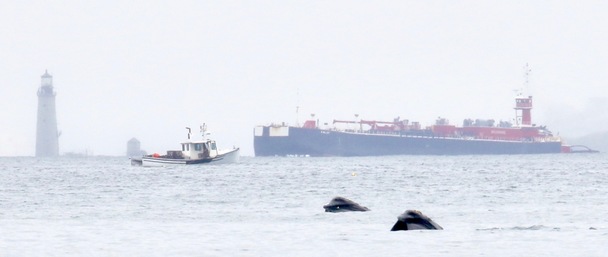
Right whale in front of lobster boat and container ship. Credit: Andy Sanford
Right whales have returned to the waters off Massachusetts
in full force. We’ve seen more than 150 endangered right whales in the Cape Cod
and Massachusetts Bays in recent days, with many in coastal areas and harbors.
In some towns, people are seeing them from the beach!
“Right whales are here feeding on dense concentrations of
their tiny plankton prey, called copepods,” says Michael Asaro, NOAA Fisheries
Greater Atlantic Marine Mammal and Sea Turtle Program Coordinator. “While they’re
here, we need everyone’s help in making sure they can feed without being
harassed, hurt, or killed by curious boaters or other watercraft."
With fewer than 450 of these majestic creatures alive, it’s
especially important to be vigilant when you’re on the water.
 Keep Your Distance
The best thing you can do to help these whales is give them
space to feed and travel. This is the time of year that they feed and build up
their energy and reserves. Approaching a whale can change its behavior, and
stop it from feeding. It’s also against the law.
Federal law requires that no
one or thing (this includes drones, kayaks, personal watercraft, etc) approach a right
whale within 500 yards (1500 feet), or about five football field lengths. If you’re
on the water, and a right whale unexpectedly appears within that 500 yard
buffer, you must immediately depart the area at a slow, safe speed.
When groups of three or more right whales are reported in an
area, NOAA will also ask vessels to voluntarily reduce speeds to 10 knots or
less in these areas.
There are four voluntary slow speed zones in effect now: East
of Boston (ends 5/3) and south of Martha’s Vineyard (ends 5/9), east of Boston (ends 5/16) and northeast of Boston (ends 5/17).
“With the
increasingly nice weather, we will be working with local law enforcement
officials to patrol coastal areas where right whales are being sighted,” says
Timothy Donovan, Assistant Director of NOAA’s Office of Law Enforcement
Northeast Division. “We will be taking extra precautions to make sure people
know about the laws to keep the whales and everyone on the water safe.”
It is also illegal to chase or in any way change a whale’s
natural behavior.
|
 Is it a right whale?
Look for:
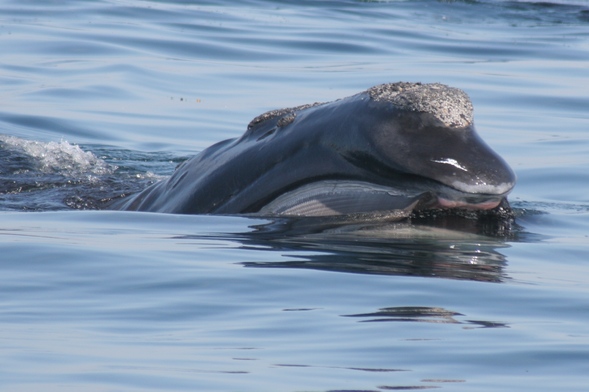
- Black body, with hard white patches (called
callosities) on their heads.
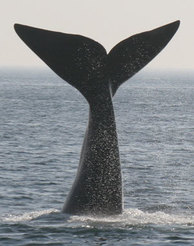
- No back fin
- Black tails with smooth edges (unlike humpbacks
that have jagged edges, and black and white undersides)
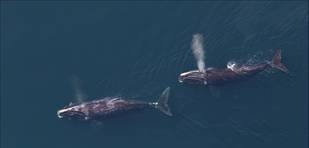
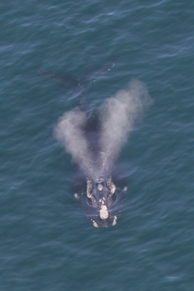
- Distinct V-shaped spout
Right whales
often swim at the surface with open mouths at the surface, as they skim the water
for their tiny plankton prey. This can make them hard to see, since they may be
just below the surface.
If you’re not sure, please be cautious and stay at least 500 yards away.
|
 How to Help
Whether a boat, kayak, or drone, follow the
right whale approach regulations by staying 500 yards away.
If you see live, free-swimming right whales
(from land or sea), report the sightings to the hotline 866-755-6622 or with
the free online app called Whale Alert.
Go slow and voluntarily reduce your speed in
areas where right whales have been sighted.
Keep a lookout posted. Look for spouts or
strange ripples at the water’s surface that can indicate a right whale is right
below the surface.
If you think a right whale is injured or
entangled, or if you see a dead right whale, report it to 866-755-6622 or US
Coast Guard Channel 16 immediately.
Don’t try to disentangle a right whale, or other
marine animal, by yourself. This is illegal and dangerous. Call us right away so
trained, permitted, professionals can respond to help save the whale’s life. Please
stay with the animal as long as you can. If you can’t stay on-site until
responders arrive, record as much information about the animal’s location and
condition before you leave.
|
Questions? Contact Jennifer Goebel, 978-281-9175
|