Safety Best Practices
 Joel Ullom views safety as an opportunity. He relishes what he learns about the hazards of an experiment and how to mitigate them, much like how he enjoys what he learns from his research. He never stops questioning. In Joel’s mind, shortcuts to a high-quality hazard review don’t exist. He wouldn’t take one anyway. His method is to first master the parts properly before fashioning the whole.
|
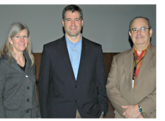 At the NIST Safety Colloquium held Dec.19, 2012 on the NIST-Gaithersburg campus, we heard from Vince Luciani from the CNST (safety in the CNST NanoFab), Mary Satterfield from MML (biosafety at NIST), and Matt Bundy from EL (safety in EL and its National Fire Research Facility) about how they and their colleagues developed safer facilities, collaborated to change safety practices, and used differing views on risk levels as an opportunity for change.
|
Watch the Video >>
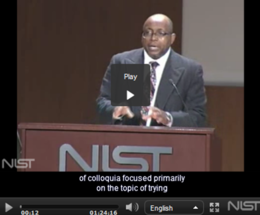
 Many of our activities here at NIST and at home carry a low level of risk when viewed as isolated events, but if frequently repeated, they could result in mishaps if a false sense of safety lulls us into complacency. That’s why it is important for us to understand and keep in mind the effect of frequency on risk.
|
Safety Management
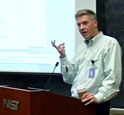 At the end of the Division Safety Representatives Summit held in Gaithersburg on Jan. 29, Pat Gallagher told the room of more than 50 DSRs that they play a critical role in improving safety at NIST. Although not scheduled to speak, Gallagher who was invited to the summit stood up at the end to share some closing thoughts.
|
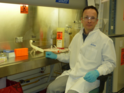 If you work with biohazardous materials, bloodborne pathogens or cryogens, or plan to, you should be aware that NIST has formalized safety requirements to help you work safely with or around these substances. This spring, NIST plans to implement these requirements across its campuses; impacted staff will have several months to meet them. Find out what to expect and how to prepare.
|
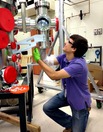 Many events and programs at NIST invite students to join us to learn about various fields of scientific research and gain some valuable hands-on lab experience by working next to NIST researchers. Now, NIST is formalizing safety requirements for minors who come to work here.
|
Recent Safety Incidents
A researcher was injured when the contents of a mislabled container he was handling sloshed and went over her safety glasses and into her eyes. The container label stated it held water, but instead it contained nitric acid.
MML l Injury l 2/15/13
A bubbler port failure resulted in a potassium hydroxide solution spraying a researcher’s head and face.
MML l Injury l 1/25/13
A researcher was cleaning a petri dish in a bio lab when the petri dish broke.
NCNR l Injury l 12/21/112
In a lab drawer, a staff member found a closed plastic bag with a form attached that stated its contents were ionic liquids and radionuclides (S-35), and “not radioactive materials as defined in U.S. DOT regulations.”
EL Near Miss 11/14/2012
A liquid Ar Dewar was found to have a bad gauge and even though the contents of the tank were vented to the air, the gauge still had a reading close to off-scale ~350 PSI.
MML l Other l 11/9/2012
|